Published
Part 2
Tell me, if applicable, about the concrete lyrical themes that you felt drawn to for Blades of Grass.
The three original tracks on Blades of Grass come from quite different experiences.
"Density" is connected to a childhood memory. I remember having a very high fever and experiencing a strange alteration of my sense of touch. Objects seemed to have a different weight and density, and even the space around me felt somehow changed. I wanted to bring back something of that unusual perception.
"Pure" is more like a fragment from a film. It's about losing and finding yourself in a relationship, and how sometimes you can become both the victim and the one causing pain. It brings to mind Baudelaire's words, Et la victime et le bourreau! and the way those roles can shift within a relationship.
"Sleepless Eyes" is particularly personal. The lyrics come from a short poem I wrote when I was young, originally in Italian. The blades of grass are also eyelashes, and the morning dew becomes those little traces of sleep we find around our eyes when we wake up. There's something of The Sandman in that image too.
That old poem is actually where the title Blades of Grass comes from. It's interesting how something you wrote many years ago can find a new meaning through music.
When it comes to exploring darker themes, what's your approach to writing lyrics? What makes lyrics good in this regard?
I usually start with an image, a memory or a few words that stay in my mind, rather than a particular subject I want to write about. Sometimes they come from something very recent, sometimes from things I wrote years ago.
I like working with relatively few words, leaving space for different interpretations. I don't think a darker atmosphere necessarily requires dramatic lyrics. Even something very ordinary can become unsettling depending on how you describe it.
For me, the relationship between words and music is essential. The rhythm of a phrase, the pauses, the way you sing it can completely change its meaning. A good lyric should also work with the music, not just sit on top of it.
And I like leaving some room for the listener. I don't feel the need to explain every image or give everything a precise meaning.
Tell me about the creative process for Blades of Grass, please. How did you realise your goals in terms of the production, including effects for your current release?
With Blades of Grass, I wanted to explore the relationship between rhythm, sound and atmosphere.
The three original tracks came from different experiences and ideas, so they don't necessarily tell a single story. But there's a connection between them, a certain tension between something quite physical and rhythmic and something more fragile.
I'm quite lucky because I work as a designer for Tiptop Audio. We're a bit like a small family, where we share ideas, discuss new projects and make decisions together. I get to be involved in the development of the instruments I eventually use in my own music. We've recently developed a modular system called ART, which allows you to create polyphonic patches while keeping the oscillators in tune. I use it alongside other modules for drums and effects.
Alongside the synthesizers, I used guitar and my own voice. I recorded and mixed everything in my studio. For the mastering, I worked with Niccolò Caldini at Tea Room Mastering. I think after spending so much time on a record, you really need someone else to listen to it with fresh ears. It's easy to lose perspective when you're so involved in your own work.
For me, mastering isn't just a technical process: it's also a matter of trust.
Exploring darker themes in the music often goes hand in hand with the accompanying artwork. Tell me a bit about this relating to Blades of Grass.
Visuals have always been an important part of my work, so I approach the artwork in much the same way as the music. I'm interested in what we inherit from the past, but not in simply reproducing it.
I think art and music often move in cycles, but nothing ever comes back exactly as it was. Society changes, technology changes, and so does the way we interpret and use certain languages.
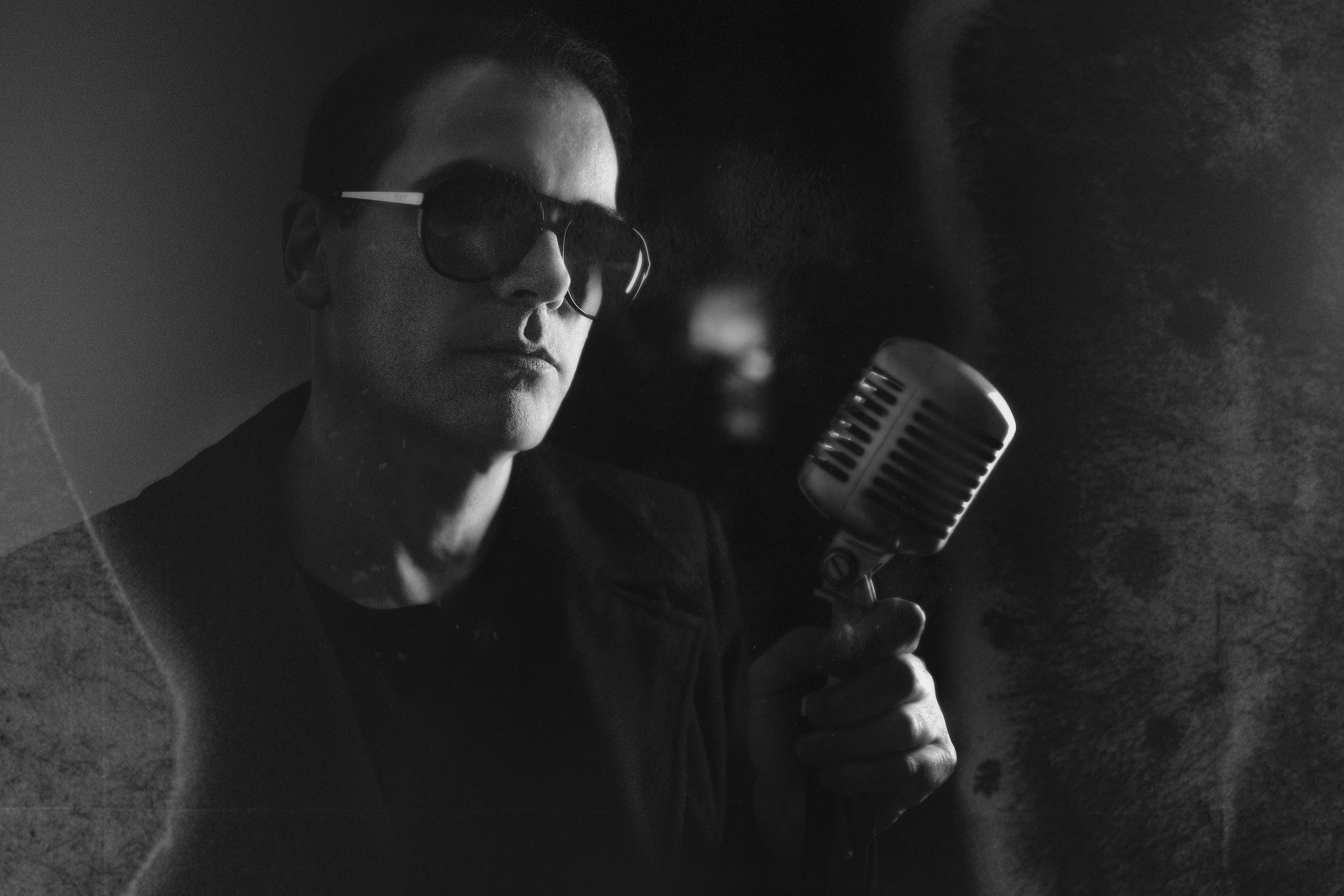
For Blades of Grass, I wanted something that owed a lot to the visual culture of post-punk records, but with a contemporary approach. I worked with bold typography, torn paper, collage and strong black-and-white contrasts. I like the tension between the rough, imperfect edges of the collage and the more precise graphic structure. I wanted to take those influences and do something different with them.
The videos take this approach in different directions. For "Rain On Me," I used my own drawings and digital animation, while "Pure" brings together performance, choreography and archival material.
"Sleepless Eyes" plays with vintage objects and the presence of an old Super 8 camera. The video for Caruan's Sleepless Eyes ('80s in Crime Remix) follows a different idea. I wanted to create a sense of mystery, using digital imagery of mysterious tapes and a Super 8 camera, then cutting the footage into vertical strips and turning alternate sections upside down. The result looks almost like a damaged document that has been taken apart and put back together.
I think sound and images can work together without necessarily telling the same story.
I would love to know a little about the feedback you've received from listeners or critics about what they thought some of your darker songs are about or the impact it had on them – have there been “misunderstandings” or did you perhaps even gain new “insights?”
The response to Romance Ruins from music critics was very positive, and I was happy to see how different reviewers approached the record.
Some picked up on the relationship between technology, matter and memory, or the cinematic quality of the music. These are certainly elements of my work, but it's interesting to see how someone else connects them.
I've also noticed that the context in which people listen to music can make a big difference. In a club, for example, there's often an expectation of something familiar, a rhythm you can immediately connect with. More introspective tracks or unusual rhythmic structures sometimes require a different kind of attention, and they don't always correspond to what people expect from a night out.
I don't necessarily see this as a misunderstanding. Music can be experienced in very different ways, depending on where you are and what you're looking for at that moment. You might have a very personal image or memory behind a song, but someone listening to it can find something completely different. And I think that's part of what makes sharing music interesting.
Sharing music on stage can change the way it is experienced, both for musicians the listeners. Can you talk about this a bit, especially in the light of darker themes?
In the studio, I spend a lot of time alone with my music, paying attention to the smallest details. On stage, everything changes. The room, the sound system, the people and the images all become part of the experience.
I first approached club culture as a VJ, so the relationship between sound, images and space has always been important to me. With Concrete Noir, Rossella Catanese works on the visual side of the live performance. We use filmed images, fragments of memory, analog objects and graphic structures that change and move with the music. I don't see the visuals as a background, but as another part of the performance. Sometimes they follow the music, sometimes they create a contrast or suggest something completely different.
There's also something very physical about the experience. Low frequencies don't just reach your ears, you feel them through your whole body, which becomes a kind of resonating chamber. A track that feels intimate or melancholic when you listen to it at home can create a completely different energy in front of an audience. The darker atmosphere is still there, but it doesn't necessarily translate into sadness. Sometimes it can be quite liberating. Fabrizio Messina also joins me on guitar, bringing another dimension to the live sound.
I think that's what makes performing interesting. You can prepare everything carefully, but you never really know how the music will be experienced until you're there.
Throughout the history of art, there have been artists who did not want to exorcise their demons, afraid they might lose their creative spark. What's your take on that?
I'm not sure we can ever really know whether making art exorcises our demons or simply gives them another form.
I think the more an artist is willing to expose themselves, to reveal their weaknesses, their strengths, their fears and even their demons, the more honest their work becomes. And that honesty is something people can recognise and connect with.
I don't know whether David Lynch ever exorcised his demons through his films, or whether Jim Morrison and Kurt Cobain were consumed by theirs, or perhaps by the system surrounding them. I think these questions are much more complex than they might appear.
What I do believe is that we can't really run away from our demons. As artists, we have to be willing to face them. Whether that means getting rid of them is another question.