Published
Part 2
Taking your recent projects, releases, and performances as examples, what, would you say, are the key ideas behind your approach to improvisation?
I think that everything occupying my mind in everyday life inevitably finds its way into the music. Some of the themes or ideas being negotiated - at least the ones I am consciously aware of - are:
Asking questions without looking for an answer, but rather to provoke further questions, as a constant internal and subconscious process of thinking. The fabrication of thoughts through play, without ever wanting to fabricate them, arising from a fundamental interest in existence, life, and everything that concerns it.
If you are now asking yourself, “But why?”, then at least you are already on the right track I guess.
I want to encounter myself and my ego in order to enter into a negotiation with it through play. You often end up arguing with yourself for entire nights without arriving at a solution. Maybe you aren’t even looking for one. Maybe you just want to argue.
The influence of culturally trained musical aesthetics on my own and on everyone else’s playing. OR: the human being as an obstacle in the futile search for the objective reality of our world.
Social roles and hierarchies in music, and consciously engaging with them. What role do you inevitably take on yourself, and how might I possibly free myself from it - or play the humanity of everyone involved against one another in the service of the music?
The attempt to find each other even, and especially, in disagreement.
In your best improvisations, do you feel a strong sense of personal presence or do you (or your ego) “disappear”?
I am trying not to judge my improvisations, but it is rather difficult not to. For me, it feels best if my ego SEEMS to disappear. But I am also very unsure whether it can ever truly be gone. PROVE ME WRONG, YOU BUDDHISTS!
The fact is, I encounter my ego more than anywhere else in the process of improvised music. But I also seem to really want to meet it.
What are some of your favourite collaborators and how do they enrich your improvisations?
My favorite collaborators are cooks with an understanding of culture, nature, poetics and love. They are unaware of their collaboration, but they enrich my life and therefore every improvisation.
If you are a cook: I love you. Keep cooking with love and ferment the shit out of this world, please. Thank you ❤️
In a live situation, decisions between creatives often work without words. From your experience and current projects, what does this process feel like and how does it work?
Do we take the decisions, or do the decisions take us? For me, a decision is a conscious choice of an action, which does not necessarily happen very often in my process. It is much more an intuitive reaction.
Sometimes, of course, you consciously switch between intuition and deliberate or clear decisions that have been preceded by thought. Music is a language which, for those who frequently “speak” it together, can contain very concrete information. Other things are often communicated through facial expressions or the movements of those involved. Sometimes you also have the feeling that you are making music completely past one another.
In the process, you encounter many problems and conflicts which, as human beings, we naturally want to solve instinctively. Those moments of conflict, when you encounter your cultural conditioning, your ego, your fears and expectations, feel unpleasant to me most of the time.
But that, in turn, also increases my presence and responsiveness. And although our bodies initially try to tell us otherwise so vehemently, there are no mistakes here. Rather, the “mistake” is a means to an end - or precisely the moment in which something new can emerge.
Sometimes, if not often, I deliberately put myself and others into such moments. An endless political process between everyone involved. Who proposes? Who reacts? Who destroys? Who plays for themselves? Etc.
Whether you are hopelessly but hopefully searching for complete musical freedom, or whether you see improvisation as a means of composition, you cannot avoid encountering your feelings, fears, preferences, culture and conditioning.
We shake hands with ourselves and with one another - sometimes sweaty and limp, sometimes excessively firm, sometimes lovingly and with genuine interest, and often not at all.
Stewart Copeland said: “Listening is where the cool stuff comes from. And that listening thing, magically, turns all of your chops into gold.” What do you listen for?
You cannot avoid listening to one another. Even if you want to stop listening. It seems to me that, in improvised music, there is an unspoken consensus that we should always actively listen to one another.
Listening is the prerequisite for every reaction, even if the reaction is; not listening. Unless you are deaf … But I think even then you still “listen” with your body somehow. I don’t know, I am not deaf.
I think the moment when I listen most closely is when I notice that I, too, am being listened to very carefully. Often, an extremely reactionary musical microcosm emerges from that. I listen for togetherness.
There can be surprising moments during improvisations – from one of the performers not playing a single note to another shaking up a quiet section with an outburst of noise. Can you tell me about such situations from your own performances and how they impacted the performance?
As mentioned, there is a lot of micro-politics going on when you play with others.
When someone suddenly stops playing, it can mean that they are revolting against your decisions through silence, or they might simply be underlining what you and the others are doing by creating space. Maybe they just thought, “What I am doing right now kind of sucks.” Or maybe they took a moment simply to think the music - just as Thelonious Monk once put it: “Some music just imagined.”
It affects me in many ways, and my reaction to these surprises really depends on my state of mind that day.
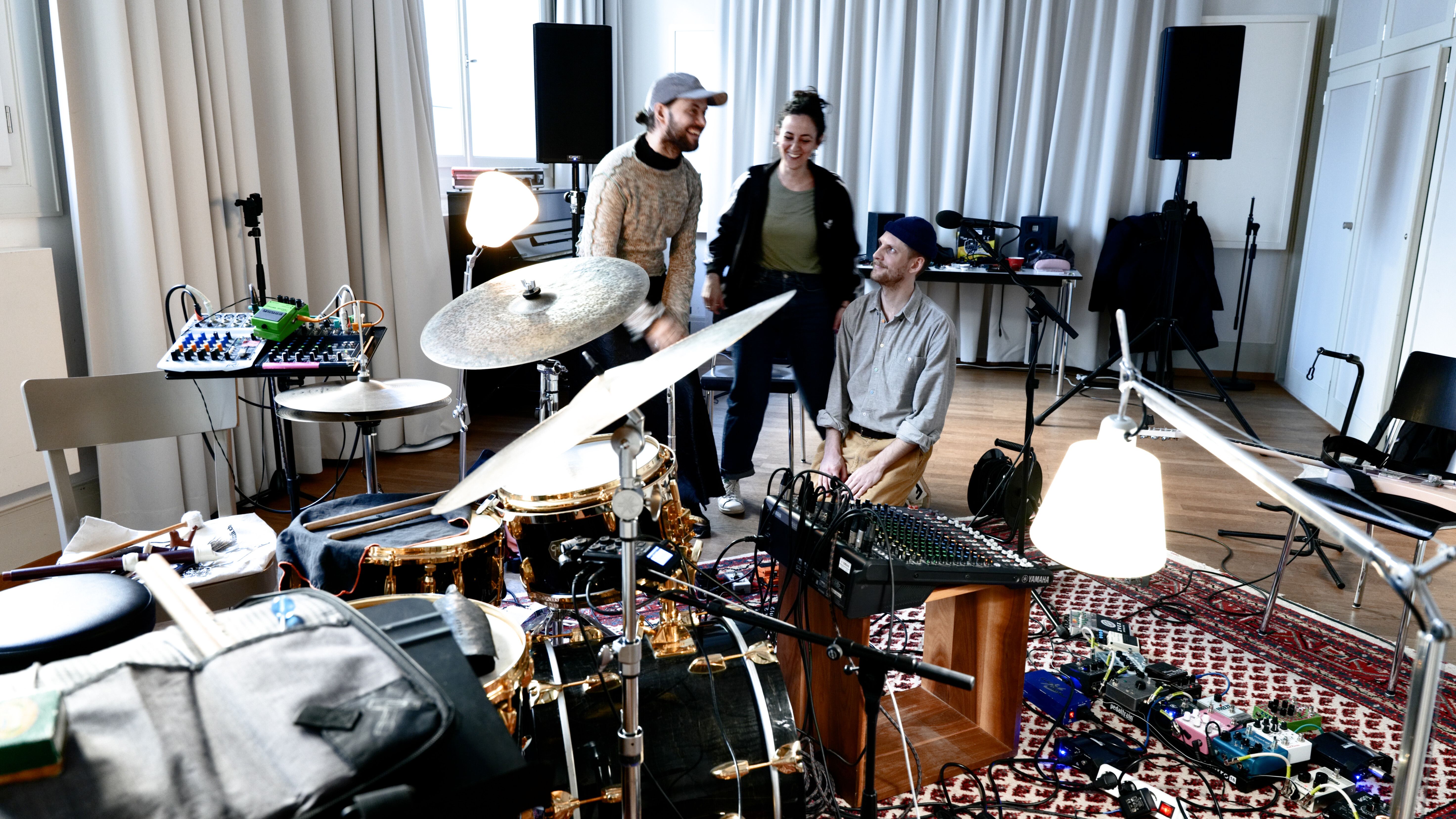
Once, I froze a single note with an effect pedal, put my guitar on the ground and simply walked off stage in the middle of the performance. I sat down while my duo partner, a trumpet player, continued playing. At some point I returned and started playing again.
Afterwards, he told me that it had made him really insecure and that he wasn’t sure how to react to it. So in this case I wasn’t helping the music I guess.
As a listener, do you also have a preference for improvised music? If so, what is it about this music that you appreciate as part of the audience?
I like improvised music that tries to free itself from the genre created by the scene itself and from its already established aesthetics. Music that searches and finds.
Innovative music that is also not afraid of humour.
In a way, we improvise all the time. In which way is your creative work feeding back and possibly supporting other areas of your life?
Improvisation is something that runs through my entire life.
Reactive spontaneity and openness - almost a certain euphoria towards the unexpected - and an interest in what might be hidden behind one’s own reaction to it.
I learn an incredible amount from trusting my own intuition and playing with it or against it.