Published
Name: Emily Kuhn
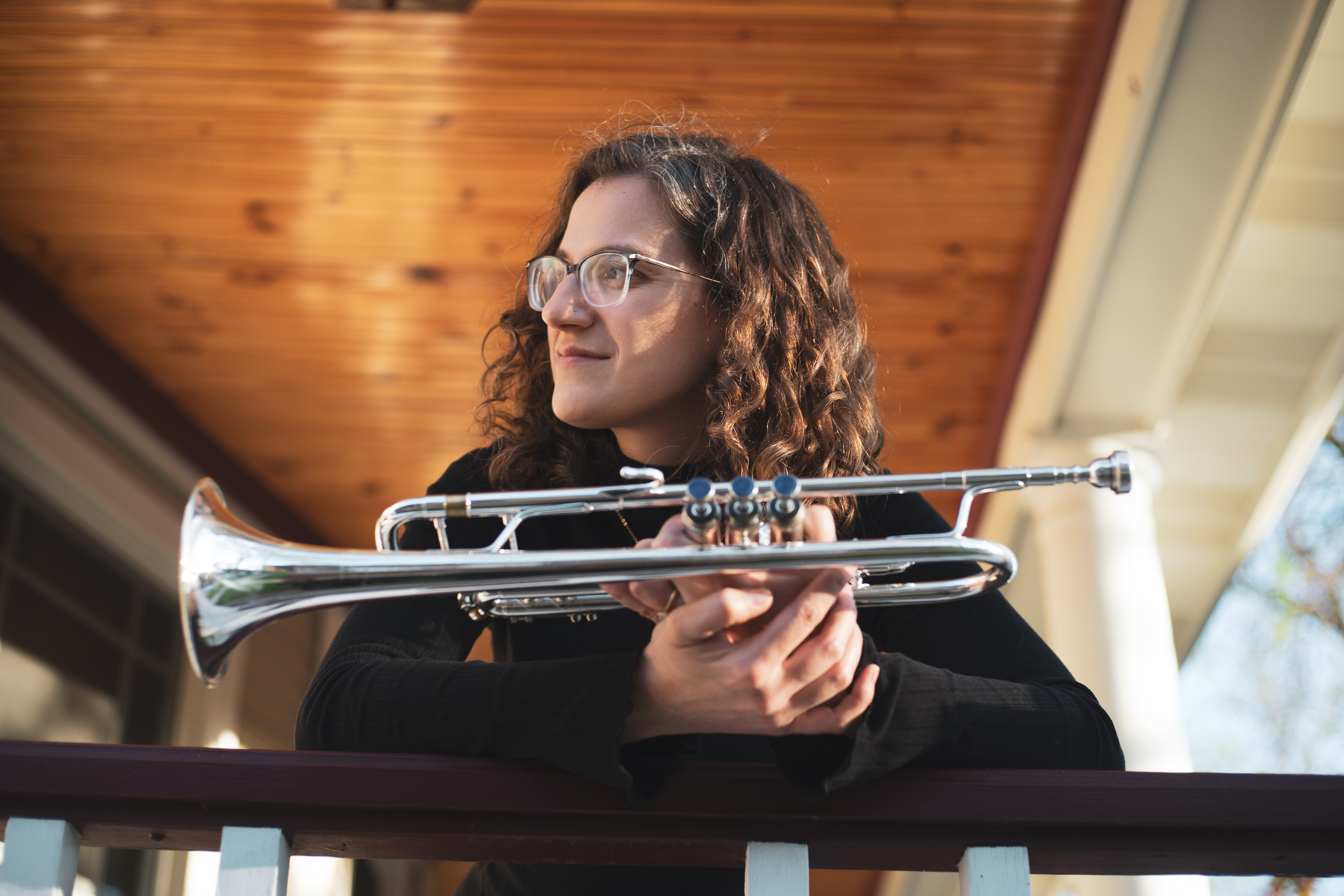
Occupation: Composer, improviser, trumpet player
Nationality: American
Current release: Emily Kuhn's new album Feathered Things, is out via Desafío Candente.
Hometown Recommendations: One of my favorite things about Chicago is the amazing network of bike trails including the Lakefront trail, the 606, the North Branch Trail, and the North Channel Trail, and the Chicago Park District which offers amazing cultural programming as well as beautiful green spaces throughout the city!
If you enjoyed this Emily Kuhn interview and would like to stay up to date with her music, visit her official homepage. She is also on Instagram, and bandcamp.
For a deeper dive, read our earlier Emily Kuhn interview.
Where does the impulse to create something come from for you? What role do often-quoted sources of inspiration like dreams, other forms of art, personal relationships, politics etc play?
I usually become inspired to create when I have a feeling that I’m meditating on and can’t shake.
Sometimes this will come from my personal life, sometimes it will come from politics, sometimes it will come from art or literature. Composing is a way for me to process my feelings without having to put words to them; it helps me to move through emotions by creating a record of them.
I’m especially influenced by the natural world and built environment. I wrote a lot of the music on Feathered Things during an artist residency at OxBow school of art, so I was in a uniquely creative space with a lot of time to reflect and workshop ideas, surrounded by artists in other fields (especially writers) to bounce ideas off of. The music reflects this headspace.
I wrote large parts of “As The Crow Flies” and “Icarus” while hiking, and both songs are influenced by this environment, with themes of freedom, resilience, and risk-taking.
Some other songs on the record are even more directly influenced by my environment: I wrote “Snowfall” as I was watching the picture-book perfect snowfall outside my studio window, and both “Vaulted” and “Telephone” were inspired by the echoes in my studio.
“Telephone” also draws inspiration from the Peter Evans recording of "Body and Soul" live in Finney Chapel, which is one of my favorite solo trumpet recordings.
Other songs come from different sources of inspiration - for example, I wrote “Gratitude” after attending an artist talk by Brad Mehldau and being struck by his resilience and hopefulness. I’m also inspired by poetry and literature, including the work of writers like Mary Oliver, N.K. Jemisin, Octavia Butler, Barbara Kingsolver, and Emily Dickinson.
[Read our Peter Evans interview]
For you to get started, do there need to be concrete ideas – or what some have called a 'visualisation' of the finished work? What does the balance between planning and chance look like for you?
I err much more towards chance than planning when I write. Often, my first drafts are stream-of-consciousness - I’ll have an idea and I’ll start a voice memo, sit down at the piano and play it, and just see where it takes me.
This is even true for lyrics - I started writing “Icarus” because the lyrics “I once was falling / You once were calling my name” popped into my head and I wanted to see where they would go. I continue to let songs change through the process of playing them live with my band.
Sometimes I do have an idea of the vibe I want for the finished work.
Since I wrote the first drafts of most of the songs on Feathered Things in the same week, I was thinking about them collectively. I wasn’t necessarily trying to find musical throughlines between the songs but I knew I wanted them to feel thematically connected.
Is there a preparation phase for your process? Do you require your tools to be laid out in a particular way, for example, do you need to do 'research' or create 'early versions'?
I do my best work when I have a clear space where I can be creative.
I usually handwrite lead sheets before I put anything into music notation software, since it helps me put my ideas down on paper more directly, without the middleman of the computer.
Do you have certain rituals to get you into the right mindset for creating? What role do certain foods or stimulants like coffee, lighting, scents, exercise or reading poetry play?
I find that being outside and making space for my brain to be still really helps me get into a creative headspace.
Being a freelance musician can be chaotic and busy, and I try to find ways to quiet the noise before I sit down and compose. Taking long walks or bike rides, sitting by the beach or in a park, and just observing the natural world around me is a reliable way for me to get in the zone for composing.
I’m also a big reader, and ideas from things I’ve been reading will often find their way into my music.
For Feathered Things, what did you start with? If there were conceptual considerations, what were they?
I wrote most of the music on Feathered Things (everything except for “Wingspan” and “Gratitude”) at a mid-winter artist residency at OxBow School of Art, sponsored by the Luminarts Cultural Foundation.
I didn’t go in with any specific ideas of what music I wanted to write, but being in a beautiful, creative environment for a week put me in a specific headspace and I think the music reflects that.
I had a feeling I might turn the songs into a suite, and I was thinking a lot about requiems and transformation and rebirth. That theme comes across in the suite as a whole, and especially in “Icarus”. Something about the Great Lakes landscape also made me think a lot about birds, as is probably evident in the song titles!
Tell me a bit about the way the new material developed and gradually took its final form, please.
Most of these songs started with melody. “Telephone,” “Wingspan,” and “As The Crow Flies” all started with the groove, but even on those songs the melody came soon after. I started writing some songs on the piano (“Gratitude,” “Wingspan,” “Snowfall”), some songs by singing (“Icarus,” “As The Crow Flies”), and some songs on the trumpet (“Vaulted”, “Telephone,” “For Those Left Behind”).
The process of writing “Telephone” was slightly different than usual for me - I used a recording set up to overdub myself playing and improvising different parts, and transcribed parts of that recording to come up with the first draft of the song.
After my initial brainstorming phase and some preliminary editing, I wrote out lead sheets (with paper and pencil before I input them into notation software), then brought the songs back to my band for a reading session where we started exploring some different vibes and making arrangement/orchestration choices.
One of my favorite things about my quintet is that I can bring in a fairly simple lead sheet, and everyone in the band will run with it and come in with really strong creative ideas. A lot of these songs really started to take shape as we played them more, and still continue to develop every time we play them live.
Some of the songs stayed very similar to my rough drafts - “Telephone”, “For Those Left Behind”, “Gratitude”, and “Snowfall” didn’t change much structurally. For “Vaulted”, I reworked the bridge multiple times before settling on what it is now. I spent a lot of time editing the lyrics of “Icarus,” since while I really enjoy writing lyrics it comes less naturally to me than writing music.
“Wingspan” is the song that took me the longest to write.
I initially wrote it as a commission for an ensemble with two trombones, vibes, and drums in 2020. That version was in 4/4 time but I knew it wasn’t quite right. Over time I kept playing with the rhythm and settled on what I wanted the ostinato to be (now it alternates 4/4 and ⅞ time).
I figured out how to write it and finalized the melody during the OxBow residency, but kept experimenting with the form as we played live shows leading up to the recording session - I even added a new section a few days before recording.
Many writers have claimed that as soon as they enter into the process, certain aspects of the narrative are out of their hands. Do you like to keep strict control or is there a sense of following things where they lead you?
I definitely follow my ideas as they lead me and try to stay open to where the music wants to go!
There are many descriptions of the creative state. How would you describe it for you personally? Is there an element of spirituality to what you do?
When I’m in a flow state I feel grounded and present in the moment, and I can’t stop thinking about what I’m working on until I see it through.
It does have an element of spirituality - keeping your mind open to ideas as they come, similarly to how you would if you were meditating.
Once a piece is finished, how important is it for you to let it lie and evaluate it later on? How much improvement and refinement do you personally allow until you're satisfied with a piece? What does this process look like in practise?
It depends on the piece, but when I write new music, I think it’s important to have a period where I brainstorm without evaluating or editing any of my ideas. Otherwise, it’s too easy to get stuck pre-emptively filtering out ideas that potentially could work.
I tend to write a first draft and meditate on it for a week or so (or sometimes longer), occasionally making minor changes but not making any big edits, before I do any major editing.
How do you think the meaning, or effect of an individual piece is enhanced, clarified or possibly contrasted by the EPs, or albums it is part of? Does each piece, for example, need to be consistent with the larger whole?
An album gives you a way to make a cohesive statement that releasing individual songs doesn’t. It’s similar to a set list at a live show - it gives you some control over the journey the listener is taking.
I don’t think that all of the pieces need to necessarily be consistent (sonically or thematically) but they need to work together.
All of the songs on Feathered Things go together partly because I wrote them in the same place, during the same week. They’re thematically related and there are similarities in the music and overall sound of each song, but there is still a lot of variation between songs - even the first two tracks of the album are very different from each other!
What's your take on the role and importance of production, including mixing and mastering for you personally? In terms of what they contribute to a song, what is the balance between the composition and the arrangement (performance)?
Mixing and mastering bring the music to life. Playing in a studio environment is really different than playing a live show, and the mixing and mastering process is where a lot of the magic happens, making the music sound as good as it possibly can.
I was lucky to work with fantastic mixing/mastering engineers on Feathered Things - Andy Shoemaker recorded and mixed the album and Anthony Gravino mastered it.
Music and the accompanying artwork are often closely related. Can you talk about this a little bit for your current project and the relationship that images and sounds have for you in general?
While I’m not usually someone who sees colors or images when I play, this album had a clear color palette for me from the very beginning. The music is tied to the winter landscape I wrote it in, so I was thinking about whites, teals, purples, and light blues contrasting with sun colors like fiery reds and oranges.
As the title suggests, there’s also a lot of imagery of feathers and flight: birds, snowflakes, wings, high vaulted ceilings, etc. I was very lucky to work with visual artists who understood this vision and enhanced it with their work - Marine Tempels Black, who did the album artwork; Sean Pierce, who created the music videos; Hayley Larson, who was the aerial artist in the “Icarus” video; and Raven See, who did the lighting for the “Icarus” video.
I had conversations with all of these artists about colors and textures and the visual mood that we wanted to create. The music is very atmospheric with swirling textures, and the visual components of the album really brought this to life in a special way.
After finishing a piece or album and releasing something into the world, there can be a sense of emptiness. Can you relate to this – and how do you return to the state of creativity after experiencing it?
Yes, absolutely. I always have a bit of a post-release hangover. I think it’s normal after putting so much effort into a project for so long.
I think it can be helpful to just focus on different things for a while after an album release and not worry too much about whether I feel creative or not. Another thing that helps me is to start working on new projects before the last one is released.
I would love to know a little about the feedback you've received from listeners or critics about what they thought some of your songs are about or the impact it had on them – have there been “misunderstandings” or did you perhaps even gain new “insights?”
One thing I hear a lot from listeners and reviewers is that my music is cinematic or sometimes reminds them of a specific film score. I really appreciate these comments - but I don’t watch a lot of movies and I almost never know the references people make!
In general I’m always honored when people come up and tell me about their experience of the music, and I love that different people can hear the same set of music and take different things away from it.
I never want to tell people how to feel - I just want to make music that feels emotionally honest to myself, knowing that other people will experience it differently.
Creativity can reach many different corners of our lives. Do you personally feel as though writing a piece of music is inherently different from something like making a great cup of coffee? What do you express through music that you couldn't or wouldn't in more 'mundane' tasks?
I think that writing music or making any kind of art is a sacred process. It involves the enormous gift and responsibility of being open to inspiration from the universe, taking the time to bring an idea to life and see it reach its full potential, and expressing something that can make people think or feel something.
While it is also special to be present and notice the beauty of everyday tasks like making coffee, I think that the intentionality required to make art sets it apart.