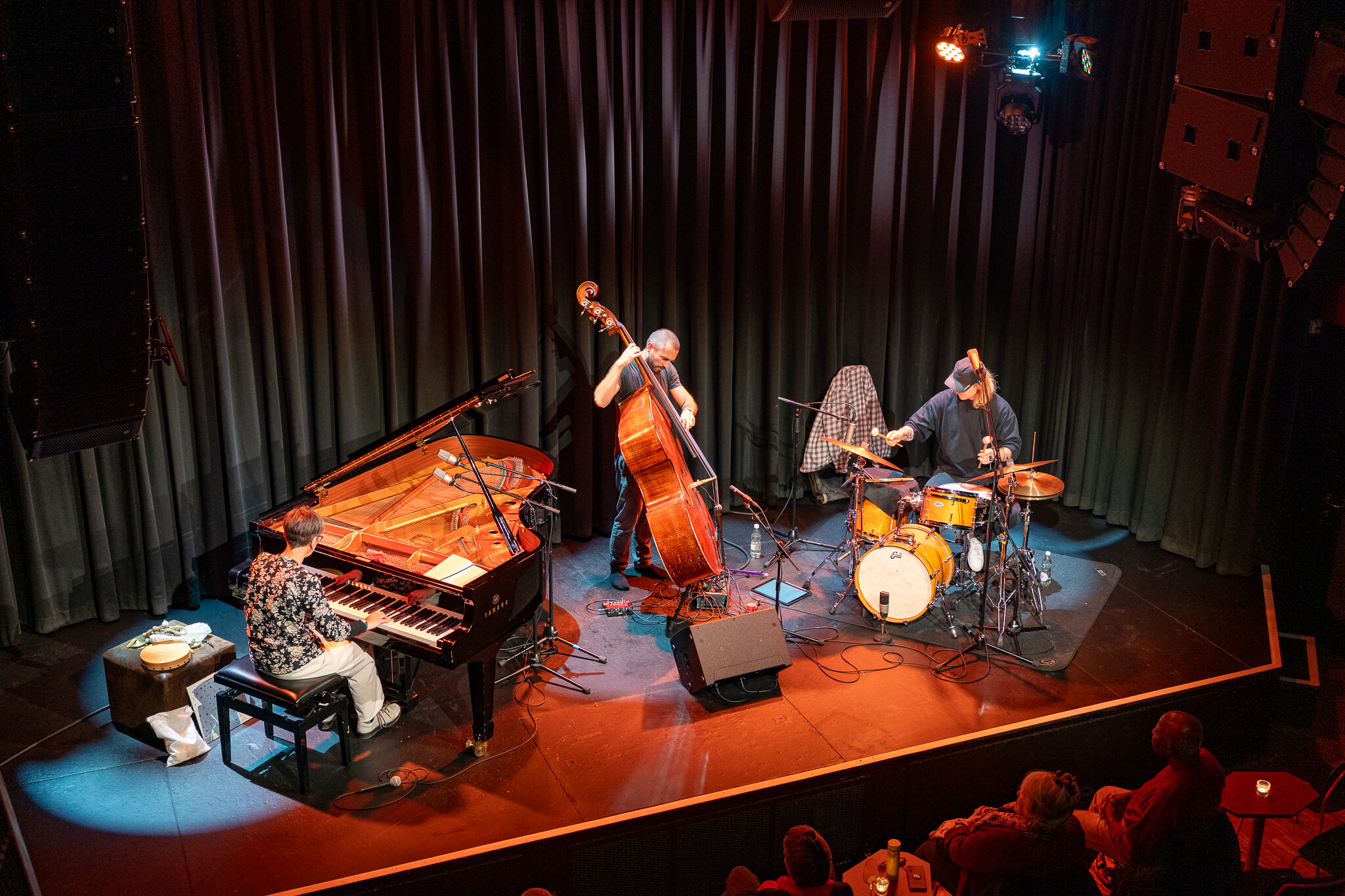
Published
Name: Gisela Horat
Occupation: Composer, improviser, pianist
Nationality: Swiss
Current release: The Gisela Horat's new album Trio Solo is out via unit.
Hometown Recommendation for Zurich, Switzerland: One place I would particularly recommend is the Museum Rietberg and the surrounding Rieterpark. During the spring and summer months, there is something truly special about spending time there, perhaps with a picnic under the shade of the old trees. It is a beautiful and inspiring place to slow down and reflect.
If you enjoyed this Gisela Horat interview and would like to stay up to date with her music and catch her live, visit their official homepage. She is also on Facebook, and bandcamp.
For a deeper dive, read our earlier Gisela Horat interview.
What were some of the musical experiences which planted a seed for your interest in jazz?
My passion for jazz and improvised music was ignited after hearing Keith Jarrett perform live around 1990.
I was fascinated by his extraordinary piano playing and the freedom of his musical expression.
What does the term jazz mean today, would you say?
Today, I see jazz less as a genre and more as a mindset.
It shapes the way I approach music, inspiring me to find my own voice by bringing together all of my musical experiences through improvisation and composition. At its best, this process can lead to something entirely new and unforeseen.
Over the past eighty years, jazz has evolved and diversified to such an extent that it now embraces an astonishing spectrum of musical languages, creative approaches, and forms of improvisation.
As of today, what kind of materials, ideas, and technologies are particularly stimulating for you?
Despite all technological developments, I still find the experience of acoustically produced sound to be the most beautiful and inspiring aspect of music.
It remains an endless source of fascination and creativity for me.
Where do most of your inspirations to create come from – rather from internal impulses or external ones? Which current social / political / ecological or other developments make you feel like you need to respond as an artist?
My creative inspiration is shaped both by inner impulses and by the world around me, and the emphasis is constantly changing. At present, it is primarily ecological and political issues that occupy my thoughts.
I find the current state of the world deeply troubling when I observe elections, political actions, armed conflicts, and the inability of societies to respond effectively to these growing threats. Added to this is the climate change, which I believe is likely to exacerbate political instability and conflict, for example through large-scale movements of displaced people.
Consequently, I find myself holding a rather pessimistic view of the future, and this perspective inevitably finds its way into my musical and creative work. Examples:
"Angst"
"Blick in die Welt"
"Innere Unruhe"
The inward source of inspiration is, above all, my own life and emotional experience. My feelings, memories, and personal reflections form an important foundation for my creative work, often influencing both the character and direction of my music.
Examples:
"Einfach müde"
"Zerstreutheit"
"Leben"
Tell me a bit about the sounds & creative directions, artists & communities, as well as the colleagues & creative hotspots of your current hometown, please. How do they influence your music?
That is not an easy question for me to answer.
I do not feel particularly influenced by the local music scene in Zurich, as I often find myself standing somewhat outside of it. This is probably due to the nature of my work, which exists somewhere between jazz, improvisation, composition, and free sonic experimentation. It does not fit comfortably into any single genre, and I am not sure I could define it myself.
In many ways, I have always found it difficult to describe my own music.
What role do electronic tools and instruments play for your creative process?
Although technology is part of my workflow, electronic tools currently play only a limited role in my creative process. I use a Zoom recorder to capture ideas, which I initially notate by hand before later transferring them into notation software.
The essence of the creative work still begins with listening, reflection, and acoustic sound.
Thanks to technological advances, collaboration has become a lot easier. What have been some of the most fruitful collaborations for you recently and what approaches to and modes of collaboration currently seem best to you?
In terms of collaboration, I am quite old-fashioned.
I believe the best creative experiences happen when people are together in the same room, responding to one another and drawing inspiration from a shared musical moment.
Jazz has always had an interesting relationship between honouring its roots and exploring the unknown. What does the balance between these two poles look like in your music?
I believe the essence of jazz lies in balancing respect for its roots with a constant exploration of the unknown. Without that forward-looking impulse, it loses a vital part of its identity. Jazz has always been about pushing boundaries and searching for new forms of expression.
While both tradition and innovation are important, it is the pursuit of the unknown that ultimately carries the greatest meaning for me.
How much potential for something “new” is there still in jazz? What could this “new” look like?
The truly new is always unknown, and for that reason it is inherently difficult to identify. Even when something new comes into being, we cannot immediately understand its meaning, or sometimes even recognise its novelty. Only with hindsight does that become possible.
At present, my creative process feels like fishing in a black box. I have no idea what lies within it. Will I find something there, and if I do, what will it be? Perhaps, in the best-case scenario, something genuinely new.
Yet what feels new to me does not necessarily mean it is objectively new. That, too, can only be judged from a later perspective.
For many artists, life-changing musical experiences take place live. How do you see that yourself?
Some of the most transformative musical experiences in my life have come from travelling and performing in places that are entirely new to me. At the moment, I am in Japan, where the abundance of new impressions is so intense that it feels almost overwhelming.
Prior to this, I took part in a residency on the island of Flores in the Azores. The island's isolation and peaceful atmosphere provided a welcome contrast to the pressures of the previous year. It gave me the space to slow down, recover a sense of inner balance, and return to a more creative and artistic frame of mind.
How, would you say are your live performances and your recording projects connected at the moment? How do they mutually influence and feed off each other?
Recording projects play a particularly important role in my artistic development. They demand a high degree of focus and encourage a process of careful reflection, as I listen back to the music repeatedly and examine it from different perspectives. This reflective process then finds its way into live performance, where it is transformed and reabsorbed through spontaneous improvisation.
Live performances are different. Once a concert has ended, the experience exists largely in memory, and memory is inherently unreliable. Our recollections are shaped not only by what was played, but also by the emotions we experienced while playing it.
For that reason, my perception of an improvisation can evolve significantly over time. If I felt uncertain or dissatisfied during the performance, I may initially judge the music negatively. Later, when that immediate emotional connection has weakened, I often find myself listening with different ears and reaching a very different conclusion about the music itself.
Ímprovisation is obviously an essential element of jazz, but I would assume that just like composition, it is transforming. How do you feel has the role of improvisation changed in jazz?
Since jazz has become such a broad and diverse collection of musical currents, I find it difficult to speak about changes in composition and improvisation in general terms. What seems evident is that the boundaries continue to shift.
Personally, I am drawn to improvisation that occupies the space between clear formal structures and the total freedom of open playing. The challenge lies in moving swiftly between structure and openness, certainty and uncertainty, while exploring unfamiliar territory.
It is this process of discovery that I find most exciting.
What, would you say, are the key ideas behind your approach to improvisation?
It is important to me that my improvisations become ever more spontaneous. I want to be able to move more freely between improvisation within a clearly defined form and completely open playing in the moment.
Over the years, the role of improvisation in my work has steadily grown. At the same time, I now expect my improvisations to function as a form of instant composition, with a clear narrative arc and a sense of purpose. This is, in many ways, a contradiction, and it continually draws me back and forth between the two poles of composition and improvisation.
At present, I often begin with composed musical ideas that are relatively simple in themselves. Finding such an idea, one that also contains the potential for development, is surprisingly demanding. Out of five ideas, I typically discard four. The one I choose to pursue then continues to evolve over time.
Ultimately, I would like to reach a point in my musical development where I can spontaneously generate and shape strong foundational ideas at any moment. Through improvisation, I am constantly experimenting and searching for new possibilities, new approaches, and new concepts.
One question that fascinates me is: what is the significance of a single note? I am intrigued by the tension between assigning great importance to an individual sound and then, only moments later, stripping it of that significance altogether. This continual play between opposing perspectives is something I find deeply compelling.
The search itself, the possibility of failure, and the sense of exhilaration when that delicate balancing act succeeds, these are among the most rewarding aspects of the creative process for me.
The Montreux Festival intends to preserve its archive of recordings for future generations. Do you personally feels it's important that everything should remain available forever - or is there something to be said for letting beautiful moments pass and linger in the memories of those that experienced them?
I do not believe that everything has to be preserved forever. Yet the moment we accept that, we are confronted with questions of selection and value: what should be kept, and according to which criteria?
Archives are also dependent on the durability of their storage media. Their contents remain available only as long as those media remain readable. If we genuinely wish to preserve material for future generations, we must think carefully about the technologies we choose. How will they age? Will they develop faults over time? Will information gradually disappear?
At the same time, improvisation is above all an art of the present moment. Its essence lies in the act of creation itself. Perhaps this is also an argument for letting certain experiences live on primarily through memory, allowing their resonance to endure rather than attempting to preserve everything permanently.