Part 1
Name: John McCowen
Nationality: American, Iceland-based
Occupation: Composer, clarinetist, recorder player
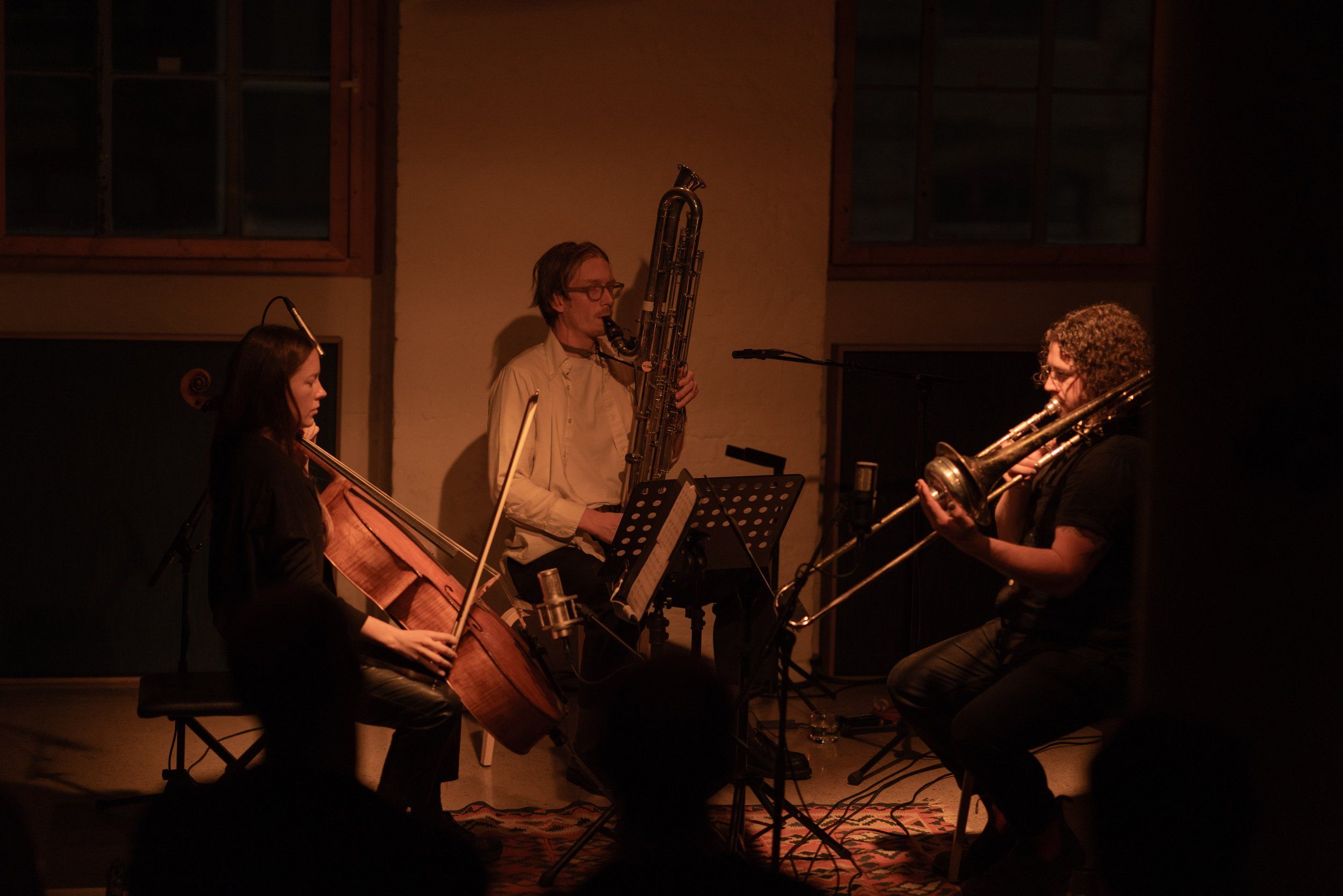
Current Release: John McCowen's new album Pressure Chords, featuring himself on contrabass clarinet and Lucy Railton (cello) and Weston Olencki (trombone) is out via Hallow Ground.
Shoutouts: People that carry on a tradition simply for the love of it, Pat Thomas, artists pushing the music forward, musicians totally against progress, the orchestrations on Court & Spark by Joni Mitchell, D’Angelo, John Gilmore, rural music scenes, Japan's extratone scene, Counterflows Festival, Carla Bley's Escalator Over The Hill, Charles Mingus' 1964 band, performers who talk to the audience, Pissgrave, teenagers that buy merch, and knowing that there is some music happening somewhere that is extremely important and I haven't heard about it yet.
Hometown Recommendations: Mengi. It’s a small, artist-run venue here in Reykjavík that’s been operating since 2013.
Things that you are passionate about but rarely get to talk about: Dolly Parton’s performance at Glastonbury Festival in 2014. I highly recommend watching it. A true masterclass in what it means to be a performer. At one point in the set, she picks up a bedazzled soprano saxophone and plays Yakety Sax (pretty sure she’s miming it).
This leads me to something I’ve given a lot of thought to - the experimental-contemporary-sound art-whatever world could learn a lot from country musicians when it comes to engaging with your audience. If you’d really like to relax an audience or just make them feel welcome - just tell a story or a short joke or something. I think it would do wonders - would help the audience be more open to abstraction. But if you want audiences to feel uneasy, do you!
If you enjoyed this John McCowen interview, visit his official website for more information. He is also on Instagram, and bandcamp.
The borders between producers, sound artists, and even songwriters are becoming increasingly blurry. What does being a composer mean today, would you say?
Everything is blurry and that’s ok.
“Composer” can broadly define anyone who writes music - producers, sound artists, and songwriters all organize sound to fulfill an artistic vision. It feels like it's all composers that just differ in theory and practice.
From my experience, the word “composer” sits heavy on students in higher education. I teach an improvisation course at a university and most of my students compose music in some fashion. But if you ask them if they are a composer, some will skirt away from saying they are - due to some self-imposed insecurity. Like, “Oh, I don’t know how to write for the violin” or something like that. Yet, most of them write songs and we are willing to call someone who wrote a national anthem in the 18th century a composer.
And I’ve heard classically-trained composition students disregard students that haven’t engaged in equal classical rigor. Musicians should be thankful people make music that sounds different than them.
Many people perceive classical music and contemporary composition as having high barriers of entrance, both for listeners and musicians. What have your own experiences been in this regard?
I’m a bit confused by what “high barriers” means within this conversation. What exactly are these high barriers? To me, this implies some kind of forced intent.
I think the world of classical music and contemporary composition is open to those that are truly interested. It’s simple, don’t listen if you aren’t interested. The high barriers for musicians are there for a reason. It’s just like professional sports - it requires a specific and exceptional skill set - but that said, the classical world has plenty of issues.
I ended up in that world because I was interested in it. My interest in music naturally lead me to those sounds. I liked to listen and perform that music - new things were exciting. When I was doing a bachelor’s degree in music, I would discover some composer that wrote for something like “4 soprano saxophones, banjo, and tubular bells” and that made me so excited - just encountering new timbres and instrumentations blew my mind.
One thing I observed from playing in the classical world is classical musicians seem to bond by complaining to one another in rehearsals - so, they have to find something to complain about, right? The most obvious thing? That contemporary piece squeezed between Brahms and Elgar. At least what I observed studying in the USA - there is a tendency to honor the past and dismiss the present and future - and that institutionalized ignorance is celebrated. Instrumental professors tell their students that contemporary music will ruin their technique instead of using contemporary music to teach flexibility.
This learned ignorance is also the fault of the greater classical world in general. That contemporary piece they put on a program sandwiched between standard repertoire, will receive a laughable amount of rehearsal time. While an orchestra will rehearse the standard repertoire for weeks, the new commission will get an hour! It’s ridiculous.
If the orchestra put as much work into making a new work as good as they can, that would reflect in the performance - making the audience more open to the new work! Rigor and hard work are palpable beyond language.
The classical world is lucky to have conductors like Ilan Volkov that prioritize new work.
As of today, what kind of materials, ideas, and technologies are particularly stimulating for you?
I’m extremely stubborn about acoustic music. I refuse to give up on acoustic instruments under the guise of some completed exploration or the optimization/excitement of digital technology.
It’s all a matter of discipline. I truly believe if people maintain a rigorous exploration of acoustic instruments some saxophone player will eventually replicate the human voice. I think Éliane Radigue’s OCCAM works helped push that message home to a new generation. But that’s my own practice - I love all kinds of electronic music and have been deeply inspired by it - different people choose different tools.
There’s that great video of Clarence “Gatemouth” Brown on Austin City Limits where he plays the viola like the human voice during a solo. We need more of that kind of exploration with total dismissal of the so-called boundaries of what is possible.
There’s that story about how running a four-minute mile used to be deemed impossible. But someone finally did it - and you know how long it took someone else to do it? One month. And someone else did it again a few weeks later. Human will combined with passion and dedication is truly remarkable. This perseverance needs to be applied more to instrumental practice.
Where do most of your inspirations to create come from – rather from internal impulses or external ones? Which current social / political / ecological or other developments make you feel like you need to respond as an artist?
It’s usually internal influence - hearing something and slowly clearing the fog until I can perceive the instruments - then thinking about the musicians and their personal dynamics until it becomes clear enough to pursue. I keep a notebook for this purpose which helps the ideas feel real.
For example, the Pressure Chords record came together partially because I had been thinking about orchestrations of my solo works and around that time I had just improvised with Weston Olencki and Lucy Railton.
The chemistry between the three of us worked well (it was a good hang) and we wanted to find a reason to keep playing music together. So, I took a solo piece I was composing at the time and spent the next few months pulling it apart spectrally and orchestrating it for contrabass clarinet, trombone, and cello. Lucy and Weston are incredible musicians with an ability to look and hear beyond the page.
In regards to the social/political/ecological aspect of the question, the subjective nature of music is amazing. When making instrumental music, it's easy to veer away from making overt statements. If you imbue music with what you are feeling, it maintains that potency and passes to the audience and can be applied to what they are feeling.
But in live performances of instrumental music, it can be said by instrumentalists in between songs - for instance: Rahsaan Roland Kirk and jaimie branch were fantastic at this and because of that, live recordings by both of those artists are potent.
[Read our jaimie branch interview]
There is a legendary video of Aaron Dilloway performing solo, where he slowly puts a contact mic into his mouth and begins to scream like he’s being electrocuted - and there is a guy behind him that proceeds to repeatedly punch the floor! No words spoken but the pure emotion of it all is so visceral. That punching guy is truly being exorcised of pain or stress. That’s where it's at!
Tell me a bit about the sounds & creative directions, artists & communities, as well as the colleagues & creative hotspots of your current hometown, please. How do they influence your music?
I live in Reykjavík, Iceland and it’s a very unique artistic community. It’s a city of around 140,000 people but the arts scene is something more akin to a major city - yet everything is so intertwined.
What makes the scene great to me is the community of young artists that are constantly booking gigs, festivals, taking huge risks, and making really strange stuff happen. That helps keep me motivated - just being in the proximity of some kind of “do-it-just-to-do-it” mentality.
You can go to a concert here where young punks and art students are having conversations with people that have won Grammys or just did the Venice Biennale and what not. It’s great - little separation and very intergenerational.
Composing has always had an interesting relationship between honouring its roots and exploring the unknown. What does the balance between these two poles look like in your music?
It’s simply honoring its roots by exploring the unknown! The musicians I am most influenced by were focused on pushing their music forward, so I am interested in continuing that.
For instance, one of my biggest influences is John Coltrane. I don’t think that’s necessarily easy to hear in my music so I feel like it reflects that ethos. To me, Coltrane had such a unique trajectory as an artist. He spent his career exhausting every obsession. He took chord changes to the furthest reaches he could, then transitioned into trying to express pain so viscerally through his saxophone, and then he would end these long solos towards the end of his life by simply beating his chest and chanting. It’s so incredibly deep and full-circle.
His influence showed me if you practice enough, new ideas and avenues of creation can endlessly appear as long as your discipline remains. It’s all about discipline. Freedom can only be achieved through discipline.