Published
Part 2
What is the difference between performing a painting and performing a graphic score?
Well, I can't say I've ever quite literally “performed” a painting, at least not without either a composer’s express intent or some kind of direction.
I suppose it's possible that a performer could “perform” a painting, but at a certain point — and this is not a bad thing — they'd be imposing their own lens of interpretation onto the work in their attempt to, albeit intuitively and perhaps improvisatory, translate it into sound.
And so I suppose the difference is, again, a matter of that negotiation between boundary and possibility, where in a graphic score certain boundaries are dictated by the composer through notation, written instruction, or other forms of guidance.
How do you prepare for a performance of a graphic score or open form composition? What kind of considerations does it require, how different is the rehearsal processs?
As with all pieces, of any form or notation practice, the process through which you prepare depends on what the piece asks of the interpreters, both in terms of imaginative interpretation and the sheer execution of the performance.
Sometimes graphic scores are really quite specific, sometimes more open, but they always pose challenges and require very diligent, thoughtful rehearsing — especially when, individually or as a group, you are just beginning to familiarize yourself with a particular composer’s voice.
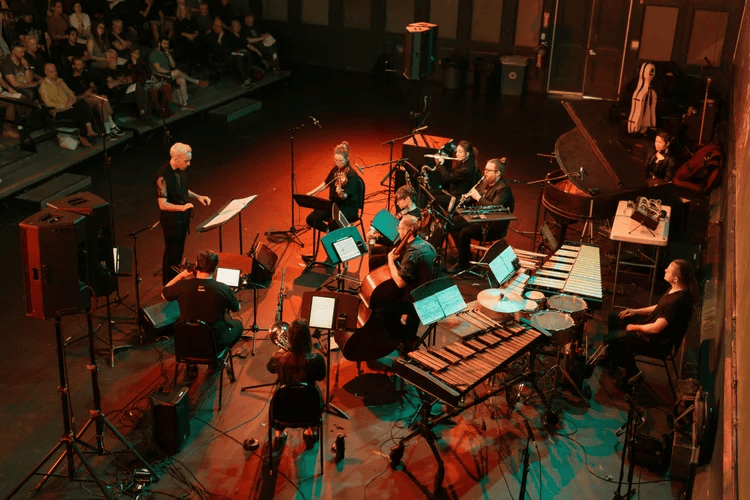
Especially when there’s an element of collective improvisation involved, one thing I like to do is run the piece, or just a section of the piece, and then talk about it as a group. We’ll go around the room and ask everybody what they enjoyed about the run, or what stood out to them this time.
It can be either a specific musical event that happened — for example, I really when the violin played that ponticello tremolo, or I loved when the flute dissolved to a pitch-less, airy sound. Or it can be a general affect or an atmosphere that emerged — I liked how active this run was, for example, or I thought this time through felt melancholic. And then you can talk about ideas for going further, developing even more interesting textures, and you go through this process until the people in the room have shaped their collective interpretation of this piece.
However, another thing that can be equally interesting — and maybe this works best for sort of the most open and indeterminant of graphic scores — is to rehearse the piece and then not discuss it. Instead, maybe take a few minutes of rest, allow everyone to clear their mind from the last time through, and then begin again with the spirit exploring something totally new.
And then through that process of repeated exploration, even without verbal communication, different ideas and variations emerge.
How, would you say, does Brown's approach to graphic scores / open forms differ from Feldman's?
Well, it's hard to say unilaterally, because for both composers there's quite a bit of variation and exploration about what graphic scores and open forms can mean throughout their bodies of work.
However, I think one possibility is that Brown seems to foreground the question of how to interpret what's on the page itself — for example, opening the question of, which direction are you reading the score? Are we reading it from bottom to top? Left to right? How do we as musicians to choose where to go next on the page? And so the performance ends up being quite literally the result of the process of interpreting — you just get the resultant sound.
Whereas Feldman, at least in my perspective, it does seem more like the concept of the sound comes first, and then the act of deciphering the graphic score is sort of the road to get there. Perhaps this is colored by my perception of Feldman’s other music — I may be viewing his indeterminate works through the lens of his later works, which explore sound itself so intently.
But I suppose that's one thing I would posit — with Brown, the sound is sort of the realization of process, whereas for Feldman the process within the score is determined by the eventual sound. But perhaps I am totally wrong!
Tell me a bit about the piece you're performing at Graphic Content.
We are performing a number of pieces across three concerts on the festival, including Feldman's early trio for soprano, piano, and cello, Four Songs to EE Cummings, his early graphic score Projection 2, and some of his middle period indeterminant pieces, both in dialogue and titled after painters in the New York school — de Kooning and For Franz Kline.
And then we're also going to perform another piece from what I described earlier as his middle period of exploration, where Feldman is beginning to explore this sort of intuitive, moment-by-moment, approach to texture and harmony: the wonderful cycle The Viola In My Life.
We’ll be performing the first three pieces — the fourth is for viola with orchestra, which perhaps we’ll do someday!
What were some of your considerations with regards to the interpretation?
It’s really always the same: the basic principle of interpretation being the negotiation between the directions and boundaries established by the composer and the possibilities to be discovered by the performer.
But then the result is the possible interpretations — meanings, feelings, ideas — that are communicated to the listener, which are highly subjective and may or may not be related to the intentions of the composers or the performers.
One of the questions posed by the organisers ahead of the festival was: “Does historical awareness ruin their idealized conception of pure sound disconnected from narrative?” What's your take on that?
It's a really good and valid question. For me, put me down in the camp of people who think that “pure sound,” disconnected from narrative or history, is a fallacy. I believe that all art is born, albeit quite possibly subconsciously, of social or historical context.
Even if Feldman or Brown thought of themselves as chasing some sort of pure abstraction through sound, I would argue that one of the things that's interesting, as we mark their centennials, is to frame these composers and their bodies of work in a historical narrative — in dialogue with their counterparts in the New York school, and indeed, to view the New York school and the trend of abstract expressionism discursively within the interconnected cultural, political and social developments of the mid-twentieth century.
But furthermore, while it's interesting to think about a piece's origins as a historical exercise, it's also interesting to think about what audiences and listeners today actually encounter when they hear this music, whether or not they know anything about the historical context of its origins. What is resonating with them? What are they feeling? And in my mind, this also challenges the idea of pure sound.
Perhaps this is subjective, but I never hear sound as absolute — I almost always hear affect, if not always narrative. I actually had a key realization through exploring so much Feldman this year — through the intention of achieving this abstract idea of pure sound, he actually opens the possibility of the listener to project their own affect, meaning, or narrative onto their experience of the piece — in the moment, in the time and place in which they encounter it.
Feldman’s music doesn’t really wear its heart on its sleeve emotionally, and doesn’t often invite much in the way of prescriptive meaning. But that doesn't mean that each listener — and indeed, each performer — isn't having their own subjective experience of the peace — and in fact, in a Barthesian way, it liberates the listener to experience the work through the lens of their own subjectivity.
And so to me, that challenges the concept of pure sound, not just in Feldman and Brown, but in all music. And, to me, that is a beautiful thing.