

Name: Mathieu Jaton
Nationality: Swiss
Occupation: CEO of Montreux Jazz Festival
Recent release: The 2026 edition of the Montreux Jazz Festival took place July 3rd-18th 2026. For more information, visit the festival's official website.
For a deeper dive, read our earlier Mathieu Jaton interview.
When it comes to curating and programming a festival like Montreux, taste is a great starting point, but I'm sure it's not everything. What else comes into play?
So we're never planning, we're never booking “what we like.” For me, the biggest risk for promoters is to think with their ego, or to think about what the media will say about the promoter.
We're booking what the audience is expecting. But sometimes we cannot, because we simply don't have the same kind of possibilities. There are big players all around us and when they're paying one million, I can only offer one hundred thousand. In some cases, I may be able to put in a similar offer – at others times, I just know that we're going to be the lowest offer. But if we can, we'll play the game because we have a relationship with the artist, because we know that it can make for a good match, or because it makes sense for Montreux.
If you look deep into the lineup of this year, you'll discover that we did invite some names that we booked early, and which are among the ten artists that you have everywhere in Europe: Moby and Nick Cave. But we can not play the game for The Cure. We cannot play the game for Gorillaz. But we did feel strongly about the other two because they are in our DNA.
In a second step, we'll think about Montreux classics? It's the 60th anniversary of the festival this year and Van Morrison mentioned that he wanted to be part of it. Of course, nobody could say no to Van Morrison. So how can we make that night special? Maybe we can do a double bill with James Taylor? Wow, that does look special. Now it's a little trip between those two guys. Can we make that work? Yes and now we're closing the festival with Van Morrison and James Taylor.
This is unique. Different tools, different strategy.
I guess it must have been similar with RAYE.
Exactly. We started the story with RAYE in '24. We fell in love with each other. She was so, so moved to be here. We brought her grandfather. We launched a vinyl release with her. So there was a lot of investment from her and from us, but it was all for the beauty of music. Then she came back in '25 as a headliner. And of course, now, on paper, Montreux booking RAYE is starting to become difficult. But thanks to the relationship, we said, "RAYE, would you like to do the grand opening? Carte blanche to open the 60th anniversary of Montreux?" And the answer was yes straight away, because we'd created a relationship.
It doesn't mean that it will always work. Sometimes we have to be patient. Sometimes it doesn't work because it's not the right timing or it's not the right period. To give an example, when Ed Sheeran is now touring stadiums, of course he will not come back to Montreux. I know that he was very happy to make his first appearance in Montreux, opening for Chris Cornell in 2012. He told me he was very moved by that. Does that mean that he will come back to Montreux as a one-off and do something special? Maybe. Maybe not. Will that be in one year? In ten years? That's the spirit we're working with. Working on classics, working on things like that.
And the last point, which is important, is that we all know that all the very big open-air festivals are striving to work as quickly as possible because they have to put the big headliner on top of the list, announcing their line-up straight away in October, November, December. You have all the lineups coming out on social media very early – while we prefer to wait.
This year in February, for example, we were still missing six bookings for the nights at the Stravinski Hall. That's a lot—one third of the program. But we know that sometimes things come up because February is the month og the Grammys. Then you have the Brit Awards. You have activities around artists releasing albums. Then suddenly someone decides to tour.
And that's what happened for us with Benson Boone, and others artists who had not been planning to do something in Europe. In the end, he said, "I want to do North Sea Jazz and Montreux Jazz." Great. That's beautiful. He's a superstar in the US and he's going to be one in Europe as well, like RAYE was two years ago.
I spoke to a few festival organizers on the Belgian scene and that's exactly what they do as well, albeit on a much smaller scale. So you're curating one of the most prestigious festival in the world, but using philosophy applied by tiny, underground, community based festivals.
Yes, and this takes me back to the very early 2000s, when the world of music changed. Live music changed completely because the record companies were not paying enough anymore, and the artists had to tour, tour, tour. Everybody thought, at that moment—I remember, in 2005, we had a board meeting. Claude was still alive, and around the table everybody was saying, "Okay, the Montreux model is over because we won't be able to pay artists enough in the future." It was then that I brought a strategy to the board and said,
"We have two options. The first option is to get smaller. We reduce the costs, reduce the free activities. We try to do what we can do artistically and fee-wise. That would work. But if we do that, I expect the festival to be over within the next 3-4 years. Or we cange change our mindset, taking the situation as an opportunity. Let's not think about the festival as a two-week event anymore, but about the brand, an institution which continues to live all year long. Then, we can capitalize on the brand aside from the festival."
And that's the case today. Financially, the festival itself is irrational. And that's exactly what I love: when you can do something totally irrational. There is a limit to the irrationality, for sure. But, to me, that's what music is about. No calculation.
And I think that's also what the artists love. When Deep Purple come back to Montreux, they said, "We're doing a show for the 60th anniversary. By the way, can we stay four nights?" I mean, the budget for four nights of Deep Purple in Montreux is almost the fee for another entire lineup. But I don't care. It's Deep Purple. They want to stay longer in Montreux. They want to have fun. I'm fine with it. I won't do that for everyone, for sure. But that's the kind of irrationality we bring to the table, and that's what makes this special. They've done so much for Montreux that we have to give something back.
It's good, sometimes, to be a foundation. Something like this would never happen if you had investors looking for a return on investment.
Do you think that among this new generation of artists, there is still a feeling that they're part of that lineage which Montreux has now established over 60 years?
It is not the same. I mean, part of that is still there, but we also have to be realistic.The business has changed. It's not the way it was when Claude's approach was shaking hands, giving a hug, "I love you. I'm cooking for you, and you have fun." The artists don't have the time for that anymore, and they also need to have a return on their investment.
Claude's strategy was working when the artists were making 98% of their revenue from selling albums. So they could come to Montreux and just enjoy the scenery. Now we have to take into consideration that the artist's revenue comes from concerts. So we should be very careful about how we build the relationship and what kind of relationship we can build.
And I think the RAYE case is the best example. It was good timing, yes, but it was also a good opportunity for her and a good opportunity for us. She understood exactly what Montreux could bring to the table when she left after the first concert. She was not unknown, but she wasn't the superstar she is right now. And she said, "I want to release the album of my performance in Montreux." I love that situation.
We had Dua Lipa playing Montreux in the small hall, Alicia Keys playing her first concert when she was 17 years old—all those situations ... I'm sure that if you asked Alicia now, "Do you have a special place in your heart for Montreux?" the answer would be yes, definitely. It doesn't mean that she will come back, but I'm sure it will happen one day. The big change for me is really that, 20 years ago, Claude could pick up the phone, call Santana and ask him: "Do you want to make something special?" —and it would work.
But we do have a relationship with Sam Smith, with Rag'n'Bone Man, Jamie Cullum, so things like this are still possible to a degree. And it may sound bizarre, but I think it will become more and more possible in the future.
I think this medium tier is also going to diversify. I think we are headed towards a situation where we're going to have superstar tier, and a really exciting and diverse medium tier of artists. From my experience, I would argue that, in cinema, a lot of the best movies are neither being made in the underground or in Hollywood, but in between.
I totally agree with you.
If you look at the lineup this year, you'll see that, at the Lab, we have someone like Sienna Spiro. Sienna Spiro was a Spotlight artist last year at Montreux, playing in front of 200 people up in the mountains. We called the agent back this year: maybe she wants to do something, because we have KWN playing, and it would be nice to have Sienna on the same bill with them.
And the agency said, "You know, I mean, she's growing so fast right now that she will definitely be doing arena tours next year. So let's think about next year." Then we said, "Yeah, but it's the 60th anniversary. It's nice to be part of it." And she accepted and posted, "Montreux is my dream festival."
[Read our Sienna Spiro interview]
That moves me more than paying a lot of money to have a big headliner at the Stravinski Auditorium, because that shows me that a future superstar like Sienna—and that's exactly what you mentioned—started to grow at Montreux, and we want to stay part of her career. Having that kind of confirmation from her ... it's deep in my heart, and it's something that moves me a lot.

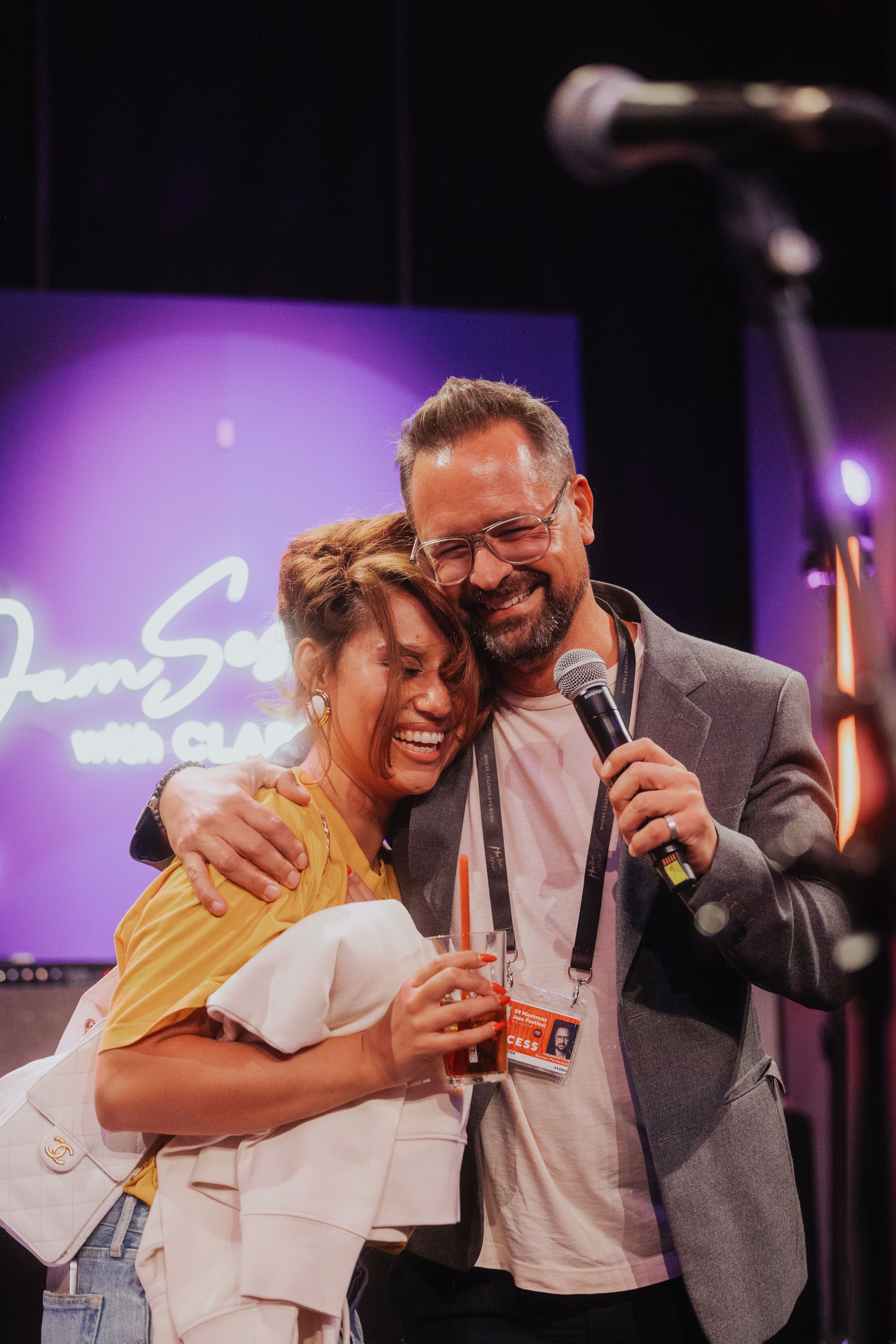 Mathieu Jaton with RAYE Interview Image by Lauriane Vega
“The biggest risk for promoters is to think with their ego.”
Video
