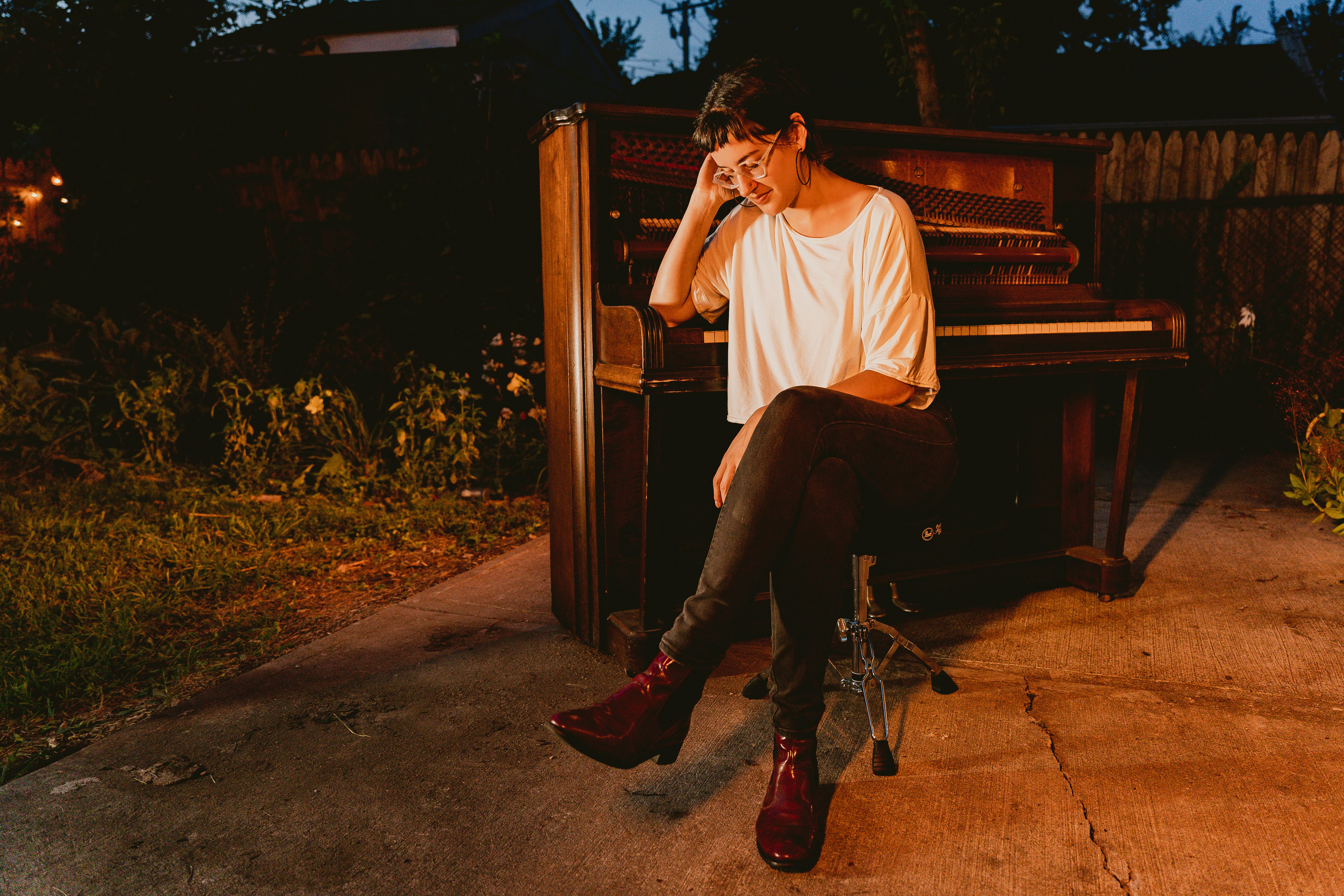
Published
Part 1
Name: Sophia Vastek
Nationality: American
Occupation: Composer, pianist
Current release: Sophia Vastek's new album Alight! is out September 4th 2026 via Hout. It features herself on piano and synths as well as Sam Torres (saxophones, tape delays, drum programming, guitar, synth, percussion), Clarice Jensen (cello), and Spencer Zahn (electric bass).
Recommendations for Troy, USA: Check out a show at the Troy Savings Bank Music Hall! For a small city of our size, we are incredibly lucky to have an institution of its caliber in our downtown. It's a historic venue that has had the likes of Sergei Rachmaninoff, Vladimir Horowitz, Keith Jarrett, and countless more on its stage. It's also renowned for its acoustic and was the preferred recording location for the New York Philharmonic, among many others, for decades. Having heard all kinds of music there, and also performed there, I can attest to just how special the acoustic is. But even more importantly, the people who run the venue are deeply kind, receptive, and open to collaboration. That's really where its specialness comes from. There are stagehands who have worked there for decades, and the love they have for the venue is truly palpable when hearing them tell their stories. Each person who works and volunteers there is devoted to that space. It's infectious. It makes touring acts fall in love with the venue, which in turn makes for extraordinary concert experiences.
[Read our Spencer Zahn interview]
[Read our Clarice Jensen interview]
If you enjoyed this Sophia Vastek interview and would like to stay up to date with her music, visit her official homepage. She is also on Instagram, and bandcamp.
The borders between producers, sound artists, and even songwriters are becoming increasingly blurry. What does being a composer mean today, would you say?
Having come up in the classical music world, I've truthfully had to undo quite a bit of baggage around the word "composer".
I was trained as a performer, and there was never any expectation that I would also compose. It just never came up. So when I first started composing, I did so under personal duress. I had so much imposter syndrome: that I didn't have the right to call myself a composer because I hadn't studied it and that I didn't know what I was doing. But I did it because I had to, because I felt very strongly that my own music was what was missing from my creative voice.
With that background in mind, I would say that a composer is anyone who brings sound into existence and organizes it in time. I think it's a state of mind.
For example, if a producer thinks of themself as a composer, then they're a composer. They might be arranging the music, or adding musical elements. They're often heavily involved in the creative process, and perhaps also an important part of the compositional process. But more importantly, it's whether they wish to define what they're doing as composing. Who are we to judge that?
I came up in a world that defined people in very strict terms and I just don't believe that's a helpful (or healthy) way to go. Are you bringing music into existence? That's composing.
Many people perceive classical music and contemporary composition as having high barriers of entrance, both for listeners and musicians. What have your own experiences been in this regard?
I've been on both the performing and presenting side of classical / contemporary music. Yes, that's a feeling that some people have.
And unfortunately, I've seen many institutions try to make up for this by pandering to audiences (in my opinion). They do this by adding ill-thought-out multimedia components, by adding alcohol or a "party"-like atmosphere, by dumbing down the repertoire, etc. I think the point is that institutions aren't actually interrogating why someone might feel the music isn't for them in the first place.
My experience is that audiences respond to being trusted. They respond to complexity and nuance. They respond to high-quality experiences. That doesn't mean you can just be obtuse and overly academic. You have to find a way to let listeners in. You have to create a space where listeners feel safe to have their own experience. You can't tell them what to feel. But if you open a door for them, listeners will usually come along with you.
My husband and I host concerts in our home. We host both touring and local musicians, and many of the artists who come through are adventurous, experimental, or working in between genres/styles. This is on purpose of course, it's what we're drawn to. We've been doing this for years and our listeners have developed into a steady, regular audience. Many of the people who come are our neighbors, non-musicians, people for whom these are brand new listening experiences.
I'm thinking of one neighbor in particular who comes to almost every show. I'll ask him what he thought after and he'll be honest with me if it wasn't for him. But he keeps coming, and sometimes he's surprised by how much he liked something. I like to think that we've fostered an environment where people are willing to try something new. We've worked hard for that trust.
Because so many neighbors come to these shows, they turn into community events. We've been told how much people enjoy coming because they know they'll feel comfortable. I think it's a bit easier for us to foster this kind of environment because it's our home, but we're also very intentional about making sure that people feel safe and welcome. And I believe that goes a long way in breaking down some of the barriers to this type of music.
Where do most of your inspirations to create come from – rather from internal impulses or external ones? Which current social / political / ecological or other developments make you feel like you need to respond as an artist?
I don't see my internal impulses as separate from external. Just like I don't see my work as a musician as being separate from my personal life. One of the reasons I adore instrumental music is that it has the potential to exist in this liminal space where it can mean anything to anyone.
Reactive music doesn't come naturally to me -- meaning, it's quite rare that I sit down with the feeling that I need to write music about x. Most of my music starts from a place of free association and improvisation, and then as I continue to work on it, it starts to form meaning for me. It's like a marble sculpture: starting with a slab and then whittling away until the form is revealed through the process, except I don't know what the form is going to be until I get there. It's meditative in that way.
I try really hard not to impose pre-conceived ideas about what the work "should" be, especially when I'm early on in the writing process and just getting to know the piece.
"Through the Smoke We See Each Other" from my new record Alight! is one example of an exception to this. I wrote it on a day when our sky was filled with a sickly dark orange smoke from Canadian wildfires. I was overcome with grief about the state of our planet, and I started playing the piano. But speaking of the marble sculpture, as I began whittling, the song ended up becoming a love song for my partner Sam.
It's funny how emotions twist and turn that way. I was overcome with grief, and then overcome with love and gratitude because I knew I had Sam by my side to see "through the smoke". The external becomes the internal in a never-ending cycle.
Ultimately, I create music because I believe so deeply in its magical ability to connect people. That's the impulse. There's something that happens when bodies in a room are exposed to the same sound waves. Many musicians and listeners alike know this, and it's impossible to articulate. But there's nothing else like it. I believe so strongly that anything that brings people into a shared space, where they're experiencing something together, is a radical act. Especially when that shared space allows people to be vulnerable and sit with their own feelings.
Live music is uniquely built to do just that. It has the power to build community -- community in the truest sense of the word -- through shared experience. I believe it's an enormous responsibility as an artist, because community is about reciprocal action. Musicians can't just take from audiences, we also need to give back and care for our listeners. That circle is what creates lasting bonds.
That's my reason. That's the impulse.
Tell me a bit about the sounds & creative directions, artists & communities, as well as the colleagues & creative hotspots of your current hometown, please. How do they influence your music?
I live in Troy, NY and have since 2018. My husband and I bought a strange building here and have put down roots. We absolutely adore it here and have no intention of leaving anytime soon unless something happens to change our trajectory.
It's a small city in a small region, so it's not as artistically saturated as nearby regions with larger populations. But there's a lot of enthusiasm and mutual support that happens within artistic communities here. You can truly experiment here, try something scary and brand new, and have a great audience turn out for it. And you can probably even get some institutional support for it. So in some ways, it's a terrific region for incubation. This area has deeply influenced my music because I've never felt more free to pursue new creative directions.
We also have true community here. We have neighbors and friends that we can call on at a moment's notice if we need something. And we have neighbors that heavily lean on us. I don't think I really understood what "community" meant until we moved here and it became geographically centered for me. Bonds are formed when you run into people on the street, when you have haphazard encounters, when you make last-minute plans. Bonds are formed when you're inconvenienced because your elderly neighbor needs you to pick up their prescription from the pharmacy. Bonds are formed when you alternate shoveling each other's sidewalks after a snowfall.
I say all this because I think that sense of belonging and mutual reciprocity has impacted my music as well. I don't know if I can really articulate it, but I think it has to do with a sense of security about where I am, how I'm spending my time, and with whom. I feel immensely supported here. There's no way that wouldn't have a positive impact on my work.
How much potential for something “new” is there still in composition? What could this “new” look like?
Well, I'll start by saying that I think the pursuit of "new" is a fool's errand. Maybe it exists in a technical sense? Maybe someone could potentially create something that truly has never been done before. But I'm also not sure I really believe in it.
The word "new" has a sort of icky feeling to me. If there's a hierarchy of composition, "new" is at the top, right? Everything else is a little bit lesser, because it's not as innovative? Culturally, we reward innovation, but at what cost?
In my mind, the word "new" often has a sneaky way of erasing the history, the influences, and the journey that it took to get there. Nothing's made in a vacuum, so how could anything be truly new? All art is the culmination of villages upon villages of creators who have pushed boundaries and created work out of nothing. We are nothing without those who came before us and those currently around us.
I think I've just talked myself out of believing there's the potential for anything new. And it's a beautiful thing.