

Published
Name: Poiesis Quartet
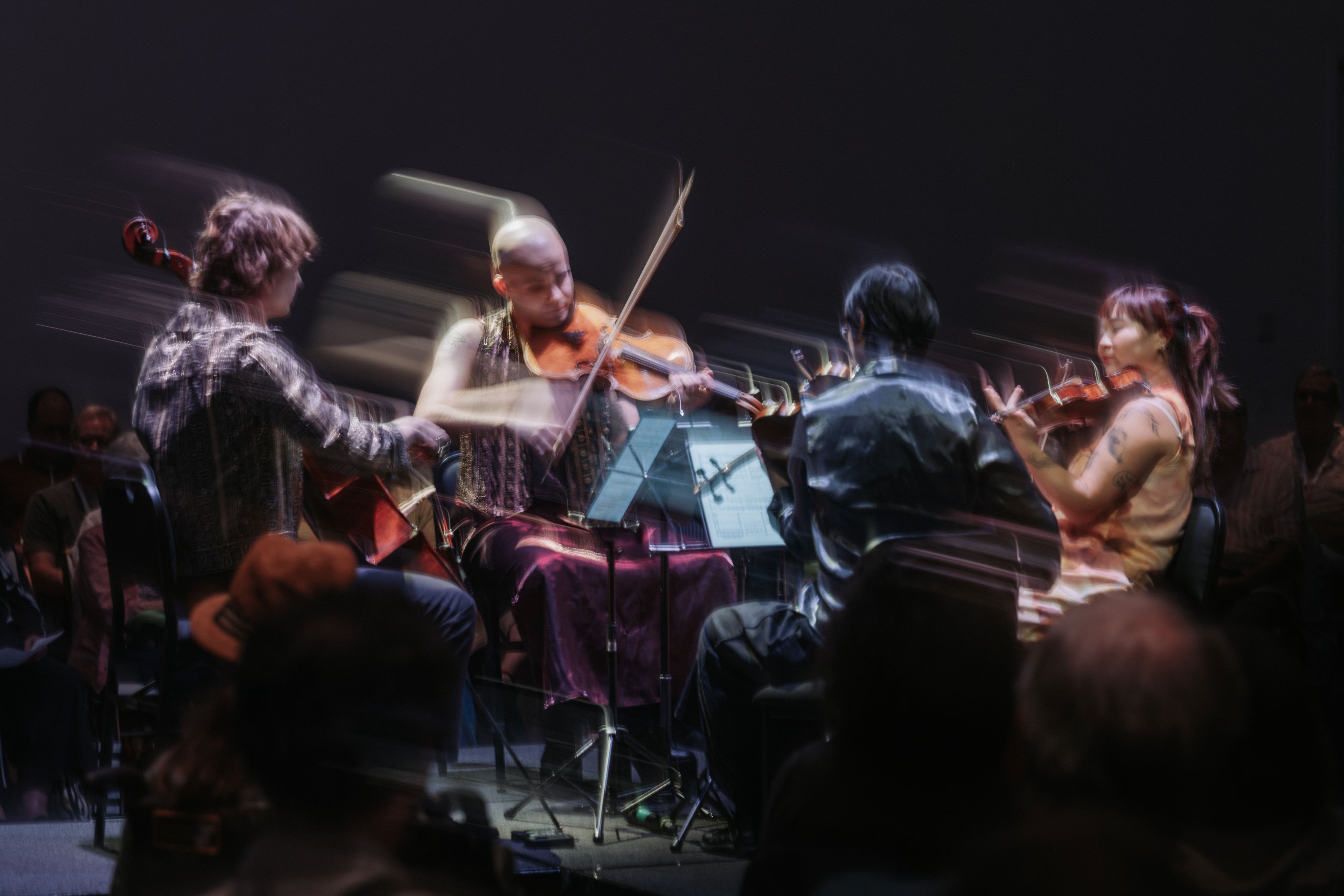
Members: Sarah Ying Ma (violin), Coco Mi (violin), Jasper de Boor (viola), Drew Dansby (cello)
Nationality: American
Current release: The Poiesis Quartet's new album Surfacing is out October 16th 2026 via Bright Shiny Things.
Hometown Recommendations: We are Ohioans at heart!! We were founded at Oberlin Conservatory and then spent two and a half years in residence at the University of Cincinnati. We’re big foodies – in Oberlin we live, breathe, and die for Thini Thai, and in Cincinnati we love LALO, Milkman, and Sichuan Palace.
We’ve recently relocated to Philly and would love to hear your recommendations for spots there!
If this Poiesis Quartet interview piqued your interest, and you would like to know more about the ensemble and their music, visit their official homepage. They are also on Instagram, and Facebook.
Which artists, approaches, albums or performances captured your imagination in the beginning when it comes to the art of interpretation?
We’re super inspired by genre-flexible quartets such as the Kronos, Attacca, and Aizuri quartets, among many others. Our musical interpretations have also been very deeply influenced by a wide array of mentors and coaches, which have included members from all different types of ensembles from the Pacifica Quartet to Eighth Blackbird.
[Read our Matthew Duvall of Eighth Blackbird interview]
[Read our Pacifica Quartet interview]
When we play works by living composers, our artistic choices are primarily guided by collaboration and discussion directly with the composers we work with and/or commission.
In 2024 and 2025, we gave the world premieres of two works on our album by composers Brian Raphael Nabors and Kevin Lau. Preceding their respective premieres, we loved meeting with the composers on Zoom to talk about their inspirations and story, emailing back and forth, discussing arc and story structure, sending clips of us playing for their feedback, and also workshopping with Kevin in-person.
Composer-performer collaboration is one of the most rewarding and exciting things we get to do!
How much creativity is there in the act of interpretation? How much of your own personality enters the process?
For us, rather than aiming to ‘blend’ four voices together, we really like to encourage individual voices and personalities to shine through.
We each have fiercely independent and unique perspectives, and when we come together, we’re met with a beautiful opportunity to experiment with finding techniques which allow all our differences to intertwine.
We feel strongly that by interpreting music guided by instincts, we can create entirely new and unexpected pathways towards a united front in our sound.
Could you describe your approach to interpretation on the basis of a piece, live performance or album that's particularly dear to you, please?
One of the most interesting pieces of music we’ve come across has been Sky Macklay’s ‘Many Many Cadences’ because of the remarkably thoughtful theoretical basis for the composition combined with an underlying cultural criticism, all presented with witty humor.
With a teasing spin challenging Western European harmonic tradition, this piece features glacially-slow sliding cadential sequences sandwiched between outer sections of lightning fast random cadential cascades in precise unison, all wrapped in a humorous and witty conversation between players.
When we first started working on this piece, we spent hours a day over the course of several months combing through each harmony, tuning every single note and resolution, tapping/stomping the rhythms, and allowing ourselves to lean into the tension-and-release of all the cadences in the score.
As we sped up the tempo over time and started getting more comfortable with the music, this rigorous slow work on intonation and harmonic awareness created a great foundation for us to play around with stroke, articulation, and pacing in performance.
We took this slow and steady approach because we knew going into this piece that as an ironic response to Western traditional harmonic progressions, the theoretical basis of the piece required us to ground our interpretation within an understanding of resonance and release.
Artists can return to a work several times throughout the course of their career, with different results. Tell me about a work where this has been the case for you, please.
Coleridge-Taylor Perkinson’s String Quartet No. 1, “Calvary”, from our album Surfacing is certainly a developmental and formative work for us. The first time the four of us ever played together over four years ago, we sightread this exact quartet and improvised.
As we continued to build a career together over the next several years, we loved taking ‘Calvary’ on tours across Europe and North America because the work’s roots in jazz, gospel/spiritual, and other Black American genres requires an implicitly improvised approach. This meant that every single time we played it, the music encouraged us to groove, improvise, and sing together in a different way.
In 2024, we wanted to take the music further and honor the African-American spiritual which inspired Perkinson to compose the quartet: ‘Calvary’. Our second violinist at the time, Max Ball, arranged the sorrowful and lamenting spiritual for four violins, smoothly transitioning into Perkinson’s writing for the standard quartet formation.
Performing the arrangement together with the quartet allows us to play around with our sounds in a different instrumental configuration and grounds the rest of our performance deeply within the spiritual’s history, including religious signification and the fight for abolition & liberation.
We were so excited to be able to record this on our album alongside Perkinson’s quartet and provide the added perspective of the foundational spiritual ‘Calvary’.