Published
Name: Matheus Lodewijk aka LudoWic
Occupation: Composer, performer, Trautonium player
Nationality: Dutch
Recent release: LudoWic's new album NUNC STANS is out November 13th 2026 via Wic.
Tool of Creation: Trautonium
Type of Tool: Synthesizer
Country of origin: Germany
Became available: 1930
If you enjoyed these insights about the Trautonium and would like to find out more about LudoWic's work, visit his official homepage. He is also on Instagram, tiktok, bandcamp, and Facebook.
For a deeper dive, read our LudoWic interview.
Obviously, since the early days of the Trautonium, electronic music's role in music culture has changed significantly. Today, most genres of music make use of electronic production means. What does the term “electronic music” mean today, would you say – do you feel as though its omnipresence has diminished its potential in some form?
I think the term electronic music has almost lost its original meaning today. Electronics have become so deeply integrated into virtually every form of music production that the distinction between electronic and non-electronic music is becoming increasingly irrelevant.
For me, the essence of electronic music lies not so much in the technology you use, but rather in the way you approach sound. It is about the possibility of treating sound as a material: something that can be shaped, distorted, stretched, dissected and reassembled.
In that sense, a single electronic tone can feel just as organic to me as the sound of a cello or the human voice.
What was your first encounter with the Trautonium? What was it about it that drew you in?
My fascination with the Trautonium actually began when I came across a concert recording of Oskar Sala on YouTube (1991, at the Stadthalle Osnabrück). I heard something that I found difficult to place. It sounded both familiar and completely otherworldly, as if I were listening to a memory of something I had never experienced before. The instrument seemed not so much to produce a sound as to possess a presence of its own.
Watching that video on YouTube was a real blinding-light moment for me. From that moment on, I knew that the Trautonium had to become my instrument. I subsequently got in touch with the instrument builder Jürgen Hiller, who has since built several Trautoniums for me.
Now, several years later, I feel completely connected to this instrument. There is such a direct relationship between my physical movements and the sound that emerges that the result feels much more personal and emotional.
Just like any other instrument, the Trautonium has a rich history. What are some of the key points from this history for you personally?
What particularly fascinates me about the history of the Trautonium is that the instrument emerged at a time when the possibilities of electronic music had barely been defined.
Friedrich Trautwein developed it around 1929, at a time when composers and inventors were beginning to question whether music could extend far beyond traditional instruments. The collaboration with composer Paul Hindemith was an important moment in this history.
But Oskar Sala is, of course, the true hero of this instrument. He was responsible for an enormous number of significant moments in the history of the Trautonium, of which the soundtrack for Hitchcock's The Birds is perhaps the best-known example.
He not only further developed the instrument's technical possibilities, but also demonstrated the extraordinary expressive depth hidden within it.
What I find perhaps most remarkable is that the history of the Trautonium is not a closed chapter. It is an instrument that largely faded into obscurity for several decades, yet its musical possibilities have still not been fully explored. I therefore do not experience playing it as operating a historical museum piece, but rather as continuing a conversation that began almost a hundred years ago.
What, to you, are some of the most interesting recordings and -performances by other artists featuring the Trautonium?
Oskar Sala's work is, of course, one of my most important points of reference. His album Subharmonische Mixturen in particular.
I would also like to mention the work of Paul Hindemith, especially Des kleinen Elektromusikers Lieblinge from 1930.
These are seven short trio pieces for three Trautoniums, performed by Oskar Sala, Rudolf Schmidt and Hindemith himself.
To me, this work truly represents the transition from traditional acoustic music to electronic music.
Today, electronic music has an interesting relationship between honouring its roots and exploring the unknown. What does the balance between these two poles look like in your music?
I think my music constantly emerges from the tension between recognition and alienation. I feel strongly drawn to instruments and sounds that carry a history of their own. Vintage synthesizers, analogue equipment, tape delays and instruments such as the Trautonium all carry a certain cultural and emotional weight.
At the same time, I am not interested in reconstructing a particular era or romanticising the past. Rather, I want to explore what happens when you place these historical sounds in a new context. Perhaps you could compare it to looking at an old photograph. You recognise something, but at the same time you know that you can never fully return to the moment in which that photograph was taken. I find that distance interesting.
In my music, I am not trying to reproduce the past, but rather to give it a new future, so to speak. For me, innovation does not necessarily come from leaving everything behind. Sometimes you have to dig deeper into something old to discover something that has never been heard before.
What are some of the instrument's stand-out features from your point of view? How would you describe its sonic potential?
What I find most remarkable about the Trautonium is the direct relationship between touch and sound. Unlike a traditional keyboard instrument, you do not play a collection of individual keys, but rather a resistance wire that allows you to control pitch almost continuously.
As a result, the traditional distinction between individual notes begins to disappear. You can literally move between the notes. This gives the instrument an enormous degree of expressive freedom. I am particularly drawn to the possibility of physically influencing pitch, dynamics and timbre so directly.
The instrument therefore feels less like a machine reproducing a predetermined sound and more like a living organism which you enter into a dialogue with. I think this very unpredictability is an essential part of its beauty.
Tell me about the process of learning to play the instrument and your own explorations with it.
Learning to play the Trautonium was, above all, a process of learning to listen differently and temporarily letting go of the musical knowledge I had already acquired.
There are no teachers or established methods for this instrument, so you have to develop your own approach to making music with it. You cannot simply transfer your piano or synthesizer technique to the instrument either. The way you approach and shape a tone is fundamentally different.
In the beginning, I was mainly focused on discovering its physical possibilities and exploring the relationship between my movements and the sounds that emerged from them. Gradually, I realised that it was important not to think too much in terms of existing musical structures. I did not simply want to learn how to play certain notes or melodies, but rather to explore what the instrument itself was asking of me. Sometimes the most interesting moments emerged precisely when I allowed myself to let go of a little control.
Through extensive experimentation, listening and trying again, my own playing technique slowly began to develop. I think this process never really comes to an end. Every time I play the instrument, I discover something I had not heard or noticed before. Perhaps that is its greatest attraction for me: the feeling that you can work with an instrument you may never fully understand or master.
Tell me a bit about the interface of the Trautonium – what does playing it feel like, what do you enjoy about it, compared to some of your other instruments?
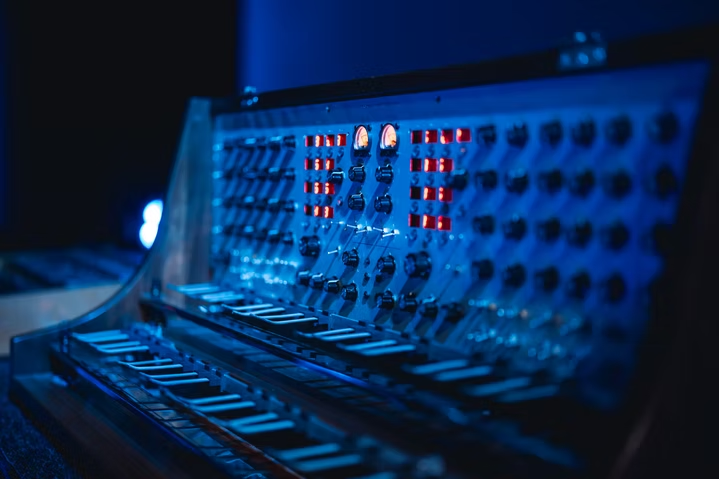
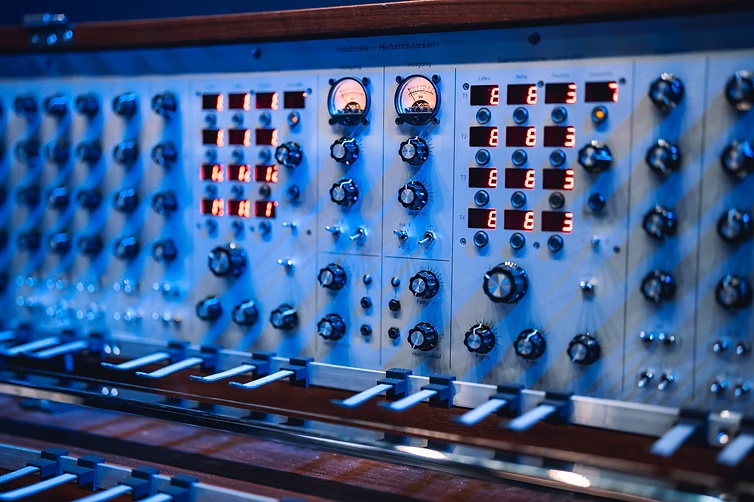
The basic interface of the Trautonium is actually very simple, yet remarkably expressive.
You play on a metal resistance wire stretched across a playing surface. By touching the wire, you determine the pitch. What makes this interesting is that you are not restricted to the fixed intervals between keys, as you are with a piano or most synthesizers. You can move continuously between pitches and make extremely subtle adjustments. This makes the physical experience of playing very direct. You can almost literally feel how a tone emerges and develops beneath your fingers.
The Trautonium has something intuitive about it, yet it is also challenging, because even the smallest movement can become audible. Compared to my other instruments, it feels less like operating a device and more like playing a living organism.
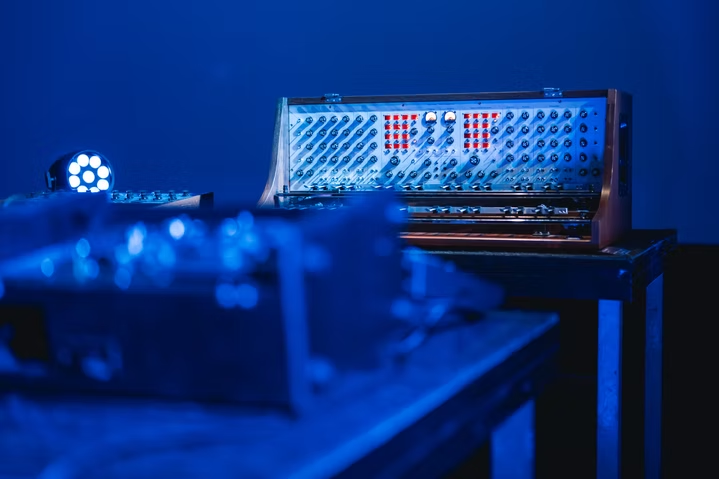
The Mixtur-Trautonium also works with subharmonic tones. Through its subharmonic oscillators, you can select a series of subharmonics, creating a harmonic cluster or chord. You can combine several of these series and switch between them using foot pedals. This creates an incredibly rich harmonic palette, which is what makes the instrument so unique.
What are specific challenges in terms of playing the Trautonium?
Perhaps the greatest challenge is that the instrument constantly confronts you with your own sense of precision.
Because you are not working with fixed keys, you have to develop a much more direct control over pitch and intonation. Even a small movement can make a significant difference. This requires a different kind of concentration and physical awareness than many other electronic instruments.
Working with subharmonic harmonies is also particularly challenging, because it operates in a completely different way from traditional harmonic theory. As a result, I rely more on my intuition than on my existing musical knowledge.
The instrument is also not always very forgiving. You cannot simply fall back on an acquired motor routine, as you might when playing the piano. You have to constantly listen to what you are doing and adjust your movements accordingly.
But I do not see this purely as a limitation. It is precisely this difficulty that makes the instrument interesting. At a time when many digital instruments are designed to make everything as accessible and reproducible as possible, I find it valuable to work with something that offers resistance. The instrument demands attention, and ultimately that attention becomes part of the music.
What interests you about the Trautonium in terms of it contributing to your creative ideals? How do you see the relationship between your instrument and the music you make?
What attracts me to the Trautonium is that it forces me to think about music in a different way.
I am interested in sounds that do not merely serve a melodic or rhythmic function, but can also create a particular sense of space, emotion or time. The Trautonium has the ability to bring something into existence that is difficult to define. It exists somewhere between the organic and the mechanical, between the human and the non-human.
This closely relates to what I try to explore in my music. I am not necessarily interested in making music that explains everything or imposes a clear direction. Rather, I am interested in creating an environment in which listeners can project their own associations and experiences.
Sometimes the instrument determines the direction of a composition; at other times, the music begins with an idea that I then try to explore through the instrument. I find this interaction essential. I want the instruments I use not merely to execute what I already have in my mind, but also to surprise me and lead me towards new ideas.