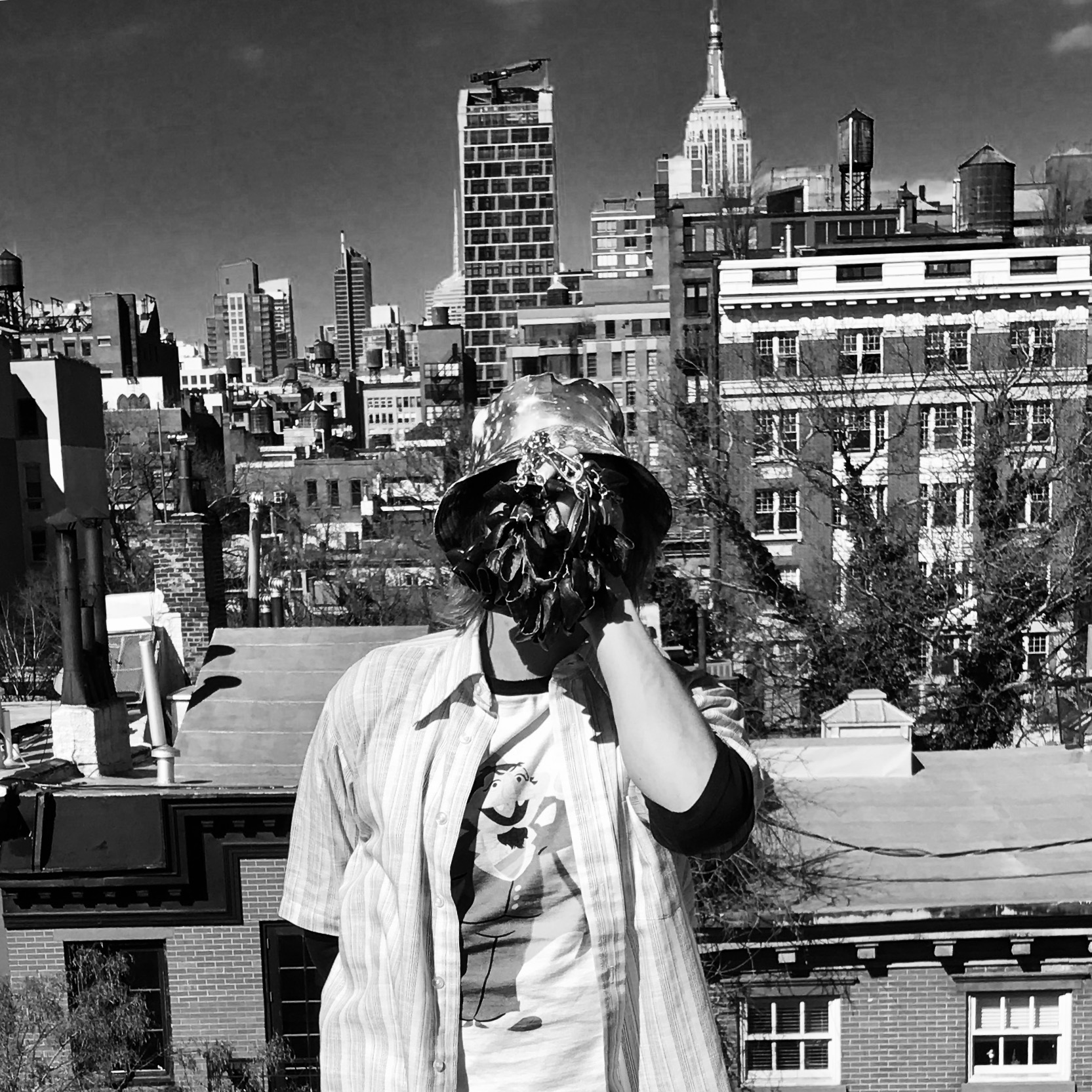
Published
Name: Trent Moorman
Nationality: American
Occupation: Writer, editor, composer, drummer, sound artist
Current release: Trent Moorman is a long-time collaborator of Lusine and featured on the latest Lusine album, Melting Days, out now via Melting Days.
If you enjoyed this Trent Moorman interview and would like to know more about his music and upcoming live dates, visit his official homepage. He is also on Instagram, and Facebook.
[Read our Lusine interview]
[Read our Lusine interview about Melting Days]
It seems as though most aspiring artists are drawn to the drums and percussion for one of two reasons: Creating sound/noise and creating rhythm. What captivated you?
I think it was the synchronization. Or the physical expression of that synchronization.
Then I heard “YYZ” by Rush, and my mind was completely blown. I think I listened to it for like 16 hours in a row.
Then discovered James Brown / Clyde Stubblefield. Those rhythms levitated me off the ground. Still do.
What was your first drum set like and what are you using today? What, to you personally, are factors in terms of build and design that you appreciate in drums and percussion instruments?
My first drum set was a double kick drum kit in Athens, GA where I was in school. A hodgepodge kit. Never had a lesson. Had no real idea how to set it up or tune it. It was red and black with Speed King pedals. I had no business trying to play double kick drums.
Today I play a maple Pearl kit. Love my Ludwig Supraphonic snare. I also have Roland Spdsx drum pads and like to get the hybrid thing going. I love dialing up the 808 hi-hat and kick drum, with my Supraphonic snare. The cross up of drum pad/real drum renders cool textures.
With Lusine it’s a lot of shaker type percussion. I like making my own with chains and escutcheons (that’s eh-skootch-ons). Upcycled Percussion out of Portland makes the best stuff. Scrabble letter tile shakers, gambling chips, milk jug lids, bottle caps. I like to gather a few of them in my hand and use that on the snare instead of a stick. It meshes well with Lusine’s beats.
Also the sound of the negative space when I pull up off the snare gives a shade or breath to the electronic beats I’m playing with.
How did you and Jeff start working together?
City Arts Magazine in Seattle asked us to play together as part of an event in 2014 where they paired artists and performers from around Seattle. Thanks to editor Jonathan Zwickel.
I was a big Lusine fan before that.
Have you worked on studio recordings of percussion with Lusine?
Yes, at Graig Markel’s Recovery Room Studio in Seattle. Graig is a great, quick, wise engineer. I love it there. He also makes incredible effects pedals with Recovery Effects. He’s a wiz.
Jeff and I also did a day not too long ago, recording in a large barn / music room in Kingston, WA. We had two field recorders and got all kinds of sounds and experimented with placing the recorders in different set ups, closer and farther away. I’m excited to hear that stuff.
I also like to bombard Jeff with random things I record. Like I was in a garage in Ponte Vedra Beach, FL and there were old, rusted metal sheets and a big sea kayak and a tin bucket with marbles and dice. I went to town in there. Also wooden bocce balls in a polyester bag. It was heavy with all the balls in there and sounded cool when I lifted up quickly. It’s a ‘gather’ technique I honed especially for Lusine percussion. The way those aged bocce balls crack against each other in the humid Ponte Vedra Beach air is an exclusive Lusine sound, haha.
Wherever I am, if I hear an interesting sound, I’ll try to record it for Jeff. I’m always hitting random objects to see what they sound like. So Jeff will get a text from me with a .wav file of some sound saying, “Hong Kong, Train Track, Tree Limb.” And it’s from me whacking a train track with a tree limb at Victoria Peak in Hong Kong when we played there.
For the session at Recovery Sounds, Jeff fed me a bunch of loops he’d made and recoded me playing to them. I varied patterns, shakers, feels, snare drums, and objects to give him a smorgasbord of sounds and beats to choose from.
How do you approach working with Lusine for live performances?
I try to fit into his frequencies, to be inside the frame of what he’s putting out. I try to match and sync so beats are given a dimensionality. Like a double exposed photo. He’ll give me direction if and when something’s changing or evolving a section. I use no rack toms.
Dinging sounds and clangs are key. I found a big Y-joint plumbing pipe in a small Tokyo shop. Very heavy, but it’s the best ‘ding’ I’ve found yet. But flying international back to the States with this heavy plumbing pipe in my suitcase, is not ideal. If you’re ever needing to find a good percussion dinger, don’t forget the plumbing shops.
I can usually find various dingers in whatever city Jeff and I are playing in. Brooklyn is easy. In a pinch, Ace Hardware usually has you covered for your percussion dinging needs.
How did your approach differ when drumming to the live set for Melting Days as opposed to his other live sets?
For me, the Melting Days set is more like a film score. More subdued and sparse.
Jazz wire brushes on the snare work well in sections. A mallet pulse on the floor tom. Very little kick drum. Dinging time rotating with those clangs on “Bird’s Eye.”
What is your approach for visual content for his live sets and how did the visual content differ for the Melting Days performance?
Lusine’s music has always been visual for me, so making videos to project while we play is / was very natural.
I like drone footage of cities at night, black and white, and mirrored. It gives the rigid architecture an organic feel. Which for me fits Lusine’s music. I like to layer footage and try to render something ambiguous. I’ll take drone footage of a highway at night, and the shape of the road can look like a blood vessel with headlights from the cars as corpuscles flowing through the vein.
For Melting Days, Jeff wanted me to play with the cover art by Michael Cina. It’s like aerial surveillance footage of arctic tidal basins. So I cut out shapes from the album art and messed with them in After Effects using EFEKT Studio’s xCloner plug-in across linear, radial, and grid modes.
How has technology, such as drum machines and sequencers, impacted the way rhythm is created and perceived? Has it been a concrete influence on your own approach?
I think sequencers and drum machines are a really fun way to make, experiment, and develop beats and sounds. It absolutely has influenced my approach.
With Lusine, I wear in-ear monitors. I need to have his beats cranked in my head so I can play to them.
But the in-ears sort of insulate you from the sound of what you’re playing. Some drummers hate that. I’ve gotten so used it. It’s more a physical / feel based thing, as opposed to an audio / hearing based method. To be in sync is the end goal.
Many recording engineers have remarked that the drums can be particularly hard to capture. What makes drums sound great on record and in a live setting?
Good question. Knowing the room, mic placement, getting comfortable with that. I think a lot of the great recordings happen because the drummer and producer are comfortable. Not much good can happen when people are forcing an uncomfortable thing.
I love the story of Bonham recording the drums for “When the Levee Breaks” at the bottom of a circular stairwell in the mansion where they were. Mics were hung from above and it was he and his engineer or producer just playing around with a delay. Then they hit on that sound and those settings, and it was gold. Bonham also tuned his drums really well and hit the crap out of them.
Which of the finished pieces surprised and/or thrilled you most on Melting Days – and why?
“Intruder” surprised me live. I do jazz wire brushes on the snare there, and found myself alternating between a marching band progression and a drum break swing around the beat. Really enjoy playing that one live.
It hits an apex with the visuals I made, and for me had this audio / visual culmination.
Rhythm is clearly important for Lusine but on this album, it seems to take on different roles other than just “propulsion. I asked Jeff about this, but would be curious how you, as a drummer, see this?
It’s an uncoiling for sure. Or unfolding. What you hear at first becomes something else. Again, very much a film score for me.
Tendrils of the beats pulse and fade and trace and sift. His beats move with a doppler trajectory. Going by you at one pace closer up, and on the other side, further away, they take on this shape you didn’t see when it was right in front of you.
The working sequence of his gears reveals itself way out on the horizon line, then is gone. It all has this giant velocity.
What makes a really great loop for you? What, to you, is the main difference between repeating something in a loop or physically playing the same lick over and over again?
How it evolves. Where does it go? Does it draw you in? Or is it just repeating?
If it shows you something new within the parameters of the loop, that’s the trick. Moving within the beat that’s there, with divisibility. I want it to develop and make people move, but not overdo it.
What are these shows like – is it more of a meditative affair (the way the album works for me, for example) or does it have more of a club feeling?
In Seattle we did two sets. Which I loved. An ambient set and an upbeat set.
The ambient was definitely more cerebral / meditative. More textural. I wanted to place the sounds off in the distance, where Jeff’s rhythms unveil themselves more, as weird as that sounds.
The upbeat set is more physical. More propulsive. More exertion from the core to sync within the engine of Jeff’s beats.