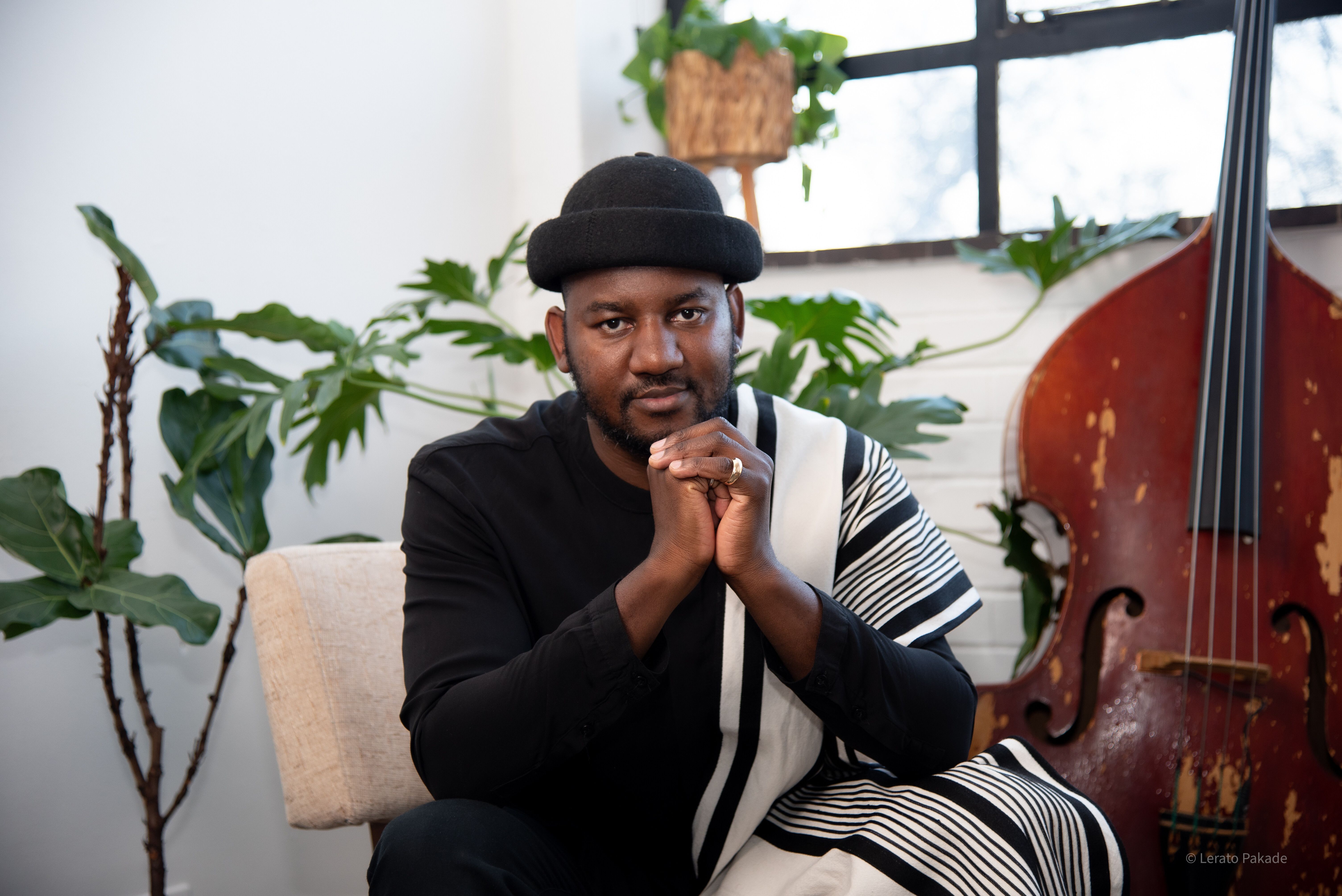
Published
Name: Thembinkosi Mavimbela aka Vimbs Mavimbs
Nationality: South African, Germany-based
Occupation: Double bassist, composer, bandleader, producer, musical director
Current release: Vimbs Mavimbs's new album Late Bloomer is out via Unit.
Shoutouts: A very special thank you to Unit Records & La Reserve Records who continue to support progressive jazz music. There’s an amazing team in South Africa who are doing amazing things called 2410 Management, don’t sleep on them. The local culture is nothing without its people, shout out to Kids Love Jazz. In Hamburg, a special thank you to the Jazzbüro, Jazz Federation and the Hochschule fur Musik und Theater.
Recommendations for Johannesburg, South Africa: You have to attend a Braai with a 7 color meal and visit the Untitled Basement.
Topic that I am passionate about but rarely get to talk about: I have special love for permaculture
If you enjoyed this Vimbs Mavimbs interview and would like to stay up to date with his music, visit his official homepage. He is also on Instagram, Facebook, and bandcamp.
What were some of the musical experiences which planted a seed for your interest in jazz?
There is something very special that promoters do when they take risks when they curate a special performance in the most unconventional space and area.
When I was in high school, we had a big performance by Oliver Mtukudzi at the community I grew up in at the Sports Ground in Mshadza. He delivered a stellar performance that broadened my interest in jazz.
What does the term jazz mean today, would you say?
Jazz has become an institution of learning, a language of communication. A place to acquire knowledge on endless possibilities of a varied techniques and tools. It comes with its own traditions and hierarchies.
To me, jazz is an ever evolving language that finds its ways to recycle ideas to make new meanings to our generation, communicate unspoken thoughts, feelings, ideas, stories and etc.
As of today, what kind of materials, ideas, and technologies are particularly stimulating for you?
I have always been interested in acoustic instruments with a blend of electronic sounds. Lately I’ve been looking into alternative tools to experiment on such as Max Msp, Touch Design, Pedals, Stage Performer.
Electronics tend to mimic the acoustic sounds that we tend to subconsciously ignore in our daily lives such as metal friction, wood cracking and etc. These sounds have always been part of our experiences and using alternative technologies affords me the opportunity to reimagine these sounds in my mode of communication.
Where do most of your inspirations to create come from – rather from internal impulses or external ones? Which current social / political / ecological or other developments make you feel like you need to respond as an artist?
The nature of creating is an ever evolving process and each season is different with its own length. Currently, I have been responding to displacement and meanings that I have been digesting. Being far from home and yet making a new home within the complex displacement.
Notions of welcome are on the tip of my tongue, scrutinizing my presence in a foreign country and trying to establish whether my presence is being tolerated. The energy is totally different from a public display of a concert that comes with an artistic prowess. How much of self motivation does one need to do to make sense of this isolation?
I am influenced by the environment of the past, present, future and these always fluctuate based on seasons.
Tell me a bit about the sounds & creative directions, artists & communities, as well as the colleagues & creative hotspots of your current hometown, please. How do they influence your music?
I come from a rich diverse artistic culture that spans over decades of innovative modes of expressions.
The voice has been at the heart of it all, dating back as far as Princess Constance Magogo kaDinuyulu, Nofinishi Dywili, Reunen Caluza, Mam’ Madosini who influence the backbone of the evolution of musical styles and genres in South Africa.
The world got to a manifestation of great musicians such as The Manhattan Brothers, King Kong (the musical), Dr. Miriam Makeba, Dr. Hugh Masekele, Dr. Abdullah Ibrahim who were in the forefront of South African’s sonic fabric.
This is just a glimpse into the broader available music that influenced my understanding of music.
To fast track some of the sounds and possibilities, leaving a few musical influences such as Kwela Music, Mbaqanga, Isicathamiya, Bublegum Music , Gospel that later influenced Kwaito and currently Amapiano. Jazz was always at the center, with the likes of bra Zim Ngqawane, Bheki Mseleku, Busi Mhlongo.
All the above are a calumniation of the current sounds in South Africa such as Dr. Nduduzo Makhathini, bra Andile Yenana, bra Herbie Tsoaeli, Sisonke Xonti and many more.
[Read our Nduduzo Makhathini Interview]
There is a strong sense of jazz awakening with the movement such as Kids Love Jazz, uManyano Lwe Jazz, The Vibe and many more.
This is the current culture that is calling and reimagining South African sounds and expanding the love for live jazz music.
What role do electronic tools and instruments play for your creative process?
Technology always has its challenges and resistance, but I think technology has allowed for new opportunities of sounds. As the world evolves, so, too, should sound and technology.
I do love the blend between acoustic instruments and other related electronics such as pedals, synths, etc. I grew up listening to a blend of these instruments and they have influenced me a lot.
Jazz has always had an interesting relationship between honouring its roots and exploring the unknown. What does the balance between these two poles look like in your music?
The roots will continue to grow thick as the years progress, whether one has decided on their side or not. These roots give us the opportunity to expand our knowledge of the culture.
There is a danger to every tradition, once practiced for a long time, of leaving less room for innovation and exploration. I try my level best to honor how it makes me feel with less attachment to how its supposed to be. I let sound guide my music as much as I am guided by these unknown explorations. I keep certain traditions of structure, harmony, improvisation, melody but I’m always curious to know what is out there for me to learn and explore.
For now, the Late Bloomer project is a gift that I am proud to share with the world and it has it’s own soul.
How much potential for something “new” is there still in jazz? What could this “new” look like?
Lol, New? I doubt we are doing anything new, but I do believe that there are better ways to package a song to speak for a larger community.
Music has always been a platform to communicate and that communication goes both ways (the composer/artist stories and the consumer/audience). These communications or stories are a gateway for the artist to share these stories and also for the listener/consumer to choose those stories to best describe these shared moments. Once these connections have merged, then this newness of a bond between the artist and their consumers forms a new meaning.
Traditionalist and new music are always in constant battle. At the end of it all, when you are creating a body of work, I/we need to accept the possibility of acceptance and rejection. So, I keep taking risks, listening to my inner voice. Who knows where it will take me.
How, would you say are your live performances and your recording projects connected at the moment? How do they mutually influence and feed off each other?
The recordings are very important to me because they capture a certain moment in my life, the musicians I played with, the energy that was there.
I believe that live shows pay tribute to the studio recording as much as possible but continue to have a life of their own. I am not overly attached to the studio recording and always looking forward to the unknown.
Improvisation is obviously an essential element of jazz, but I would assume that just like composition, it is transforming. How do you feel has the role of improvisation changed in jazz?
The kind of music or collective is defined by the musicians, genre, collective, band, the type of platform that encourages for transformative experiences. There are basic levels of improvisation techniques that you learn formally and informally. Depending on your capacity of your knowledge and platform, band, formation, this platform will change a lot based on the above.
With improvisation, the more you dive into the practice, the more you get to understand how deep and wide the possibilities are.
There is a misconception between free-improvisation and structured improvisation. Understanding these two is a great basis on what could possibly be expected from your involvement. Music is like a pendulum (it swings both ways) and sometimes you find yourself on one end.
What, would you say, are the key ideas behind your approach to improvisation?
Accepting that things that will guide me in the exploration of the universe of endless possibilities. Using basic sense of rhythm, harmony, listening to the collective and being present.
The Montreux Festival intends to preserve its archive of recordings for future generations. Do you personally feels it's important that everything should remain available forever - or is there something to be said for letting beautiful moments pass and linger in the memories of those that experienced them?
In the digital era that information and archive is a commodity. I believe in the preservation of art and if recording is one form archiving, then I support it.
That said, I am definitely in support of exercising presence when watching a show because phones and cameras can come with heavy distraction.
Nothing can ever replace the experience of a show or performance.