Part 1
Name: Yugen
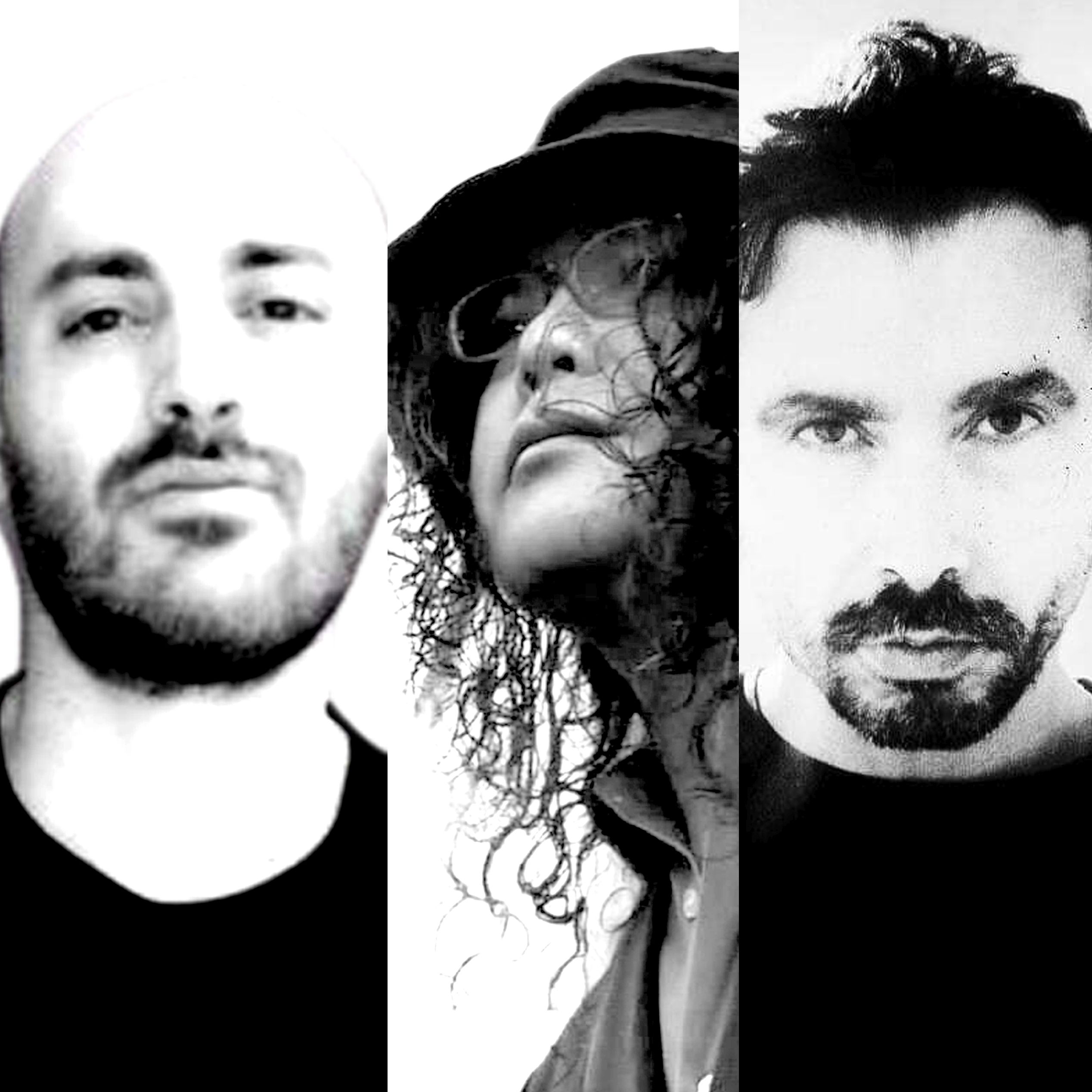
Members: Gianluca Ceccarini (field recordings, synth), Alessandro Ciccarelli (tuba, guitar, percussions, lyre, bass gopichand, xaphoon, coils), Tetsuroh Konishi (alto recorder, trumpet)
Nationality: Italian (Gianluca Ceccarini, Alessandro Ciccarelli), Japanese (Tetsuroh Konishi)
Current Release: Yugen's self-titled album, also featuring Milena Punzi Anfossi on cello, is out via Disasters By Choice.
Recommendations on the topic of sound:
[GC] These days, for a work in progress project, I'm reading Solaris by Stanisław Lem and as I read the various chapters I make notes and pay particular attention to the moments in which the writer focuses on the description of sound events. It's a stimulating and important exercise for those who deal with sound, and it can be done with all novels. Do it with Odissea by Omero or Moby Dick by Herman Melville.
[AC] It is not exactly my field of study, besides Oliveros, Westerkamp, Schafer books I am sure on the World Forum for Acoustic Ecology web site it is possible to find the resources to go deeper.
[TK] The Soundscape Organisation of Japan
[Read our feature on the lyre]
[Read our feature on the lute]
[Read our feature on the trumpet]
If you enjoyed this Yugen interview and would like to stay up to date with the musiucians, visit the official websites of Tetsuroh Konishi and Alessandro Ciccarelli. Gianluca Ceccarini is on Instagram.
Do you think that some of your earliest musical experiences planted a seed for your interest in sound?
[GC] Yes, I strongly believe that any musical experience, even the most disparate and immature, is fundamental for the maturation of a musician or for anyone who deals with sound in general.
For example, when I was very young I listened to a lot of blues and ethnic music, two genres that by their nature go beyond the structure of the song, of tonality and of Western temperament, a characteristic that I now find in the electroacoustic experiments that I listen to and in what I try to do.
[AC] Certainly, when the music is authentic, it expresses an adherence to one's own experience and therefore is necessarily the result of a path. Today's music is the sum of past experiences, not only musical, but of books read, films seen, people met …
[TK] I think so. However, I feel that there is more than one seed in sound and music, but also in many other experiences of my life. Seeds are always thinking, I believe that many have germinated while changing rapidly, connecting to each other as if the neurons of the brain were connected.
Do you experience strong emotional responses towards certain sounds? If so, what kind of sounds are these and do you have an explanation about the reasons for these responses?
[GC] I am fascinated by all the sounds that surround us, both natural and those coming from musical instruments. I have no explanations and I don't try to look for them because as much as I can I would like my personal experience with the sound world to remain just an "instinctive fact".
[AC] The emotional aspect is something slippery in the artistic field, especially in the musical one. What I try to do is "compose inside the sound": the musical work should ultimately express only itself, without needing to represent something. So the piece is not descriptive: it is not an object to be appreciated only from the outside, but it is an input to go inside and live it in contemplation from the inside.
Edgard Varèse said he wanted to be inside the material, to be part of the acoustic vibration. This is certainly a suggestion I always try to keep in my mind.
[TK] There are definitely some things that cause a strong emotional reaction to a certain sound, but often it is the musical structure, the harmony, rather than the sound itself. I am always aware of "wind", "water", "earth", and "flow" when it comes to the sound of the trumpet I play.
Are there places, spaces, or everyday devices which intrigue you by the way they sound? Which are these?
[GC] Everything, really everything that surrounds us is a wonderful potential source of wonderful sounds. Working on my projects I have often recorded in nature, in the woods, at the seaside etc. But I have also archived seemingly banal sounds like the crunching of ice in my fridge or the cracking of a tile on the floor.
[AC] Every sound space or sound event that surrounds us is interesting in itself, even if only for its permanence regardless of our presence. Quoting John Cage, sounds will continue even after us.
[TK] I love churches surrounded by stone and spaces that sound like a long tail. I also like "decaying" sounds, guitars and other instruments and pianos are always important to me.
For some, music equals sound, to others they are two distinct things. What is the relation between music and sound for you? Are there rules to working with sound, similar to working with harmony, for example?
[GC] As far as I'm concerned, there is only sound. Harmony is just one of the many possible ways to organize a world that I perceive more as an ungovernable ocean.
[AC] About this I like to recall the words of Giacinto Scelsi:
“Music cannot exist without sound. Sound exists by itself without music. Music evolves over time. / Sound is timeless. / It’s the sound that matters. / Sound is strength.”
[TK] I believe that the line between sound and music should always be blurred. This is because if there is a clear line between sound and music, the possibilities of musical art become extremely limited. I used to create sound sources with soundscapes as accompaniment and I consider natural sounds as an element of music.
What were your very first active steps in terms of working with sound and how would you rate the gains made through experience?
[GC] For my personal experience it was important that I have been a professional luthier for many years, making plucked string instruments. So my interest in sound comes from the daily relationship with the material and the sound sources. Everything that came after is almost a natural consequence.
[AC] The first steps were to explore the various timbral possibilities of the traditional instruments I had in my hands. Working in this field of research it was natural for me to move from the "found sound", generated by the traditional instruments, to the "invented sound", electronic music.
In both cases the common aim is always to explore the depth of sound (“la profondeur du son”) as the sum of two events: the spherical propagation of sound in environmental space and the temporal-psychological dynamic of listening.
[TK] Perhaps it is not the intent of the question, but I do not "self-assess" myself in everything. In everything, I leave the assessment to a "third party".
However, I dare say that I think it is important to "notice", as well as experience and learn, to broaden one's perspective. Without "awareness", experience and learning are mere "knowledge". It is only through awareness that one can broaden one's horizons.
For your own creativity, what were some of the most important things you learned from teachers/tutorials, other sound artists, or personal experience?
[GC] Creativity is a forge that must be fed every day with inputs that can and must come from the most disparate fields: literature and cinema are the things that fascinate me the most and from which I can find the greatest inspiration for sound experiments.
Then there are the meetings: I am learning a lot from the musician friends with whom they collaborate, such as Alessandro Ciccarelli or my friend Antonio Tonietti, who one day by showing me his way of working opened the way to electroacoustics and a certain vision of work as a continuous process and experimentation.
[AC] The most important thing I learned is to know how to accept the unexpected, the casual, the unpredictable and collaborate with it, welcoming it and developing it.
Whether this is a human event, whether it is the circumstance as the voice of the environment with which to dialogue and collaborate musically. Walter Branchi defines this as "awareness of belonging".
[TK] I have been learning and continue to learn, but my thoughts keep changing with the ever-evolving technology. What I think is most important right now is, "What do writers think and produce?" With the innovation and development of technology, it has become easier for creators. That's why it's very important for humanity to ask, "What do we think and create?" It's very important for humans.
How and for what reasons has your music set-up evolved over the years and what are currently some of the most important pieces of gear and software for you?
[GC] My approach to experimentation is very naive. I have never felt like a real musician. I use music and sounds, as I also use photography and moving images, only as one of the many languages available to tell something.
Up until now I have used an old and broken digital pocket recorder to capture sounds and noises and simple software like Audacity and Reaper to process everything. In addition of course to musical instruments like guitars, lutes, musical bows and various sound machines.
[AC] I don't have any instruments that I consider essential in my set-up. I certainly like to explore the electroacoustic universe by producing sounds even with extra-musical tools that occasionally change.
However, I have a background as a brass player, so brass instruments in various sizes have always accompanied me for years.
[TK] I currently use a DAW for production, so the important equipment are monitor speakers, headphones, audio interface and microphone. The software is Logic Pro and Pro Tools.
Already as a little kid, I was drawn to all aspects of electronic/electric music but I've never quite been able to put a finger on why this is. What's your own relationship to electronic sounds, rhythms, productions like – what, if any, are fundamental differences with “acoustic“ music and tools?
[GC] I cannot separate the two worlds, the electronic one and the acoustic one. In my favorite listening and in the projects I work on I always need to find the right balance between synthetic sounds and acoustic sounds. The thing I love most is starting from acoustic, material sounds, and transforming them to the point of almost transcending the original sound source.
[AC] The difference is really substantial! With traditional instruments the timbric possibilities are limited to the constitutive factor of the instrument itself. If we have a piano in our hands, despite all attempts, we will never be able to make it sound like a trumpet. The piano sounds like a piano, obviously we can work with extended techniques but we will always produce the "found sound".
With "invented sound", or electronic music, instead we can acoustically determine every component of the sound itself, from a timbric point of view, of spatial diffusion ...
In my organization of sounds I feel comfortable with both, it is always the idea that guides the choice of one or the other.
[TK] My interest in electronic music and synthesizers originally started when I was young and was recognized by Isao Tomita, a judge in a composition competition. Before that, my music was basically "acoustic" music. I don't think there is any fundamental difference.