Published
Part 2
How much of the emotions of your own music would you say are already part of the composition, and how much is the result of the recording process?
It depends a little on whether I’m alone. If I’m writing for solo piano, I really only write a sketch. Here’s the melody. Here are the chords. Here’s the basic idea that showed up. And then I stop.
I don’t want to perfect it at home because I want to leave some room for the piece to surprise me when I record it. That’s probably the jazz musician still living inside me. My studio at home is a space I live in every day. I know the piano. I know the room. I know exactly how everything is going to respond. And there’s comfort in that, obviously. But comfort can also become a little stale.
I can rehearse something until I know exactly what I think it should be, and then I walk into the recording studio and spend the entire session trying to recreate something I already decided was correct. And to be honest, that 100% happened on a track with “Where We Are.”
At home, I had it exactly the way I wanted. But once I landed in Oslo and the red light came on, it was like the airline lost it in luggage. Lol. So there’s something about getting out of my own room, sitting at a different piano, and suddenly the piece has a chance to disagree with me. The song has its own personality, whether I like it or not.
With other musicians, obviously I can’t be quite that loose. There has to be ink on the paper. This happens here. We change here. These are the notes. But I don’t think of the ink as a restraint.
Think of a children’s park with a fence around it. You could look at the fence and say, “Well, that’s a boundary.” And technically it is. But the boundary is also what lets the kids run anywhere they want inside it without ending up in traffic. That’s how I think about an arrangement. Here’s the park. Now go play.
And if I’ve chosen the right musicians, I really don’t want to tell them how I would play their part. I’d rather say “Go have fun!” What would be the point of bringing in someone who knows more about their instrument than I do and then saying, “Great, now please sound like me”? I want to hear how they read the ink. That’s where all the color comes from.
hush surprised me constantly that way. “the hour between” in particular. I have listened to that piece on repeat an embarrassing number of times because it became something in the room that I never could have fully imagined sitting at home with the score.
Listening back to the recording of that song in particular in the studio is what lead to the name hush. So, ya. Songs surprise you in ways you’re sometimes never ready for.
And I think that’s the recording part of the equation. You obviously want a take where everyone is together and technically it works. I’m not suggesting we celebrate wrong notes for the sake of being authentic. But there are absolutely times when one take simply feels more honest than another. Maybe somebody takes an audible breath in a pause. Maybe you hear a chair squeak. Maybe a phrase isn’t mathematically identical to the one before it. So be it. I think we’re all a little exhausted by perfect. Or at least the notion of perfect is or isn’t.
Almost every element of hush was intentionally made by hand. The single artwork was physically painted. The album cover uses real cloth. These are real musicians in a room together, breathing and moving and reacting to one another. I want some evidence that it happened IRL as my kids say.
Because if you remove every little imperfection, eventually you also remove the possibility that this exact moment could never happen again. And it can’t. It won’t. It shouldn’t, actually. That’s what being ‘in the room’ so to speak is all about.
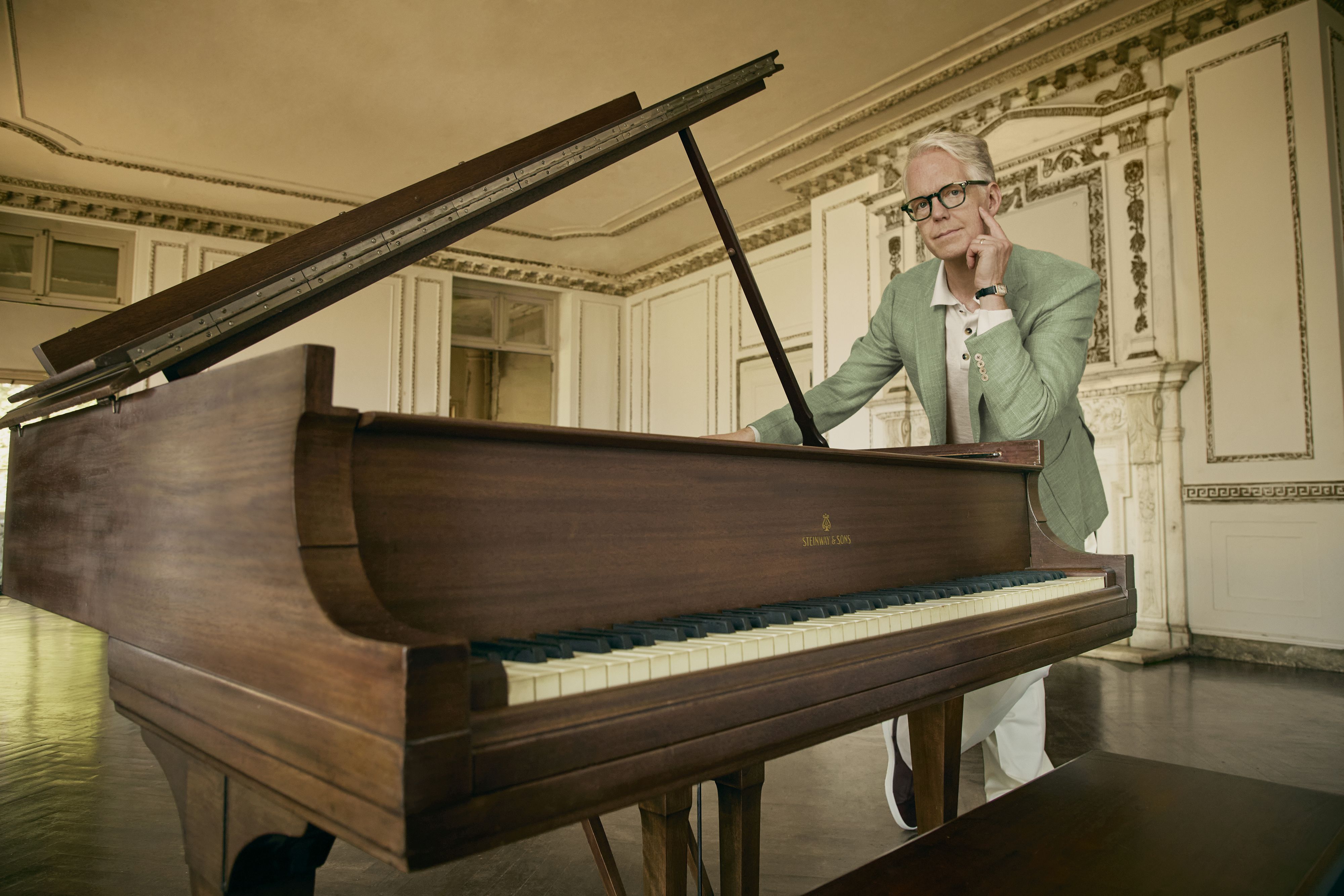
And speaking of rooms, yes the room matters too, of course, but for me it’s really the piano in the room. I may be the body, but the piano is the voice. I first recorded at Angel Studios in the summer of 2025 for Where We Are, Together, and I remember playing the first note on that piano and basically thinking, “Um ... I may have just found my forever home.” I’ve played a lot of extraordinary pianos around the world, but every now and then you sit at one and there’s no negotiation. Whatever my fingers wanted to say, that piano responded. Effortlessly.
So I suppose the composition brings the emotional idea into the room. But the recording is where I stop telling it what it’s supposed to be and find out what happens.
How do you capture the emotions you want to get across in the studio?
I think it starts before anyone plays a note. With hush, every morning on the way to the studio I stopped at a florist nearby. I had three little glass bottles, nothing fancy, and I’d put fresh flowers in them and place them around the live room.
Studios can be pretty bare places by necessity. Everything is there for sound, which sometimes means anything that doesn’t serve that purpose gets removed. Sonically it’s wonderful. Emotionally, it can feel a little like you’re recording inside a very expensive storage unit. So I wanted something living in the room. Something fresh. It was tiny, and I doubt anyone walked in thinking, “Ah yes, the flowers have transformed my emotional state.” But I noticed them. And I liked what they reminded me of.
And before we started recording, I talked to the orchestra about why we were there. I get messages every day from people telling me where this music has met them. Someone who couldn’t sleep. Someone sitting beside a person they love in a hospital. Someone trying to find a little hope or calm in a really difficult season.
These musicians will probably never meet any of those people. But they’re part of that story. I wanted them to know that what they were putting into the room that day might end up holding the hand of somebody they’ll never know existed. Maybe years from now. Maybe even a generation from now.
That matters to me. It changes the session from, “Okay, let’s make a record and hopefully get it on some playlists,” to, “What we do in this room today may actually matter to somebody.”
And then there’s one little ritual I’ve never really talked about publicly. (Baring my soul here!) It started with my first solo album, Set on a Hill. I was driving to the studio, somewhere in Maine or Vermont or honestly somewhere up there, and I put on Tom Petty’s Wildflowers.
That album is perfect to me. Start to finish. The writing, the playing, the not playing, the production, all of it. It just brings a smile to my face. AND if you can listen to it on a beautiful day with the windows down and your arm out the car window, even better.
So ever since then, on the first day of every album I record, I listen to Wildflowers from beginning to end on the way to the studio. No lie. Seriously. 100% honest truth. Call it superstition, ritual, whatever you want. For me, it gets me out of my own head. I stop thinking about whether the album is good enough, whether I’m prepared enough, whether this take or that take is going to work. I’m just listening to music I love. And somewhere along the way I remember, Oh right. Music is beautiful. This is fun. I get to do this for a living.
That’s an absurdly golden ticket, and I don’t take it for granted in the least. So I want to walk into that first day carrying that with me. Gratitude. Excitement. Curiosity. Not pressure. Because whatever you bring into the room tends to find its way into the music.
What role do factors like volume, effects, amplification, and production in general play in terms of creating the emotions, energies, or impressions you want?
For me, most of the time it’s a piano and a microphone. And if it isn’t a piano and a microphone, it’s a piano, an orchestra, and a microphone.
I’m not anti-production by any stretch. I’m literally listening to Brian Eno and Beatie Wolfe while I’m answering this, and there are people who can do things with sound that absolutely fascinate me.
But I also know my lane. I want to make things that feel timeless, both compositionally and sonically. I’d love for somebody to put on a vinyl copy of hush twenty years from now and have no idea whether it was recorded twenty minutes ago or twenty years ago. Or if the pieces were written in 1820 or 2020.
Emotion doesn’t really date itself. Right? Only the dates change, not what people go through. I mean, the details of our lives change, obviously. What heartbreak looked like a hundred or a thousand years ago is probably very different from what it looks like now. But the heartbreak itself? That part hasn’t changed. Hope hasn’t changed. Grief hasn’t changed. Wonder hasn’t changed. We’ve all been pulling from basically the same library of feelings since the beginning.
And it’s one of the reasons I’m careful about anything that timestamps the sound too heavily. For instance; you hear a certain snare drum from a pop record in the ’90s and instantly you’re in the ’90s. You know the sound. You can’t unhear the decade. Nostalgia is fun, sure, don’t get me wrong. But for me, it also creates a ceiling because that song will always live back there.
With hush, I wanted a lush orchestra and a piano that feels close. Very little getting between you and the instrument. I don’t want the piano floating somewhere at the end of a cathedral. I want it to feel like you’re sitting on the bench with me. Like I saved you a seat.
Beyond that, I really do trust the people around me. Especially the ones that know which knobs to turn and not just because it looks cool. Stephen Price mixes my records, and I don’t stand over his shoulder telling him which colors to use. He hears things I don’t hear. That’s why he’s there. And between Stephen and my producer and arranger, Geoff Lawson, no relation, oddly enough, those two have ears far greater than I would ever want to possess, if I’m honest. A gnat could fly into the room and they’d probably tell you what key it was humming in and the frequency its wings were flapping at. The level of attention is absolutely lost on me. And I’m actually okay with that!
But every time Stephen sends something back, there are details and shades in it that are far more beautiful than whatever I would have tried to describe. I like surrounding myself with people who are really good at the things I’m not good at. That actually lets me enjoy their work more.
So when I hear someone like Eno doing something I would never think to do, I don’t have to sit there dissecting it and wondering which plug-in created which sound. I can just listen to it and say “Man, I love this album.” Create. Don’t compete. I learned that a long time ago.
Artistically, I think we each have a note at the piano, metaphorically speaking. Some of the notes I play will resonate with someone. Some won’t. Same with Eno. Same with anybody. The mistake, I think, is trying to play all the notes for all the people. I’d rather play the notes that actually resonate with me and trust that they’ll find the people who are supposed to hear them where they are.