Published
Name: Jakob Vasak
Nationality: Austrian
Occupation: Composer, sound artist, instrument developer
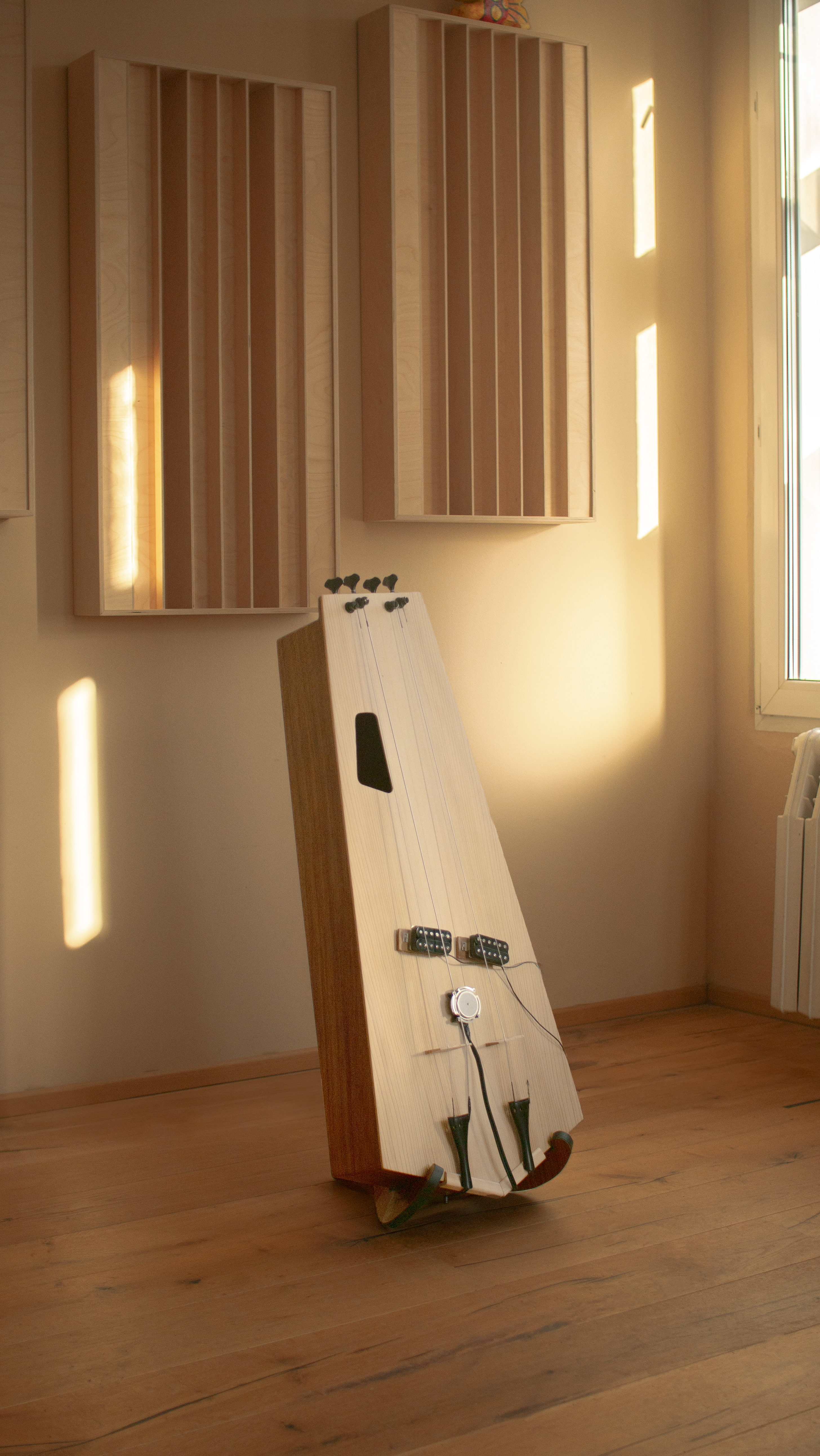
Current events: Jakob Vasak just finished deloping the Kobophon, "an electroacoustic string instrument he developed around a closed acoustic feedback loop," which "grew out of a compositional question: how can sound resist clear instrumental identification while remaining unmistakably physical?"
If you enjoyed this Jakob Vasak interview and would like to know more about his music and upcoming live dates, visit his official homepage. He is also on Instagram.
You mentioned in your email that you are “interested in source-ambiguous yet physically plausible sound phenomena — sounds that feel materially grounded without pointing to a recognisable object.” Why, would you say, does this interest you?
There is some kind of inner resonance I have with a certain quality of sound that seems to derive from a part of the natural world that cannot be heard, but can only be felt.
Often when I listen to music, I’m like, “Ah yeah, that’s a synth, that’s a cello, and ah, there are 10,000 effects that make this sample sound super cool.” But I wanted to create a sound that doesn’t fit into any of those categories and also feels like it could derive from a natural environment.
Not having a familiar source to recognise encourages you to find a connection within yourself, through your own memories, experiences and feelings or beyond. This source ambiguity enables you to draw your own conclusions about what a sound could mean or be in a certain context.
As a listener, what kind of music did this interest initially lead you to? Are there artists which you feel close to in this regard?
I’m drawn to music that feels like remembering, but without a particular event attached to it. It’s closer to archetypal images and feelings than to memories of things that happened to me.
A sound can feel strangely familiar without me knowing why or what is producing it. That kind of recognition is something I look for in music and also try to create in my own work.
I find that quality in the music of Taylor Deupree and Fennesz, as well as Sam Slater and Thomas Mertlseder. Sam and Thomas have also been important references through the instruments they’ve built, which helped me imagine building my own.
[Read our Taylor Deupree interview]
In the context of this discussion, what are your thoughts about “extended techniques” on traditional instruments which would, if performed “traditionally,” not be source-ambiguous at all?
There is a lot you can do with extended techniques in terms of source ambiguity. I wouldn’t say that a double bass played using certain extended techniques is necessarily less source-ambiguous than the Kobophon.
I feel like, with any given object, exploring and experimenting with its sonic properties can take you beyond its familiar sound. You start to discover how it behaves as a physical object, and you somewhat transcend what it was built for.
Exploring less familiar physical behaviours of resonant bodies and making them audible was also a key motivation for building the Kobophon.
Before developing the Kobophon, did you also attempt similar results in a synthetic-sound environment or colaborate with artists who do? If so, what were these like?
I spent years working with recorded instruments, field recordings and digital processing, searching for this broken, voice-like sound that felt natural but was still harmonic.
In my experience, the physicality of a resonating body is extremely difficult to simulate convincingly. I could process sounds extensively and still feel that something was missing.
Now I have this thing standing in my studio that sounds that way on its own. I don’t have to keep racking my brain over how to bend a sound into what I want it to be. I can start with the sound the instrument already has and be very happy about it.
What is the difference between creating sounds that have a source-ambiguous quality in a digital environment compared to creating them with an actual physical object?
Part of it is the immediacy. With the Kobophon, even a gentle touch makes the whole instrument respond. I’m making musical decisions while the sound is happening.
There’s an actual wooden body in front of me, with all its irregularities, the tension in its construction, and the way the material and electronics interact. The sound comes from those interactions actually taking place. The strings and body are physically vibrating. What you hear is the instruments own behaviour, not a simulation.
A simulation may produce a convincingly similar sound, but it is still a simulation: it represents a physical process without that process actually taking place. For me, that difference matters a lot, especially in an increasingly hypermediated world.
When you started working on the Kobophon, what were some of the earliest premises or considerations that went into the conceptualising?
Seeing instruments that friends of mine had built opened up a possibility: perhaps I could build something myself that would produce the sound I’d had in my head for years.
Their instruments sounded amazing, but I was chasing something quite specific. I can’t really put the sound into words. In my head, it goes “whup, whupwhup” at different pitches. I felt that a wooden resonating body, strings, and feedback I could shape harmonically were my best shot at finding that sound. Strings coupled to a wooden body are obviously a well-established idea, but I wanted to explore my own take on it.
One thing I knew early on was that I wanted a tonal range somewhere around that of a cello or guitar. That gave me a starting point for the body’s size and proportions, and for the quality of the wood.
Once one exceeds conventional instrumental properties, doesn't one create a new category? Or to put it differently: How do you create an instrument which can not be clearly identified?
I think that’s actually what makes this interesting.
The Kobophon sounds source-ambiguous partly because people don’t know the instrument yet. If it became established, they might simply say, “Oh, that’s a Kobophon.” Its sound might become less ambiguous in that sense, but the instrument would still have opened up a new category of sound.
At the same time, some of its sounds evoke something like animal voices, but the resemblance never quite settles into one thing. You can hear several possible origins at once. I think that tension would remain, even if you knew perfectly well that you were listening to a Kobophon.
Tell me a bit about the technical/acoustic insights which went into choosing the right materials, please.
It was important to choose wood that would still resonate well with pickups and a transducer mounted on it. The top is made from cedar, and the rest of the body is ovangkol.
The wood originally came as a set intended for building a Weissenborn-style guitar, which gave me a practical starting point as someone new to instrument building.
The Kobophon makes prominent use of feedback. I'd be curious about why feedback seemed like the right “material” in terms of the sonic properties of the instrument.
Feedback arising from the physical properties of a resonating body has something magical about it. It makes aspects of the material audible that would otherwise remain hidden. You can hear the instrument’s inner workings.
The interactions between the wood, strings and electronics make things audible that you wouldn’t normally think of as having a sound. There’s something psychedelic about that, as if the resonating object were revealing another layer of reality. It also allows for a way of playing that is rooted in the instrument’s own physical behaviour.
Dynamics and pitch aren’t simply imposed on the instrument from the outside. They emerge from the instrument itself, through the interaction between the strings, the body and the feedback loop. I can guide that process, but I’m working with what the body wants to do.
Feedback is a simple concept in principle, but once put into motion, feedback systems can get very powerful and complex. What is your take on the limits and potentials of sculpting feedback?
Playing with feedback is always a dialogue. It’s almost impossible to recreate a feedback loop exactly, even when you return to the same settings. There’s always a degree of uncertainty about when the feedback takes hold and when it starts to distort.
That’s part of its beauty for me: no two sounds are ever quite the same. Resonant filters, LFOs and compressors let me steer the feedback in certain directions, but it behaves differently each time. With the Kobophon, the feedback is channelled through four strings, so it stays more or less tied to their natural overtone series, which helps a lot if you actually want to make music with it.
But the four string signals and the filters interact differently each time. Which frequencies emerge, and when, still constantly surprises me.