Published
Part 2
I would assume there were at least a few prototypes which you discarded. Did you try radically different concepts?
I built the first prototype to prove to myself that I could build a string feedback system on my own.
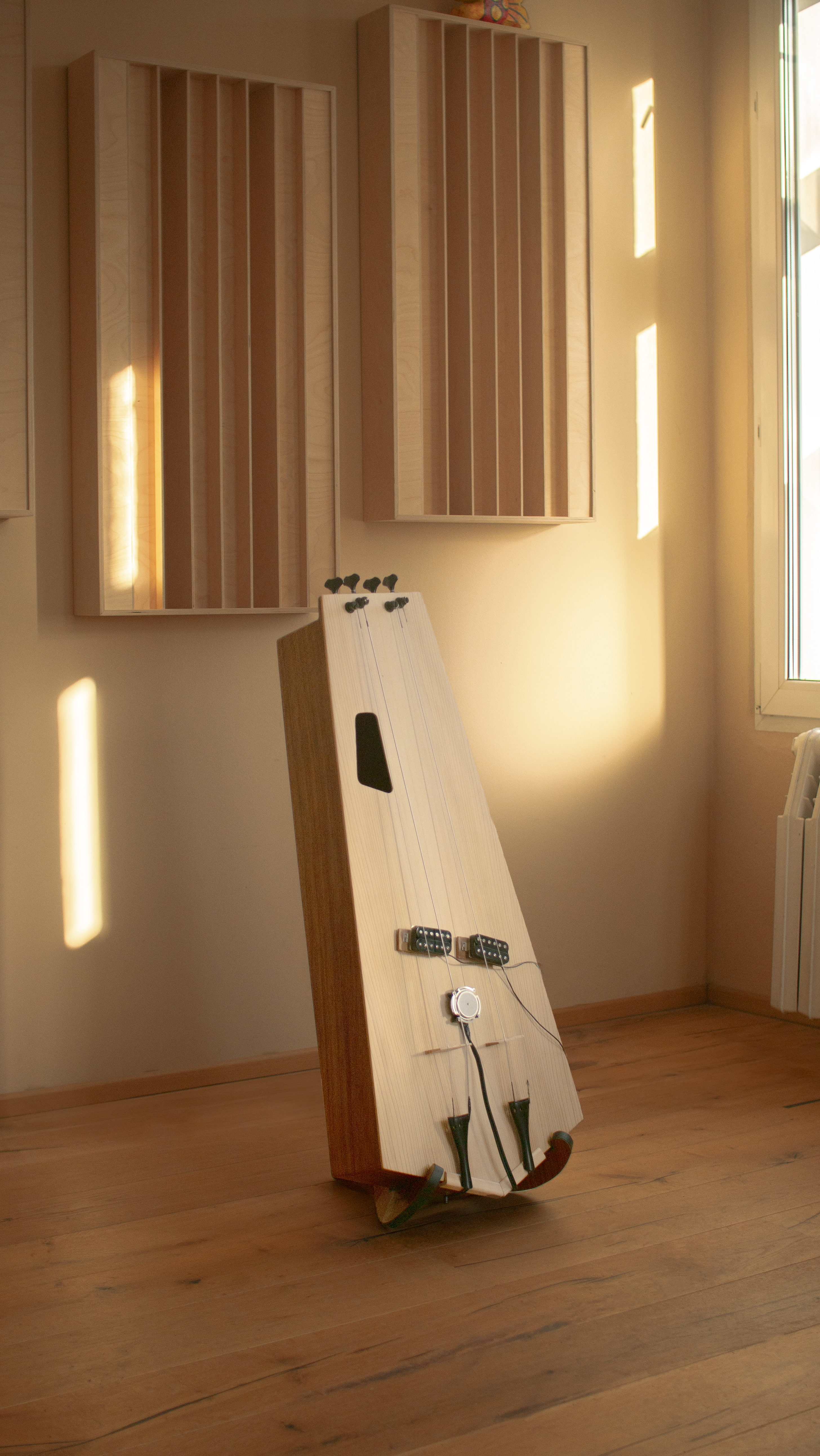
The very first version used a Bluetooth speaker I had lying around instead of a transducer, and that worked … more or less. The first proper prototype had the full electronic setup, but its body didn’t resonate the way I wanted it to. It always sounded like a tiny little box.
So it became clear to me that I need to spend some time building a resonating wooden body if I wanted to go to the next level.
What was the concrete building process for the Kobophon like? What were the challenges?
The biggest challenge was that I was very new to the acoustic aspects of instrument design, and I still definitely wouldn’t call myself a professional instrument builder.
I had to start from scratch and research wood properties, construction and dimensions in relation to the tonal range I had in mind. I was doing many things for the first time, without knowing whether they would work, especially whether the structure would withstand the tension of four strings and the intense vibrations from the transducer. And even if it held together, I couldn’t be sure it would actually produce the sound I wanted. It was an experiment.
In the end, I’m really glad everything worked out so well. Nothing broke, and I was able to achieve what I had imagined and more, both visually and sonically.
Describe how the Kobophon is played, what playing it feels like, and what listener response has been like so far.
Since it’s a string instrument, it’s obviously possible to pluck or bow it. But that’s not what I built it for.
Playing with its internal feedback loop and modulating it with a modular rack feels like a form of dialogue with the instrument. I have to listen closely to how the resonances evolve, responding to them and guiding them. Sometimes it feels like I’m asking it to do one thing, but it has its own surprising interpretation of what that could mean or sound like.
The resonances of the strings and body tend to fight with each other, so it’s never fully controllable. There are certain sweet spots where the magic really happens. I might catch the most beautiful fragment of a voice-like melody just before a really heavy bass sound takes over. Once I’ve set up certain conditions, the sounds gradually evolve on their own. I can then change those conditions by turning some knobs or retuning the strings.
Most people have been quite intrigued by its sonic character. Through the Kobophon’s wooden body, the sounds have such a clear acoustic character, but still would be impossible to create with just an acoustic instrument without an electronic feedback loop. A few people have described the sounds as animal-like, be it whales, birds or a moose.
Every instrument influences how an artist approaches the creative process. How has the Kobophon influenced yours? What are your first pieces on it like?
This has changed radically since I started playing the Kobophon. I used to spend a lot of time processing and arranging recorded instruments and field recordings, which made it almost impossible for me to really “perform” the music I created. Now I can play, loop and layer everything much more intuitively, and I don’t need digital effects to achieve the sound I want.
I’m currently exploring this as I develop my first live concert series with the Kobophon. I’m interested in a compositional process that behaves more like an ecosystem. Rather than having one voice that everything else follows, I create certain conditions and listen to the relationships that emerge between the sounds. These relationships are not fully predetermined. They develop through the way the sounds affect one another.
That doesn’t mean every sound has equal weight or occupies the same amount of space. Ecosystems contain larger and smaller beings with different sizes and responsibilities, but they remain interdependent. I’m interested in allowing that kind of interdependence to shape the music.
Most of the time, the result sounds like a natural field of non-human voices interacting with each other. I feel like I’ve found a way to describe the shifting energy of a place, the way it moves through and around everything.
You write that your focus is on “abstract but materially coherent sonic environments.” What does the term “abstract” mean for you here?
By abstract, I don’t mean vague or unspecific. A sound can bring up a very particular feeling, or a sense of remembering something, without giving anything you could clearly identify. It’s closer to the archetypal images and feelings I mentioned earlier than to recalling a particular event.
What interests me is that this recognition can remain very precise as an experience, even when it escapes rational categorisation. There doesn’t have to be one shared material reference that explains what the sound is or means.
Sometimes I feel that not being able to name or explain it makes the experience more immediate and sensuous. I can feel it quite distinctly without being able to say exactly what it is. The association can stay undefined without losing its intensity or specificity.
Many instrumentalists have told me about their deep relationship with their instrument. Is your relationship with the Kobophon as an instrument which you personally conceptualised and (I would assume) built and which falls outside the typical boundaries of instruments different – and if so, in which way?
I cannot really make statements about other people's relationships to their instruments, but I definitely feel a strong connection to the Kobophon that has grown since I first touched the wood and started building it. I’ve been involved in how this particular instrument came into being, from the material itself to the sound I’d been imagining for years. That story is part of what I feel when I play it.
Also, there’s only one Kobophon for now, which makes this particular object very special to me. But even though I built it, I don’t fully know what it will do. Sometimes it feels like it’s talking to me.
This might be one of the main differences in how one might relate to other instruments. There’s something quite curious about having created an instrument yourself and still being surprised by it.