

Published
Part 2
Jazz has always had an interesting relationship between honouring its roots and exploring the unknown. What does the balance between these two poles look like in your music?
Our roots are clearly audible – for Julian it’s Chet Baker, for Roman it’s the compositions of Michel Petrucciani, which have always inspired him. But our roots equally include pop songs, film music and the music we grew up with at home with our parents.
So for us, “tradition” is broader than the jazz canon. We have great respect for it – but we always play from the heart and as freely as possible, without boundaries.
For us, the foundation is the melody, the song – even when it has no lyrics. That applies regardless of genre: whether a piece comes from jazz, pop or film music is secondary. What matters is whether there’s a melody you can sing.
The unknown comes in through people. Working with Harry Mack, a freestyle rapper, on “Never Hold Back” was new territory.
On Timelines it’s the Latin American rhythms and the urban impulses from Japan – have a listen to “Bajo la luna” or “Namesake’s Birthday.”
As long as the melody carries, we can go almost anywhere.
How much potential for something “new” is there still in jazz? What could this “new” look like?
A lot – but maybe not where people look for it. We don’t believe the new lies in ever more complexity. More notes, odd meters and faster tempos have all been done brilliantly.
The new lies in combinations: biographies, cultures and scenes that haven’t met before. Five musical lifelines crossing in one room in Hückeswagen – that’s new, even if every single element has its own history.
And perhaps the new is also structural: artists who own their music, their recordings and their label. For us, Schnaff Records is part of the artistic statement. Our motto is “True to the music”.
For many artists, life-changing musical experiences take place live. How do you see that yourself?
Absolutely. You can’t download the moment when a whole room holds its breath.
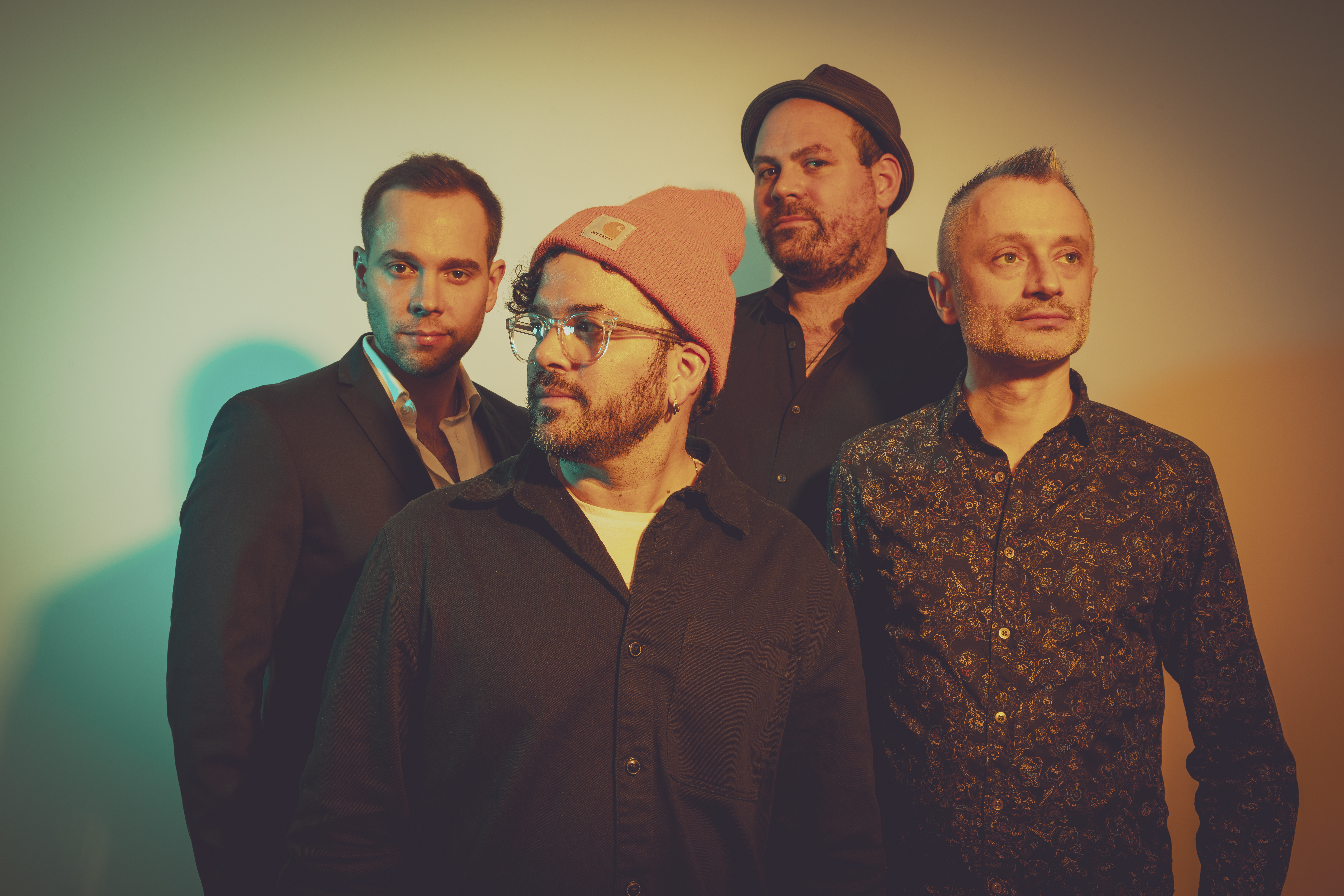
This summer we celebrated twenty years of making music together with a concert in Wipperfürth, close to home – with old friends and long-time companions in the audience – and played music from Timelines there for the very first time. That evening, a lot of lifelines really did cross.
During lockdown we deliberately did hardly any streaming concerts. Roman’s worry was that everything would be given away and might settle in people’s minds as an equivalent substitute. It isn’t. Live music needs a shared space and shared time.
How, would you say are your live performances and your recording projects connected at the moment? How do they mutually influence and feed off each other?
They push each other back and forth. Safe Place began as a sketch Julian wrote on guitar – even though he can’t really play guitar. Then we played it as a duo, then as a trio with Jörg Brinkmann, and finally with a large ensemble, the WDR Big Band.
With every line-up the song revealed something new about itself. To this day it’s the song we most love to play on stage.
With Timelines it’s the other way round: we recorded in March, and since then the pieces have kept growing live. The album celebrates its release at the Leverkusener Jazztage, with Jan Prax as our guest.
By the time people buy the record, the band will already have moved on a little – and that’s how it should be.
Improvisation is obviously an essential element of jazz, but I would assume that just like composition, it is transforming. How do you feel has the role of improvisation changed in jazz?
For a long time, improvisation was often about showing what you can do. Today, for many musicians, it’s more about sound, space and the collective – about what the band creates together rather than a single soloist.
And the most exciting improvisers right now may not even be found in jazz. Harry Mack freestyles complete verses about anything the audience throws at him. That’s pure improvisation, and it reaches millions of young people.
It shows us that improvisation is very much alive – it just doesn’t always carry the jazz label.
What, would you say, are the key ideas behind your approach to improvisation?
Julian: Serve the melody. Already on our second record we said we didn’t want to lose ourselves in technical acrobatics – simple songs with intensity. That still holds true. I try to improvise the way a singer would phrase, and that is clearly Chet Baker’s influence.
Roman: Listening. After twenty years, Julian and I know each other’s breathing. I can feel where he wants to go before he gets there, and that gives us the freedom to leave space.
Our duo is the smallest form of a band – and leaving something out is often the strongest musical decision you can make.
Are there approaches, artists, festivals, labels, spaces or anyone/-thing else out there who you feel deserve a shout out for taking jazz into the future?
First of all, the musicians we just made Timelines with:
Juan Camilo Villa and Dennis Frehse, who show how naturally Colombia, Japan and Europe can come together in one band. Mathias Heise, who makes the harmonica sound like a completely new voice in jazz. Jan Prax, Paul Heller and Nir Felder – musicians who play with incredible depth without ever showing off.
Likewise Jörg Brinkmann, with whom we’ve shared a close friendship for years. And Harry Mack, because he shows a whole generation what improvisation can be.
The Leverkusener Jazztage are a real hub for us, bringing very different scenes together. But above all, the many small clubs and cultural initiatives run by volunteers. Without the people who organise concerts, build stages and welcome musicians, there would be no living jazz scene.
We’re currently planning a new festival ourselves, and we know how much heart goes into it.
And a short thank-you to Siggi Loch, who created something new with ACT back then and gave us a chance as teenagers.
The Montreux Festival intends to preserve its archive of recordings for future generations. Do you personally feels it's important that everything should remain available forever - or is there something to be said for letting beautiful moments pass and linger in the memories of those that experienced them?
Julian: I learned to play from recordings. Without those Chet Baker records there would be no Remember Chet – and maybe no Wasserfuhr brothers at all. So yes, archives are a gift to future generations, and Montreux has captured moments that are part of music history.
Roman: But there’s something to be said for the opposite, too. On Safe Place, there’s a little piece called “Perfect Tiny Moment” – that one moment when everything is just right.
Some of the most beautiful things we’ve experienced on stage only exist in the memories of the people who were there, and that makes them precious. If everything is always available, there’s a risk that nothing feels special anymore.
So: preserve, yes. But listening should remain an act of attention, not mere consumption.