Published
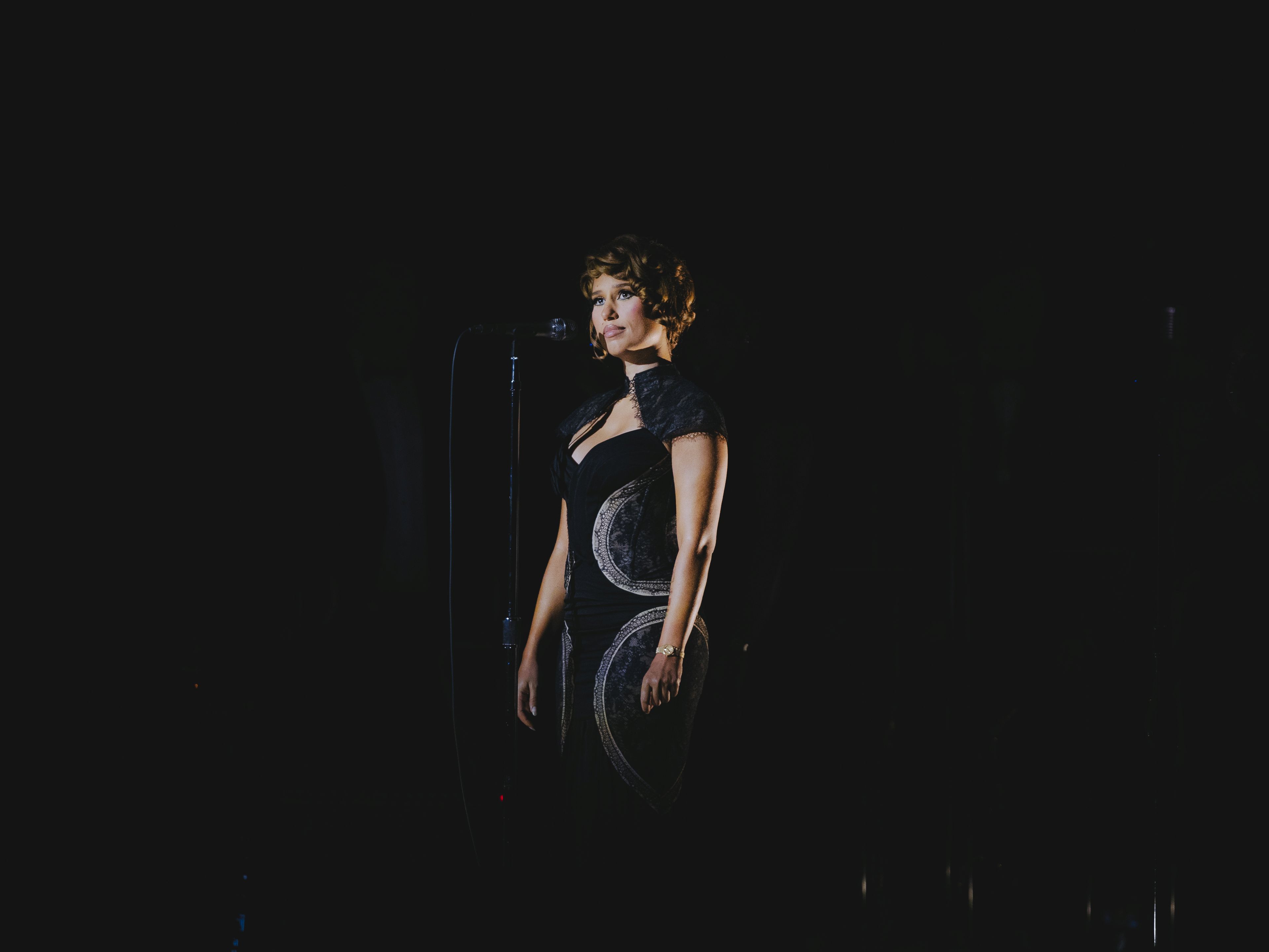
The time loop starts around four and a half minutes in. The lights have been dimmed, the curtain has lifted, the stage is drenched in darkness. The spotlight is on a vocalist clad entirely in black, accompanied by little more than an acoustic guitar and a small string section. After going through the first two verses and choruses of Fairport Convention classic "Who knows where the time goes,“ she looks up, addressing the audience for the first of many intimate moments.
"In 1976, on this stage, on the 3rd of July, 50 years ago today,“ the singer says, "Nina Simone stood basically right here and she sang this song – so much more hauntingly than I ever could.“ Then she returns to the piece again with eyes closed, leaning in even deeper and finishing the song just as hauntingly as Simone did. This is the opening of the 60th anniversary edition of the Montreux Jazz Festival and, quite possibly, the most widely anticipated concert of the event for a very long time.
The artist, of course, is Raye and her relationship with Montreux has become symbolic for the future of a festival which, as deep into its history and as renowned as it may be, has always had to find its own unique path through the constantly changing constellations of the music industry.
A few weeks earlier, I had spoken to the MJF's CEO Mathieu Jaton and he had told me that the story with Raye had been like a love affair which began in 2024. She had been genuinely moved to be able to perform in Switzerland, Jaton recounted, had sung in front of her Swiss grandfather and her family in a gig which the festival would later publish on vinyl. A year later, she had returned as Montreux' headliner, then broken through on a global scale with her widely praised LP This Music Contains Hope. Booking her has become a lot harder since then, he admits, so, to make it happen, he had offered her the opening night.spot as well as carte blanche in terms of the creative aspects. The way he remembers it, she didn't even have to think twice to confirm.
Raye has certainly made full use of the freedom given to her. The stage she and her band are placed on is circular, revolving and custom-made. Her cast of musicians includes a tight core group of drums, bass, keys and guitar, as well as formidable backing vocalists, a horn section and a tastefully integrated chambermusic ensemble. It feels like a statement of intent, a return to the times when jazz, in its prequel-emanation of swing and big bands, was quite arguably the biggest music phenomenon the world has ever seen, a euphoria sweeing the planet, when huge orchestras would anticipate and fuse, long before the fact, the energy of rock concerts, the kinetic magneticsm of dance clubs and the musical ambitions of symphonies into a single, singular experience.
That era eventually succumbed to the depression and ever since, jazz in all of its later incarnations would express itself in more modest forms, with perhaps the short exception of the jazz rock period when Miles Davis would command huge bands. Tonight, the exuberance and excess of the golden glory days are back – which is why this setting never feels like overkill, but like a heartfelt tribute and an expression of optimism towards an ever-uncertain future.
As a fan of the festival, Raye has also made use of the opening slot as an opportunity to educate her audience. At a later point of the opening night, she gives a personally motivated overview of some of her most beloved gigs from the past decades, with the band intoning short musical excerpts of, among others, James Brown and Al Green.
Clearly, she knows these legendary moments inside out which is why it is ironic, albeit charming, that her introductory remarks are actually historically inaccurate – although Simone did perform at Montreux a full five times, with founder Claude Nobs going to increasingly extreme financial lengths to convince her to keep coming back, recorded many of her classic songs here (collected on live albums and the fantastic compilation The Montreux Years), and indeed stood on stage in 1976, exactly 50 years earlier, she did not play "Who knows where the time goes“ back then.
Perhaps Raye was thinking of a heartwrenching rendition from around the same time of that tune in New York, which is even more sparse, and slower, almost to the point of arresting time and descending into a state of dreaming.
It is easy to forget just how courageous it is to not just, through the invitation of many guests like Alicia Keys and Mark Ronson and going through a wide range of stylistic swings, create a miniature version of the MJF as a whole. Especially so, since there is no safety net here, with all of the contributions played live, withouth any backing track or additional vocal lines cued in from a laptop. But then again, the conceptual framing also frees Raye from the often perceived demand for perfection.
This isn't just simply a concert. In a way, it is a re-enactment of an entire phase of jazz, in which Montreux came to become so representative of the genre that it is still, 60 years later, being held accountable for its perceived deviations from the right path. For almost an entire century, few things have come as easy to critics and commentators as defining what jazz isn't. The Montreux Festival is one of the few places that actively seeks to explore what jazz actually is and can be.
In my conversation with Jaton, we had laughed about the response to the short teaser video for the 2026 edition of the MJF posted by the organisation a few week's ahead of Raye's opening. Featuring mostly club music, it had elicited the predictable response among viewers that there was essentially no longer any jazz being performed here. "Why would you use this kind of electronic music that literally doesn’t indicate anything linked to the actual music that the event really stands for?“ one comment read, while another claimed that "Claude [Nobs] would be rolling [in his grave, presumably].“
Jaton and me agreed that Nobs would certainly not have been opposed to this kind of openmindedness. But the objections have been there for years and they simply won't go away, although it is sometimes hard to see where the critics draw the line. When I first wrote about the jazz aspects of the festival two years ago, singer-songwriter Mahalia's gig, which I felt, was very much in tune with the long lineage of fantastic soul singers at Montreux, essentially received all but identical rejections. But then again, jazz as a whole has already been facing the same arguments for much, much longer.
In fact, negative verdicts on thegenre's updates have accompanied the history of jazz from its very first days.
For some, already 1940s bebop constituted little more than a random smattering of notes; for others, Ornette Coleman's Shape of Jazz to Come was the way jazz died, and Bitches Brew was seen as little more than rock in disguise. If music didn't swing it wasn't jazz, if it didn't include improvisation it wasn't jazz, if it featured an electric bass it wasn't jazz.
The irony was that many of its most beloved purveyors did everything in their power to overcome this hermetic thinking. John Coltrane's path led him from stonecold canon classics to radical reinventions like OM and Interstellar Space, while Herbie Hancock's discography expanded the vocabulary into hip-hop, electroacoustic composition and noise as well as electronica. And, then, of course, there's the towering figure of Miles Davis, to whom the act of defining itself ran counter to the very core priciples: "I can’t stand people assuming they know what is jazz and what isn’t,“ Italian trumpet player Lorenzo di Finti stresses, "That’s the kind of attitude Miles would have destroyed!"
When I researched my first article about Montreux in 2024, I made use of many interviews I'd conducted about improvisation over the years, concentrating on that particular, isolated component of the jazz tradition. Intriguingly to me, although no one disputed the importance of improvisation in general, most artists agreed that, in a way, performing spontaneously did not have to express itself in something that conformed to the strict definition of a solo or a completely unexpected outburst of never-before-heard creativity. Pianist Clara Vetter's simple, yet astute observation that "there is probably no music without some layer of improvisation, at least when it is played by humans," still rings true.
For this year's festival, meanwhile, I decided to perform the research on location. And so, I got up at half past four in the morning in Berlin and took an eleven hour train ride to spend time in Montreux and see how these ideas panned out in practise.
Besides me, a total of 550 accredited journalists from all over the world would be visiting the festival over the course of two weeks. Even more would be watching, as would many spectators. In fact, one could argue that already the festival is taking place just as much on laptops and mobile phones as it is in Switzerland: While 250,000 physically-present visitors and a near-perfect occupancy rate for the paid-for performances are nothing to sneeze at, the online transmission of the gigs – of which more than 50 (a remarkable ¾ of the ticketed events, but admittedly only a snipped out of a grand total of 700) were streamed in full – raked up around 10 million views. When the Montreux team presented this year's statistical analysis at the closing press conference on July 16th, the numbers really did give hope to the idea that the event has a bright future ahead of it, despite what the organisers drily call "a context marked by a sharp rise in production costs, notably linked to the significant increase in artist fees.“
To get back to Miles Davis - he never thought that changing things up meant sacrificing your ideals. I am reminded of this on the second day of my visit to Montreux, seated in a tiny cinema in the Lake House, a gorgeous multi-story building placed rght between Lake Geneva's glamorous Grand Rue, with its elegant, luxurious, entirely-out-of-my-league hotels and cafes on the one hand and the dreamy, winding, too-beautiful-to-be-true water front on the other, watching a documentary about electronic music pioneer Morton Subotnick with a handful of other spectators, almost all of which will leave before the end of the screening.
An oversized air fan is noisily blowing wind into the space, which nonetheless feels like the best place in the world to me at this point, after having just spent most of the day "weatherlagged" in my hotel room.
It is an intimate film, slow and full of bittersweet reminscences and Subotnick's views on life, death and music, which become increasingly clear towards the end of his life. After many years of consciously swimming against the tide, Subotnick discovered his music had found a following in a new generation of electronic artists. He understood that they regarded him as a father figure and that the music this new generation of producers and performers created had to be as similar and as different as one's own children, who, despite sharing some biological similarities, ultimately had to find out who they were for themselves.
This, I felt, was an apt vantage point for Montreux and its stance towards programming: The point is not to look or sound exactly the same as you did in your prime, but to carry that DNA of constant renewal forward as it passes through time.
Only a day earlier, I'd arrived in Montreux, checking in at the Freddie Mercury Hotel, named after the city's possibly most famous fan.
Although Mercury never actually performed at the Jazz Festival, he did make the city his second home, recording as much as six Queen records there. The first of these wasn't called Jazz for nothing (it is also, coincidentally, one of the weirdest and most quirky entries in their discography, albeit featuring, fittingly for the discussion, not a single note of jazz) and the front album cover of posthumously released Made in Heaven shows Mercury looking out over the spectacular lake view.
Right after putting down my bags, Florian Striedl of the event's German PR agency picks me up for a tour of the festival grounds which run alongside the boardwalk for what seems like an eternity, snaking along food stands and a variety of outdoor stages and concert halls, most of which have been errected specifically for these two weeks in June. The route along the quays has been extended from previous editions, now encompassing, as the visitor information informs me, "the Spotlight and Super Bock stages, set up at the east end of the perimeter, at Parc Vernex, the Paloma [with its] summer holiday vibe, all the way up to] the Duplex, the Festival’s new electro stage with [its] play of lights and immersive scenography.“
While walking, we pick up his colleagues Ute and Lena and finally end up at the Pro Bar, a small balcony deck reserved for journalists and guests to rehydrate. As the first concerts of the night draw nearer, conversations naturally touch on the event and its programmatic outlook. “For Claude Nobs, the term jazz ultimately meant freedom,“ Florian says, which is pretty much exactly what the majority of artists have told me in my interviews on the subject as well, albeit with some noteable exceptions and caveats.
Of course, what you use that freedom for does still matter. A few hours later, heading back to the hotel again, I pass by the same stands and stages I saw earlier during the daylight and which have now come to life. Every few metres, the soundtrack to my nocturnal stroll changes, running the gammut from rock and hiphop up to house and trance. It is the freedom to ignore all expectations and throw out the dictionary: By themselves, it is entirely clear that very little of this has anything in common with the textbook definition of jazz.
In the Lake House's basement club, the Memphis, packed to the brim and styled like a classic night club taken straight from Casablanca with row after row of small, table-clothed round tables and wooden chairs, the jam sessions never end. But in many respects, it feels like a gift to the diehards, a last place or refuge for the purists (although even the Memphis's curation includes a variety of adjacent styles as well). But couldn't one see the curation of the festival as a whole as a testimony to the ongoing spirit of jazz of blasting borders and eliminating prejudice?
As if to silently confirm this, the Stravinsky Auditorium's merch store contains, side by side with tshirts, mugs and even jojos with the festival logo, an integrated record store at back with a mostly vinyl selection of music from the event's featured artists and acts from a wide range of genres. Jazz is just one, albeit quite substantial, section of this store and it comes across as entirely natural. It is the kind of eclecticism and free association we have come to accept for record stores and music magazines. Why should it feel so very different for the event as a whole?
In the Auditorium, Sasha Keable's performance is already underway. The hall has recently been renovated and the finished space manages to house a crowd of 5,000 while still feeling intimate. Even from the back, I feel as though I could clink glasses with Keable who is enjoying her wine on stage between songs. To my mind, her concert feels every bit like a natural part of the festival's legacy, her long personal revelations and updates on her private life ("I'm single again … so if anyone wants to approach me after the gig ...“) included. If the point of in-the-momentness is to extend the studio version of a song into a new realm, then Keable's voice is that portal into her world, magnifying the emotions of the original and ripping open any remaining protective layers.
It is the opposite of a pop approach, which is aimed at a perfect reproduction of the product in a live setting and considerably upgraded by her band, whose contributions feel as though they could work as stand-alone instrumental compositions in their own right, a paradoxically both smooth and intense combination of complex drum patterns, mesmerising key harmonies and boneshaking bass runs which flows like a dark river underneath these cathartic torch songs.
A similar confessional ambiance was also present at Raye's first gig at the Montreux Jazz Festival. To remind myself of that now classic performance, the next day, I wander through the streets of the old city in the midday heat with my headphones, the sun beating down on me remorselessly, as the recording of Raye's first visit here takes me back in time.
Just like some of the great storytellers before her, Raye loves drawing her songs out until their form disintegrates and you forget where they started, celebrating every single ending like the finale of a symphony, loosing herself in an epic section filled with greetings to her family and thoughts about life and love. I am sure that Claude Nobs would have found exactly what he was looking for in this extraordinary delivery.
Even less "jazz“ on the surface and yet even more so underneath is Joy Crookes on my second night. Her confessions are less personal than Raye's and Keable's – involving asking the audience whether they like her new dress and having this very morning taken a swim in the lake - but the in-between-banter is merely the surface of a far deeper ritual of passing into the event's pantheon.
After a debut album which sounded like a contemporary update of Massive Attack's 1990 Blue Lines blueprint, her most recent sophomore release Juniper dove deeper into rnb and soul, sounding both looser and more urgent at the same time.
In the Stravinsky Auditorium, meanwhile, Crookes and her congenial backing band pull off the astounding feat of making every single piece sound like it's being reinvented from scratch. Not so much through the act of improvisation, of which, in the strictest definition of the practise, there is little, with the exception of quite a few impressive sections where the drums take center stage, and more thanks to inventive re-arrangements:
The 60s references of the album are worked out far more prominently, as is its funk, and when Joy straps on her guitar, there is even an element of folk that comes to the fore. On "I know you'd kill,“ the band's energy takes what sounded like a smooth soul song and turns it into a raw, sharp accusal, as Crookes makes you feel the razorblade sharpness and knife-like nature of the lyrics.
Clearly, when done right, performances like this one reinforce what Danish electronic music producer Mads Kinnerup recently stated to me in a podcast interview: that, although he was working on software solutions putting the potential of AI into the hands of everyday musicians without the support of a big label budget, the final remaining dividing line between human and machine creativity was the live performance and the direct rapport with an audience on stage.
It is a feeling shared by many, and possibly best expressed by Swiss composer and guitarist Louis Matute, when he says that, to him, "jazz is a blessing for us musicians“ and "one of the few possible sustainable futures for music."
Matute lives in and works from Geneva, just around the corner, so I decide to take a deeper look into his ideas about the value of spontaneity and surprise.
The obvious namesake for the great lake which Montreux is so idylically placed next to, Geneva is a just over an hour short, 100 kilometer train ride away from the Jazz Festival, yet that trip, spent with locals all bent over their smartphones in defiant ignorance of the beauty flying by right in front of their window, will take you to a different world.
Geneva is a metropolis ten times Montreux' population size and a global hub for diplomacy. It is a prosperous and culturally diverse town and so, just like similarly near Lausanne (host to, among others, the JazzOne+), it has never felt the need for a huge festival to draw even more attention to it. As a result, as Matute describes it, a small but close scene has established itself here, which continues to feed into his work as well his personal relationship with and view on jazz which relies a lot on a feeling of localness.
One example he quotes is Bongo Joe, a record store named after street musician George 'Bongo Joe' Coleman, and its associated small label with an excuisite release roster. Combining metal frames, wooden furniture in a rustique stone building, the physical location doubles up as a cafe and home to a tiny festival. Although Bongoe Joe, the shop, is typically known for its selection of jazz music, it is by no means restricted to the core repertoire and neither is its own catalogue.
As I'm typing this, I am listening to the incredible second album by Yalla Miku, an astounding fusion of krautrock, post rock, and world music about which band member and Bongo Joe founder Cyril Yeterian has said that, rather than jazz, a sense of "punk rage" infused every single track.
For Matute, it appears, visiting Bongo Joe has turned into a ritual for both himself and for supporting the scene, buying records of which very few last year were actually strictly speaking jazz, and most more in the direction of ambient, guitar compositions and "basically all kind of popular music mixed with additional electronic textures that makes the tune sound like it’s a bit deviant.“
Even if the community is small, its power can be very strong. It's something I personally experienced when I was still living in Münster, a medium-sized German city close to the Dutch border, whose conservative surface proved the perfect soil for the formation of a thriving and dynamic underground. Over a cool and refreshing alcohol free "Superbock 0.0" beer, Florian Striedl will tell me the exact same thing after our introductory round of the MJF 2026's festival ground,about the even smaller Southern German town of Regensburg.
Says Matute about Geneva:
"I think people underestimate the value of local music. Jazz people always want to go to New York, Paris or other big cities, but I’ve never felt so curious and pumped than now, working with different musicians from Geneva. There is so much that has been done in this city and you have to be interested in your local culture and show some respect for the people that showed us the way before us. We have a great history of artists fighting for their rights. There is a strong history of squats and protest. The music venue called AMR is a very interesting place for jazz.“
Last Summer, Matute made use of the diversity of music events the wider Geneva area offered him to visit several festivals and made the experience that it was infallibly those concerts which leaned heavily towards "improvisation, interaction, and surprise." Jazz was the one genre, he felt, capable of uniting artists and listeners around the world. Although he personally lives in the past ("because the present scares me“), he firmly believes that "jazz becomes even more powerful when it’s mixed with some other genres. […] I feel that this music needs other genres to keep growing and inspire. It is why sometimes I don’t get people that are dying for jazz but are not interested in other stuff. I mean, jazz was born out of blues and work songs, African music and then broadway songs and classical music right?"
Of course, one could even argue, vice versa, that jazz, thanks to its refusal to stand still, mark time, and remain stuck to its legacy, remains a constant source of inspiration for other scenes, even though its commercial appeal remains limited. "Though jazz emerged from a specific culture, time, and political context that we may only understand from a distance, it paved the way for countless genres, sounds, and artistic movements around the world," relate Luxembourg formation Jambal, "And somewhere within that global melting pot of roots and inspirations, we try to navigate and showcase our own experiences."
Dutch duo Waan, whose two debut record is among my most played LPs of jazz or jazz-adjacent music, put it well when arguing that one of jazz's most recognisable features is precisely its constant renegotiation of what can belong under its umbrella and how far it can go in terms of its expressive potential.
The more I think about it, the more I arrive at the conclusion that the three ingredients that Matute mentions, "improvisation, interaction, and surprise," rarely combine in a single act. This is why, when they do, the effect can be overwhelming.
It is also, I would argue, what lies behind the stunning viral success of Angine de Poitrine, the Québécois duo whose ascent from complete obscurity to one of the most talked about music projects of the moment is precisely down to this seemingly so simple trifecta of ingredients: By themselves, not a single of their defining features is new per se. But by blending surprise (microtonality, their costumes) with interaction (the performers merge into a single organism on stage and the guitar lines and percussive elements interlock so tightly there is no longer a "melodic“ or a "rhythmic“ layer as such anymore) and improvisation (on stage, many licks and loops are created on the spot and the element of risk caused by the mere fact that performing this music live is breathtakingly complex), they create something that is hard to turn away from.
When I read that the band were to play the Montreal Jazz Fest just shortly before the start of the Montreux Jazz Festival, it made complete sense to me. Whatever you want to call their music – math rock, post rock, prog rock – it was always jazz in its heart of hearts.
That said, I feel that it is still jazz in its more textbook definition, which gets this message across in a way that very few styles of music ever could.
Roughly a week after I've returned to Berlin, I tune in to the live streaming channel of the Montreux Jazz Festival for a performance of Billy Cobham's new band, Time Machine. Already now in his 80s, the drummer has remained by young by refusing to settle down, and the ensemble of musicians he has gathered around him brings together experienced players like Gary Husband on keys with younger talent for a thrilling experience. Time Machine's first record in this constellation, Times of my Life, was a trip down memory lane, a treasure trove of some of Cobham's most timeless tunes which made them sound remarkably contemporary. On stage, meanwhile, the formation opens up another time loop, going far beyond the tasteful arrangements of the LP and setting the stage on fire with a one and a half hour long dive into the nooks and crannies of his back catalogue.
Cobham's style has always been cool and supportive rather than flashy and powerful, which makes it possible for him to choreograph the action from the back of what is an expansive collective. His grooves structure these pieces which stretch out on the wings of majestic thematic introductory sections, expansive solo passages rotating within the line-up according to an unpredictable, but unquestionably effective logic, with subtle changes in colour and intensity. They have a floating quality to them which occasionally reminds me of the drifting drumming of Harald Grosskopf on Klaus Schulze's late 70s synth-and-percussion works, the same hot-air-balloon-weightlessness which makes the mind leave the body without ever loosing its grounding.
Each of the band members lends their unique signature to their improvs, from Husband's darkly ethereal composition-within-a-composition performances – in one instant, his solo section leads straight into a quiet, dark place so deep it feels like returning from a labyrinth when he eventually finds his way back to the group – via Antonio Baldino's glowing trumpet lines, drenched in a baroque splendour, which seem to instantly lift the entire stage a few centimetres higher off the ground, up to the psychedelic guitar work by Rocco Zifarelli, a former Ennio Morricone collaborator, whom Miles Davis would, were he still alive, I'm sure, love to work with.
But, to me, two players stand out in particular. Remaining in a controlled and supportive role for almost the entire duration of the gig, Brazilian percussionist Marco Lobo is eventually given an extensive spot in the limelight, providing him with the opportunity to showcase his full range of instruments, from something as simple as an empty water bottle and what looks to be an oversized whirly tube, which he circles over his head like a lasso, to taking a rhythmical walk with a huge bamboo stick and metallic shaker-cans attached to his feet. His "solo“ - co-created by Cobham from his drum stool – harks back to something the Art Ensemble of Chicago could have done in their heydays, the idea that anything capable of creating sound was fit for the stage.
On wind instruments, Björn Arkö is given plenty of space with his saxophone, but really shines when he switches to the NuRAD R2, an electronically controlled instrument with a futuristic timbre and hyper-real control capable of creating quicksilver leads. The organic integration of the electronic into an already electro-acoustic line-up further intensifies the sensation of witnessing, literally, a time machine in action, an overlapping and merging of two layers in the space-time continuum.
Billy Cobham's performance feels like an ecstatic triumph not because it's more jazz than some of the other gigs here, but because jazz, when performed at its peak, may truly have an edge up on many other genres, when it comes to achieving precisely these ecstatic triumphs. As such, it is far more than just a denominator. It speaks to a way of approaching art as an extension of life. Everything here, even if it's "just music,“ feels personal, because it is.
And it feels political because jazz has always been that, too.
An article for Kolumn Magazine about Stanley Crouch, one of the most influential jazz critics of all time and a vocal opponent of limitlessly expanding the scope of jazz too far beyond its original missive, succinctly described why he, and his younger friend Wynton Marsalis, who regarded him as his most important mentor, felt so strongly about restricting the eclectic growth of the genre, arguing that they both
"believed that jazz had core values worth defending against dilution, especially the kinds of dilution they associated with fusion, market calculation, and loose standards masquerading as innovation. Both valued lineage, swing, compositional rigor, and historical literacy. Both also believed that jazz deserved institutional seriousness equal to that granted European classical music. Crouch […] helped frame jazz as a repertory tradition and a high public art without stripping it of its vernacular roots."
This was not just a question of community, however. Crouch's positions found both many supporters as well as detractors and many of the latter have always come from the Black American community. In a famous podium discussion with Crouch, songwriter-composer James Mtume felt that rather than the new shapes of jazz having to wait for audiences to catch up, they rather had to wait for critics to catch up. Crouch, he felt, was wrong to argue that contemporary jazz was trying to establish a new language for communication. Rather, the new movement sought to expand the vocabulary of the language that was already there.
When I spoke to Adam Fell of the Miami version of the Montreux Jazz Festival, who worked with Quincy Jones for a full 20 years until the producer's death in 2023, Fell related Quincy Jones's view on the matter, which turned out to be far more permissive and inclusive. Although to Jones, jazz "also represented for him the influence of African music and the African beat as transported by the trans-Atlantic Slave trade“, his general outlook was simply that "jazz represents “freedom.” Remember, Quincy grew up, as he used to say, “in the largest Black ghetto in America” - the South side of Chicago - during the Great Depression. His grandmother was a slave. But for him, the foundations of jazz represented a time when the standard of musicality couldn’t have been higher.“
Then again, the music that Quincy Jones would have heard growing up would never have been particulartly pure. Contrarily, the diversity of the communities mentioned by Adam Fell almost by definition fostered a thinking beyond borders. This is what Kenny Dope of house duo Masters at Work, admittedly born a few years later than Quincy Hones, had to say when asked about his influences in an interview with Red Bull Music Academy:
"Being in New York, actually, being in Brooklyn, I was surrounded by a lot of different styles of music. I’m from Sunset Park, which was primarily Puerto Rican. Next to me, I had Bay Ridge, Brooklyn, which is all Italian. Further up, it was a Jewish area. To my left, it was African-American, Jamaican. So I was in the middle of all of that. So I had reggae on one side, I had Italian stuff on the other, electro and alternative stuff, rock, and then my area. Growing up to all of that, that’s where I learned about breaks, and learned about different styles of music. And then being Puerto Rican, my pop, all he played was Latin music, which I hated as a kid."
Nobs realised this from the very beginning, as did his audiences, which never once, as far as I know, complained about musicians from the realms of soul, rnb, or even classical making an appearance on the bill. There was an earnestness in their work, even when things got humurous or relaxed, which took the sounds into a space of special significance. Jazz, this perspective suggests, can be entertaining, but it can not just be entertainment.
This is why the appearance of South African singer Tyla does feel quite strongly out of place here. Performing before a clearly enthusiastic audience, nothing about this is spontaneous or in the moment. With all – admittedly amazingly engineered – tracks, including a lot of vocal cues, coming from a backing tape, Tyla and her six dancers are offering what feels more like a choreography set to music than a concert. Even the in-between announcements and cues for audience participation come across as generic and scheduled, as the giant video screens play footage of her clips and visualisers. Whether or not this is a good gig or not is besides the point - after Sasha Keable has just set the controls for the centre of the heart, this landing is a rough one.
It reminds me of a theory recently posited by Atlantic journalist Jonathan Garrett in an article titled "How to Make Music Popular Again.“ In it, Garrett describes how his parents' generation would treat listening to music as a social event, a moment of communality. Even if the music was coming from a record – he relates the story from how his father was invited to friends' houses whenever a new Beatles record was released and how they would dress up and then collectively celebrate the first listen – the power of shared listening translated into something which could never be replicated by solo listening on headphones.
Even in the 90s, he maintains, he himself was introduced to many life-changing albums in college dorms. Now, everyone is off going through their playlist in isolation, paving the way for "an exhausting array of festivals with absurdly long artist lineups“ which reflect "the haphazard, algorithmically reinforced tastes built by the culture of headphones.“ "Live-listening and album-playback sessions on Twitch" are attempts of re-capturing that era, but they can not shake the underlying more general trend that
"music hasn’t disappeared from our social lives, but it is more often consumed privately than communally. This revolution is less a rupture than a culmination of a long shift—from music as a unifying force to music as an individual pursuit. Headphones transform music from something you might once have blasted through speakers—in a car, a dorm, a living room—into something almost entirely confined."
And yet, one could argue that Tyla's gig at Montreux proves why even these risk- and surprise-free displays ultimately feel so much more valuable than watching Billy Cobham's Time Machine from my apartment in Berlin alone, while the rest of my family is doing something else: They are shared, reminding us that, as humans, we can and usually don't want to be alone.
And yet, despite Garrett's misgivings about the eclecticism and random nature of modern festivals, in a weird way, it feels inspiring to see this juxtaposition of extremes.
This is because unexpected, even almost contradictory programming decisions or juxtapositions can create, seemingly out of nowhere, new ways of appreciating the work.
I am thinking here about the beautiful, almost tender covers to some Merzbow albums, as for example, his series of "13 Japanese birds" which also came in a gorgeous, handcrafted bamboo box for the entire collection.
Or, as a more genre-relevant example, John Coltrane's Interstellar Space, already briefly mentioned at the beginning of this article, his 1967 studio album, a duo release with drummer Rashied Ali. The title suggests cosmic drift, the cover (a sepia tinged sunrise over a vast, peaceful cloudscape) ethereal meditations, and yet the music, energetic, constantly shifting, free to the max, completely negates these expectations.
These contrasts are a genuinely different take on the LP, perhaps a visual representation of the sense of inner calm attained not while the music is playing, but after it has returned to silence, the mind purified and cleansed, the music wiping out preconceived notions and melodic memories in favour of a furious train of thought process.
Many years ago, I attended a podium discussion in Berlin with, among others, German DJ, producer, and author Justus Köhncke. The way I remember it, the conversation was very loose, covered a lot of ground and was mostly unspectacular. At one point, however, I instantly veered up from my seat. Köhncke was sharing an annecdote about how he, long before he would go on to found influential project Whirlpool Productions, had found his very own entry into house music as a young listener. He bought 12inches and would listen to them at home the same way he would to pop and rock: sat on a comfortable chair and letting the record run from the very beginning to the very end.
Not knowing anything about club culture or DJing, he did not skip the up to 2 minute long percussion sections at the beginning – purely designed to make mixing easier – and would sit through endless repetitions of the same bars like an audience member at a classical music concert, unaware that these were designed for dancers lost in a trance.
This memory elicited charmed laughter at the Berlin event, but to me, it was a moment of recognition: Wthouth any historical insights or practical experiences with dance culture, I had done the same – a "mistake“ that would end up shaping my perspective on music and path as a listener forever.
This is the way I approached the Montreux Jazz Festival as well. When I first started hearing about the event through newspaper articles, recordings and the occasional clip on TV, I wasn't even "educated“ enough to have a fully formed grasp of what constituted jazz for the majority of listeners and critics. And so, it didn't really raise an eyebrow that Nina Simone, Ella Fitzgerald, and Marvin Gaye should have perfomed at the same location as Miles Davis, McCoy Tyner or Les McCann & Eddie Harris.
In fact, when imagining them side by side, their juxtaposition seemed to make perfect sense: there was the same harmonic world, the same feeling of in-the-momentness and performative intensity, the same way they'd often spin their songs out towards entirely different places at some point, only to safely return to the origins again later. Later, obviously, some line-up decisions did feel leftfield, Deep Purple and Korn in particular. The way I explained this to myself was that the artists would adapt their set-list and approach to the Montreux spirit and put together a jazz gig especially for the event, just like Thomas Köhncke had imagined the spun-out intros to club 12inches were an act of radical arrangement.
And, of course, once you actually zoom in on the Deep Purple connection, it gets increasingly more logical. What made the formation such a perfect fit was its unwavering belief in productivity and staying active rather than overthinking things. When they first came to Switzerland in 1969, they were at the beginning of a remarkably prolific run, which would see them release seven albums in just ten years. This in itself placed them close to the fast-moving improv scene where album cycles tended to be measured in months or occasionally even weeks rather than years. Still, while the band's debut studio album did include space for instrumental solos, these never quite reached the side-spanning lengths of bands from the psychedelic spectrum.
On stage, however, the group cut loose of whatever restriction might still have applied to the studio versons, embarking on a fifteen-minute cover of "Paint it Black“, a 20-minute interpretation of "Wring that Neck“ and a close to a half-hour epic expansion of "Mandrake Root“ which had only clocked in at a humble six on the studio album. Already 1971, all tracks had undergone radical changes again.
Later, Deep Purple would make Montreux their second home, recording their classic Machine Head there and remaining in close contact with the organisation until the present day.
In a recent interview, the band reflected on the relationship between studio and stage and their sentiment that they always saw the former as a nececessary evil to allow them to gig as often as possible. The ultimate goal, they emphasised, was not to make the live sets as clean and perfect as the recordings, but to liven up the album process with the adrenalin of their concerts. And although they admitted to being somewhat fed up answering questions about "Smoke on the Water,“ they never stopped playing that song for their audiences, because no single performance will ever be the same.
Interestingly, as the years moved on, their live performances never returned to the jazz rock excursions of their prime. Both official releases from their run at Montreux feel a lot like a regular live record from a rock band, with solos reigned in and surprising repertoire choises reduced to a minimum. That said, the band kept using Montreux as a platform for experimentation on a more subtle level. When they returned in 2018, the impression of an attending critic was that, by seguing all tracks into each other for a single, continuous, comstantly flowing, piece, the effect was mesmerising and overwhelming, amounting to a "concert-album, a concert-concept.“
Of course, Claude Nobs had wanted to drop the "jazz“ from the Montreux Festival for a long time.
When he had started the project, jazz was at its commercial acme and the peak of its creative influence and the specific focus had undoubtedly helped him sell the extremely expensive idea to the local tourism board. Also, Nobs was a voracious lover of all kinds of music, a precursor of the modern eclectic who drew no lines around taste and felt it one of his main goals to bring people together through music rather than segregate and separate them into tiny communities and micro-niches.
Although I don't think this was the original intention, the soirees during the festival, when he would invite the creative heavyweights performing at the event up to his gorgeous chalet with its breathtaking view of the lakeside for delicious meals and engaging conversations, I do believe that the ideal of artists from the most diverse camps and confessions sharing in a beautiful moment outside of the strenous and often depleting reality of actual life as a musician, played a big part in why these evenings would end up being as talked-about and every bit as unforgettabe for those priviledged to attend them, as the music played at the venues.
Jazz had merely been an umbrella term or a Leitmotif for this togetherness, a useful markting tool. But after Montreux had proven its viability and longevity, Nobs became deeply dissatified wih the restrictive nature of the term. After many years of tinkering with the idea, Nobs actually did change the name of the festival for its 1977 edition, which was now to simply be called "Montreux Festival.“ The response was mostly one of confusion and rejection, all but forcing him to return to the old nomenclature and dropping the topic forever – although, ironically, none of this had any bearing whatsoever on the direction and programming.
Artists certainly never had an issue with appearing at the event despite belonging to a different audience. Carlos Santana personally curated and hosted an evening of "pure“ blues music in 2004, Iggy Pop's 2023 concert at Montreux made many reflect on the influence that jazz had on his career from the Stooges's second album Fun House onwards, and Sting's nine performances at Montreux ran parallel with his own development from punk, pop and reggae, via soul, and funk to jazz and classical music.
For some spectators, however, the terminology has proven to be an issue. Every year, as the official program is announced on social media, many join in a chorus of disappointed voices, complaining about the perceived lack of actual jazz in the line-up choices. To a degree, this is understandable and indeed a result of the shifting festival landscape and the financial realities of running an event of the size and scope of Montreux these days, as Mathieu Jeton openly admits.
At the same time, the criticism discounts the fact that every edition now appears to have a unique focus, and that, contrary to public perception, some of the more recent editions, actually featured more jazz or clearly jazz-adjacent projects than those from its "golden past.“
In many respects, the spiritual centre of the festival has shifted not so much stylistically, but physically.
This has become even clearer after the completion of the large scale remodelling of the Auditorium Stravinsky. A quick glance at the 2026 schedule reveals the new hall to be firmly focused on singer songwriters with a soulful flair – from Lewis Capaldi and John Legend (who performs right after Joy Crookes but whose gig I decide to forego to catch some of the more low-key action on the free stages of the festival) to pinkpantheress, Sting and Van Morrison. The Jazz Lab, meanwhile, located in the same complex one story down, follows a dual strategy, allowing visitors to see legends like Charles Lloyd or Billy Cobham in action, alongside performances by Ben Böhmer and Adriatique, house acts both with no discernible connection to the genre.
And yet, Montreux's true heart beats not far away from these more contemporary concerts. Just five minutes by foot on a heavenly mild Summer night, I descend from the boulevard down a flight of stone steps, pass a minigolf range to my left to arrive at the Memphis, a club arranged at the front side of the cinema.
Behind a thick purple drape, dividing the world of natural phenomena outside from the space of in the moment divination, is a room filled with round tables and simple wooden chairs, all pointed at a stage where folk duo Maestro Espada are delivering their set. Here, every single day for the duration of the festival, jazz bands are delving deep into improvisation, workshops, screenings of iconic performances from the past, and spontaneous sessions between audience members take turns, taking you to a parallel dimension. Later in the night, starting as late as eleven and potentially open-ended, the stage opens itself up for an extended jam portion, where some of the Montreux Jazz Festival's biggest stars return in front of a much smaller, but possibly even more appreciative audience, for unplanned interactions.
From a cynical perspective, one could regard this place as a consession to quell the disappointment of an older generation over the gradual decline in volume of "actual jazz“ in the larger festival's program. But when I look around me, that is not at all what I'm seeing. In fact, the audience is every bit as diverse, if not more so, than at other places of the event, truly confirming Louis Matute's idea of jazz as the big unifier among genres. And far from being a mere jazz stage, even the Memphis stays true to the concept of building bridges: Tonight, before Maestro Espada enchant their audience, there was a video screening of Massive Attack's 2024 performance, which, in some respects, brings that band full-circle in terms of its own influences, with many of their debut's original samples, including "Safe From Harm“'s instantly recognisable bass line, taken straight from Billy Cobham's "Stratus.“
On the first day, after Florian had taken me past all the tiny stages that form the free part of the festival, we had made our way up to the main road and passed the Fairmont Le Montreux Palace, a hotel so spellbinding that I would imagine setting foot in it is like entering a different world. The Fairmont also houses the beautiful grand-cafe-style Montreux Jazz Cafe, which isn't part of the festival as such, but demonstrates just how tight the association between the event, its organisation, the city and its community has become. Florian emphasises that an often overlooked aspect of the MJF is to support local acts and that this goal of feeding back into the community will sometimes supersede considerations of style or even craftsmanship. It is a festival that wants to be local and global, dedicated to the soul of jazz, while highlighting the full diversity of music that the planetary jukebox is offering us.
In this sense, places like the Memphis are spaces of renewal similar to how the club scene is currently retreating from its motto of global unity and spliting into a multitude of smaller, much more clearly defined niches. As DJ Sprinkles once said in the opening introductory piece of his classic Midtown 120 Blues, "house is not universal, house is hyper-specific.“ What he meant by that, or at least the way I understood it, was that this music fed from lived experience – sometimes contradictory, often painful – not abstract notions. And aren't things the same with regards to jazz in many regards?
Ever since its beginnings, jazz split into ever more specific scenes which meant that each precisely expressed a certain state, condition, view on life. When the forward movement appeared to eventually stall or at the very least slow down, as it eventually had to after a phase of almost breathless innovation and exploration, the definitions calcified. I feel as though Stanley Crouch's constant questioning whether fusion was still jazz makes more sense and becomes more sympathetic if one views it from this angle: Rather than claiming that the term "jazz“ can simply incorporate anything, he seemed to argue, we should make sure that these new influences don't lead us away from the things we truly love, hold dear and support.
To my mind, the puristic approach of the Memphis and the cross-over curation at the Jazz Lab serve as refuges where a narrower definition of the term is preserved while, outside of them, the expansion is allowed to continue more chaotically and with youthful abandon, with the evaluation and socia-historical placement taking place later.
I believe the disappointment stems more from the unique situation that jazz finds itself in right now, Ever since the 60s, it has reinvented itself in a way that kept it in the public eye almost without interruption despite ceding the charts to pop, rock, hip hop and the different manifestations of electronic music. After Miles Davis took jazz rock to unheard of success with Bitches Brew, and Herbie Hancock firmly implanted jazz into hip hop culture with "Rock It,“ the 90s saw possibly its deepest infusion of mainstream culture through sampling.
In many respects, next to dub, jazz was the quintessential creative catalyst of that decade's music landscape, standing at the cradle of - or serving as a template of - drum n bass, trip hop, house, idm, the native tngues movement, downbeat and so many others. Around the same time, Erik Truffaz reimported many tropes of breakbeat culture into his own cosmos, supercharging a new generation of jazz musicians with the tools to meet the challenges of the future. The Esbjörn Svennson Trio were the closest this new generation would remain to the roots – it comes as no surprise that their 1995 performance at the festival would come to define them.
Nothing has ever been the same since then. After many decisive blows, sampling in hip hop changed and new directions in the genre showed a far smaller affinity with jazz. Today, many of the legendary, genre-defining stars are on their last tour cycles, and the music has started a roots revival. Vibrant new communties in many of the major metropoles are creating a grassroots movement which is still, however, at its beginning.
From a musical perspective, the situation has created an inspiringly open and free scene where almost nothing is out of bounds and the future seems wide open. For those who grew up with a very clear idea of what jazz should sound like, meanwhile, and with a desire for being able to experence this sound live in big venues, the influx of other genres must feel like a surrender to the demands of the market.
Increasingly, the renewed underground factor of jazz feels like an opportunity. Sampling led to some of the greatest recordings of the 90s, but it also created a culture of plunderphonics which considered the back catalogue as a free-for-all buffet of found sounds ripe for the taking. Today, those parts are often played by hand again, which supports a return to the craftsmanship which seems integral to the jazz philosophy. It also means that the familiar tropes from the past suddenly feel new again.
Joy Crookes is a great example here. Her debut, Skin, harked back to a music which was built on LPs from the 60s and 70s and the love of escapism. These influences manifested themselves as a direct reference to an era without actually copying or appropriating it. The songs on the album literally felt "fresh“ because they were, not a dusting-off but an "everything old is new again." Live, in turn, they become food for exploration again.
In this regard, Crookes memorable gig is not that dissimilar to one of the most impressive performances I witnessed, Midnight in Wax's integral interpretation of their classic Carboot Soul, a masterclass in jazz thinking: The initial album was culled from samples from curated jam sessions, then carefully and meticulously arranged in the studio as an electronic projct, only to be performed by an all-star band at X-Jazz, who live-performed the samples and seamlessly welded the puzzle piece together again.
On the last morning, I have some time to reflect on this, while, at around 6am, I am waiting for my ride home at the Montreux train station. Ultimately, while it is true that genre definitions have generally become more open and less strict for modern listeners, it is equally true that any definition, when taken to extremes, becomes meaningless. It reminds me of an interview I conducted with Jonas Sorgenfrei, who said that "instead of defining music through genres, I find it more interesting to describe it through its aesthetics, its emotional impact, and the artistic intention behind it. […] Today I tend to think of jazz more as an attitude or an approach: an authentic and individual form of expression through improvisation, regardless of the musical context I’m working in.“
It may be an opinion shaped by his own path to jazz via Rush, Yes, Metallica, Dream Theater, Red Hot Chili Peppers, or Blink-182. One could argue that none of these bands – not even the progressive rock leaning ones – have anything to do with jazz whatsoever. And yet, they ultimately opened him up the genre, constituting essential stepping stones on his creative path. Who's to say there is no connection there? On a long enough timeline, it all slots together.
Says Brazilian singer-songwriter Liniker about standing on the Montreux stage: “I’ve been dreaming of this moment since I was 16 years old. I’ve always watched the performances from the Brazilian artists who represented us here at the Festival. Ten years later I’m here, celebrating 60 years of Montreux Jazz Festival with Brazilian music!” This is the time loop that opened up with the very first edition of the festival and which has been going in for 60 years. The way things are looking, it is not about to close anytime soon.