Published
Part 1
Name: Wallace Woo
Nationality: Hong-Kong born, Paris-based
Occupation: Contemporary artist, musician
If you enjoyed this Wallace Woo interview and would like to know more about his work, visit his official homepage. He is also on Instagram.
I was intrigued to read you have a background as a make-up artist. Can you briefly talk about the expressive potential of make-up and the creative potential of it?
If you look at make-up purely from a technical standpoint, it has over a hundred years of history. But to me, that history isn't a linear progression of techniques — it's sedimentation of contemporary aesthetics and social traces, layer upon layer, each carrying the imprint of its era. That logic is the same as the "Geological Abstractionism" I practice today.
The expressive potential of make-up lies in its ability to shift how a person perceives himself or herself in an instant. It's not just about enhancement — it's a "switch of identity." It can transform you into someone else entirely, or it can bring you closer to who you truly are. That power is immense — sometimes so immense that it can consume a person, because many lose sight of their original selves in the pursuit of beauty.
As for its creative potential, I believe it doesn't reside in technique itself, but in how you use technique to respond to the times, to emotions, to the present moment. When you know how to use colour, line, and light and shadow to convey a mood or an attitude, make-up ceases to be mere technique — it becomes a language.
So I would say the expressive potential of make-up lies in "transformation" — reshaping a person from the outside in; and its creative potential lies in "response" — responding to the shifts of the era, and to the flow of one's own inner state.
In my past life in the fashion industry, creativity could run wild, but execution had to be precise and controlled — that contradiction exhausted me. So I chose to leave. Not to give up, but to turn elsewhere. I let colours flow freely, learning to find a balance between control and release, allowing gravity, time, and the pigment's own character to participate in the formation of the work.
The day I stopped asking myself "what should I paint" — that was the day I truly found my creative freedom again. It wasn't about losing control; it was a deeper awareness: even when I no longer hold the reins tightly, I am still walking my own path, never having strayed from it.
If I understood correctly, one of the things which led you away from make-up was the notion that colours can serve to obscure. Can you elaborate on that a bit?
Rather than saying colour is used to "conceal," I would say I've come to realise that the purpose of makeup is the complete opposite of what I do now.
I used to use colour to "create" a surface—that was "concealing." Using technique to cover, to refine, to sculpt an ideal image. It was a world full of mirrors: backstage lights perfectly calibrated, every face meticulously calculated, pores erased from magazine covers, wrinkles vanished, fat liquefied, souls filtered down to a formulaic silhouette. Even without a makeup artist, Photoshop could achieve the same retouching effect. That's the trend of the 21st century—it seems no one cares about what lies beneath anymore.
Now I use colour to "reveal"—to reveal the traces left by time, the natural flow of pigment under gravity, the fissures and strata that cannot be controlled, only accepted. One is "concealing," the other is "revealing." At this stage, I have chosen the latter.
What's interesting is that in my past life in the fashion industry, I was happy, but I was exhausted. When you spend all your time "creating" surfaces, you start to forget that there is something beneath them. Actually, I rarely put makeup on my own face as a makeup artist—who would willingly apply these chemicals day after day? I'm not afraid to say it. Beauty has never lacked a market, never lacked followers. But I choose to put my effort into skincare instead.
Staying young has its reasons and its costs—and I'd rather let that cost be real, than something layered on, one coat after another. But the day I need plastic surgery, I'll come back and tell you.
What was the process of arriving at Geological Abstractionism like – what were important stepping stones?
Geological Abstractionism wasn't something I planned in advance. It evolved step by step, through constant reflection in the process of creating.
At first, I just wanted to step away from "control"—away from that mode of having to be precise, having to be perfect, having to meet others' expectations. Then I started letting the paint flow on its own, letting gravity participate in the creation, letting time become my collaborator. Later, I realized that what I was doing on the canvas was actually very similar to geological movement—layering, slowly sedimenting, irreversible. And those processes of waiting in the dark, of fracturing under pressure—they also resembled the path I had walked myself.
That's why I say Geological Abstractionism is not an "invention," but a "discovery"—the discovery that I had always been doing this, only now I have a name for it. Like the formation of a stalactite: it doesn't appear overnight, but through a long process of waiting and accumulation, and then one day you look back, and it's already there.
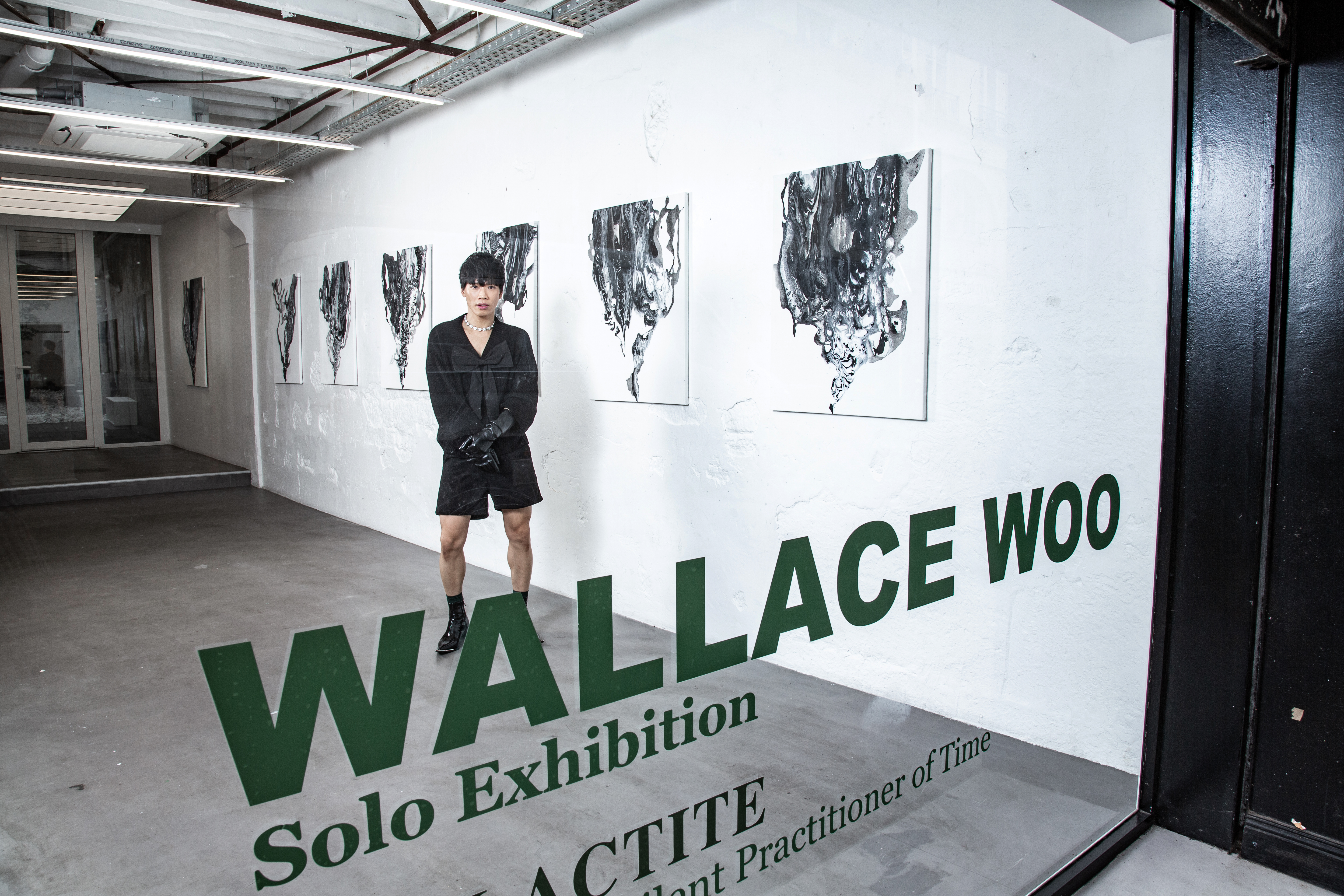
What grounds me the most, of course, is that this theory finally found its footing at my solo exhibition in Paris this June—that was the first key moment. Geological Abstractionism is how I put concepts onto the canvas, but its core is actually Stalactite Aesthetics—a larger worldview.
I'm also glad that this approach and practice have been documented in my artist's book, now part of the Hong Kong Public Libraries collection. No one knows what the future holds, but I hope to see it truly grow into something meaningful in my lifetime.
Tell me about your criteria for determining the right materials to work with, please.
To be honest, when I go to an art supply store, I just pick whatever feels right in front of me.
But there are many types of linen—I particularly like the rough ones, because that texture is unique. Sometimes I go for smoother ones, depending on the moment. I don't overthink it. If my usual materials are out of stock, I try something else. After all, isn't that what art is for—experimentation and experience?
Materials are partners, not tools. I see how they want to respond to me today, rather than forcing them to become what I want. It's like interacting with people—you can't always expect the other side to accommodate you. Sometimes you need to accommodate their rhythm.
Materials are the same.
Can you describe the process of creating one of your works? What are some of the qualities you are looking for to determine if a piece is finished, what it needs and which to use/discard?
My creative process lacks dramatic passion, which doesn't easily attract market attention—there are pros and cons to that. But every time I step into the studio, I feel excited, because it's filled with anticipation and uncertainty.
I don't have many rituals; sometimes I'm quite spontaneous. I generally mix colours and prepare the pigments according to my mood at the moment, then slowly pour the paint onto the canvas, guiding it to flow naturally. If you're expecting an explosive performance, I might not be your best choice—but if you're looking for a reflective, meditative depth, I'm here with the viewer.
The creative process is slow—if it's too fast, the colours become muddy and lose their clarity. Yet at the same time, you also have to let them blend and change in order to achieve unexpected layers. The waiting is long—you want to touch it, but you can't. A single layer might take eight hours to set. Almost no one will notice that layer; only I know it's there, much like a geologist knows that a single millimetre of sediment represents a thousand years. This process tests your patience—its pain points are remarkably like life itself.
There is no such thing as a "finished" work—there's always room for improvement, so it's never truly complete. I used to ask myself "is it good enough?" Now I ask "is it honest?" When a painting no longer needs more covering or mending, when its cracks and layers have truthfully revealed what they are meant to reveal—that might be the moment it's finished.
As for what to keep and what to discard—I have no fixed rules. If a layer of pigment, once settled, feels "excessive" to me, I'll cover it. If it makes me stop and look twice, I'll keep it. The decision is never rational—it's intuitive. Some experiences you hold onto; others you let be covered by the next layer. There is no right or wrong—only whether it feels true in the moment.
I tend to believe that texture is the connecting link between visual art and sound, but it's not a term that gets mentioned a lot. Can you talk a bit about the role that texture holds in your work and how you shape it?
Texture is one of the most central languages in my work. It's not an accessory to the visual—it is the content itself.
I don't "shape" texture—I let it happen. When pigment flows under gravity, dries over time, and cracks through layered accumulation, texture grows on its own—much like strata naturally form their patterns through millions of years of pressure.
All I do is set the conditions, and let the material speak for itself.
Sometimes I feel that texture is like memory—it's not "manufactured," but "left behind." Just like memory—you can't force it into a particular shape. You can only let it settle naturally, and wait for it to reveal itself.
Working in black and white is generally seen as working without colours. But there are infinite worlds of nuances within these two tonalities. How would you describe these worlds?
Working in black and white is actually much more difficult than working with colour. Even black has different shades of darkness—if not handled well, it just becomes a mess.
What I love is that sense of "infinity within limitation"—it's an aesthetic I recognise from East Asian ink traditions—where restraint becomes richness. You think you're seeing an "absence of colour," but what you're really seeing is what remains after colour has been refined to its purest essence.
The world between black and white is like the process of time emerging from its deepest depths to its most visible surface. What you see as black may be the accumulation of time; what you see as white may be what remains after time has settled.
And the infinite shades of grey in between are like geological strata—each layer representing a moment, a waiting.
Mark Rothko saw the treatment of space as the defining feature of a visual artist. How would you describe your perspective on space?
Rothko‘s space is “depth on a flat surface”—he uses color to make you feel as though you’re falling into an infinite field. My space, by contrast, is a spiritual dimension beyond the senses.
It is not an extension of vision, nor an illusionistic game—it is a place you can actually “enter.” If Rothko’s space is an abyss you look up into, my space is more like a cave you can sit inside—not to lose yourself, but to linger, and through that lingering, to recover and reflect on your most authentic self.
Let me elaborate on this spatial perspective through five directions:
WHY: Why is my space spiritual rather than visual?
Because vision is ultimately sensory, and the senses fatigue, habituate, become satisfied, and eventually tire. A spiritual space is different—it doesn’t ask you to “look”; it asks you to “be.” When you stand before one of my stalactite paintings, you see not just color and form—you see how time sediments, how gravity shapes, how matter transforms through waiting.
None of these can be “seen” by the eyes alone; they require your full presence—a kind of attention that goes beyond the senses—to perceive the traces left by time's sedimentation. Space ceases to be the physical distance between you and the canvas; it becomes the inner distance between you and time.
This is a fundamentally different kind of spatial experience: it is not about “what you see,” but about where you want yourself to be.
WHAT: What is my space?
My space is “the thickness of time.” It is not a measurable three-dimensional space—length, width, and height—nor is it the fourth dimension of physics (time as an abstract coordinate). It is something that transcends both: the fifth dimension—time sedimented into a tangible, palpable material entity.
A painting’s surface may be only a few millimeters thick, but if you peel back its layers, each one represents a moment, a decision, a waiting. That is not space; that is time solidified into matter.
Standing before the work, the viewer is not facing a flat surface, but an entity with strata, fissures, and memory. Space here is no longer geometric—it is geological. It is not empty; it is filled with time.
WHERE: Where does this space exist?
It exists between the layers of pigment, at the edges of drying, in the instant a crack forms. It exists in that moment when you stand before the canvas, your gaze finding no fixed point to land on, only to wander and linger.
It is not a physical "there"—it is the suchness of the here and now.
WHEN: When does this space occur?
It begins to take form in the act of creation, but it is only truly completed in the act of viewing. Space is not "manufactured"—it is "discovered." When I pour pigment onto the canvas, let gravity guide its flow, let time dry it—I am not creating a space, but the conditions for space to occur.
Space is not on the canvas. Space is the moment the viewer chooses to stop—and in that stopping, arrives at sudden clarity.
HOW: How does one enter this space?
I did not deliberately design it, but three mechanisms exist as they are: visualized stratification, concealed focal points, and density variation.
Stratification lets you glimpse the layers of time—it is not a total flat surface, but a geological cross-section bearing both past and present. Concealed focal points prevent you from seeing through it all at once—there is nothing to "grasp," so you can only wander through it.
Density variation asks you to adjust your distance—sometimes near, sometimes far—each movement an investment of time. Together, these mechanisms accomplish one thing: they transform you from a "viewer" into a "lingerer." When you stop rushing to judge, interpret, consume—when you simply stand there, letting time slowly permeate your perception—in that moment, space appears.
So to return to the original question: Rothko's space lets you see infinity—an infinite expanse without boundary or end. My space lets you see sedimented time—layer upon layer, built drop by drop. One is a visual abyss; the other, a spiritual cave. One lets you fall; the other lets you settle—and in that settling, become clear.