Published
Part 2
Many musicians I've spoken to have used colour references when talking about their compositions. Vice versa, how much sound, if any, is there in your work?
Musicians use color to talk about sound. I use time.
A lot of interesting sounds flash through my mind: the rapid breathing of backstage crew at a fashion show, the noise of rushing from one venue to another, champagne glasses clinking, makeup brushes brushing against skin, the rustle of cash being counted—these sounds pour into my head from every direction, carrying an exhilarating rhythm.
But honestly, sometimes that rhythm throws me off balance. It feels like being trapped on a treadmill that keeps speeding up, with no way to step off. So my work doesn't have those sounds. Or rather, I create in order to escape those sounds. A quiet, serene sound is what best allows one to experience my work—like the echo of a water droplet in a cave.
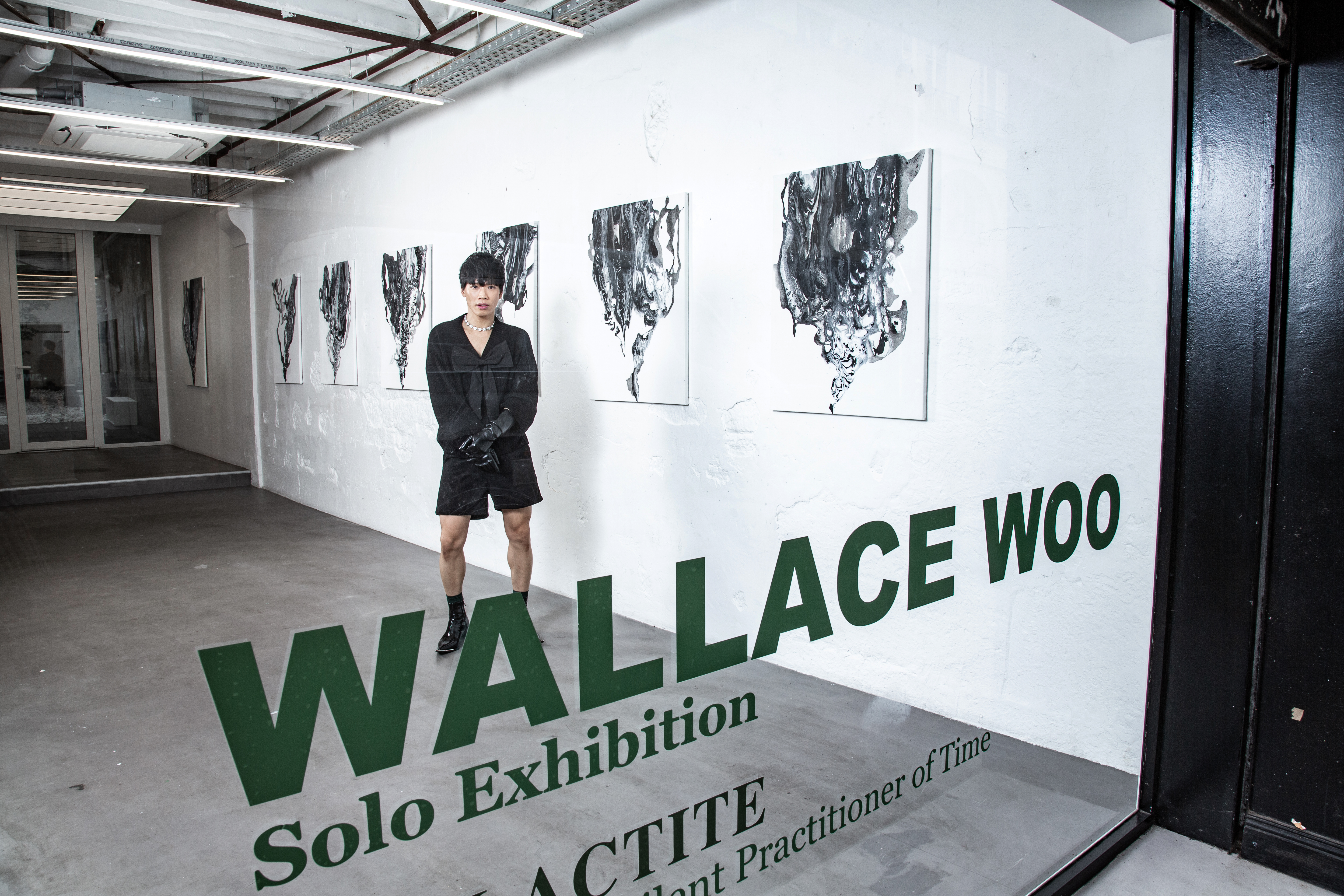
Musicians are used to using sound to express time—rhythm, tempo, rests. But I do the opposite: I use time to express sound. When you layer paint onto the canvas, wait for it to dry, and layer again—those layers of pigment are not paint; they are slices of time.
The hours each layer takes to dry, the wait for each crack to form, the interval between each covering—these are not part of the making process; they are the sound itself. It's just that the frequency of this sound is too slow to be heard by the ears—you have to see it with your eyes, wait for it with time. It's the same principle as a musician layering tracks—the difference is simply that one listens with ears, while the other waits with time.
To me, color is more like the form sound takes after it has sedimented—not something to be heard, but to be seen. There is no melody on my canvas, no chords. But if you're willing to pause and look closely, there is indeed a rhythm hidden within. It's subtle, like the deepest track in a mix—most people don't notice it, but it's always there.
The sounds buried in my work come from a lifetime of experience—pain, sorrow, joy, and depression. I simply present them in another form, laid out before the viewer. They may not always be felt, but between those layers of pigment, there is indeed a frequency. It doesn't play. It waits to be discovered.
Do you have specific ideas about how your work should be placed and lit when exhibited?
If the budget allows, I'll be very particular about the lighting and placement. If not, I'll still do my best within the given constraints.
But I always consider how to make use of every corner of the space—to let the work present itself in the best possible way, in the here and now.
When you're working on one of your visual works, will there occasionally be sonic inspirations for you? How do you see the overlaps between the different senses?
When I create, I do need sound—but it's not about "listening to music"; it's about letting rhythm enter the body. Layering paint and layering soundtracks are the same gesture—one listens with ears, the other waits with time.
There are no clear boundaries between the senses: color has weight, sound has texture, time has thickness. When you enter a state of creation, these boundaries dissolve—you no longer distinguish between visual and auditory; you're simply feeling the same thing flow through you.
Your work deals with time, but for many observers, paintings will seem still. Where does time take place in these paintings?
My work is a vessel. Time is not only on the canvas—it exists in the layers I've layered; it exists in the moment the viewer chooses to stop.
People can pause in front of any painting, but what sets my work apart is that it offers no shortcuts. You won't find a story, an emotion, a clue about "what the artist is trying to say." It simply places itself there; leaving you to decide how much time you're willing to give, to truly face it.
Let me illustrate this sense of "no shortcuts" with a story. The first time I signed up for a Vipassana meditation course, I had to wait six months before I could attend. During those six months, anything—work, health, and emotions—could become a reason not to go. You think you've made a decision, but time has a way of shaking that resolve. You start asking yourself: Do I really want to do this? Is the wait worth it?
And when you finally stand at the entrance of the course, you realise that time hasn't disappeared. It has gone into the waiting, into the gaps of your hesitation, into the moments you thought you were wasting. Time is never linear—it sediments.
My paintings aren't designed to offer anything in particular—they simply reveal themselves as they are. Stand before one for three seconds, and you'll have a three-second experience. But giving more time doesn't guarantee a proportional return, because only you know what you're looking for.
Time is already in your hands.
There seems to be a quality of silence in your works. How do you see that yourself and how would you define silence for you as an artist?
My friends often say that I speak slowly and with a certain elegance—I think it's because I dislike loud noise and commotion, and perhaps also the result of years of spiritual practice.
A baby's first cry at birth is a response to being slapped awake—it's a survival instinct, something we never chose. To survive in this strange era, we feel compelled to fill every silence with noise, because quiet makes people uneasy.
But the truth is, we don't have to wait until the day we die to learn how to be still. In this life, we do have a choice. At the very least, in this moment, as I return to the starting point of my breath in meditation, I have already found that space. Stillness is a state of being—a space where you can empty your mind, pay no attention to anyone, and yet still feel a sense of ease.
The stillness in my work is not an emptiness devoid of anything—it is a stillness that has been filled by time. Like a cave: when you stand inside it, what you hear is not "silence," but your own breath, your own heartbeat—the most primal conversation you can have with yourself.
Since you're also working with music, how would you describe the influence of your paintings on your music and vice versa? How do they mutually inspire each other?
I see artistic creation and music as the same thing—both are spiritual nourishment for me, simply expressed through different mediums to convey the same rhythm.
I need music to stir my emotions and help me enter the right state of mind, but that doesn't mean that if I play rock music, the work that comes out will be rock-infused. Even when I'm playing dance music, my body can still move slowly as I work. Yet during the creative process, I am intensely focused, so what I hear is neither fully present nor fully absent—it hovers somewhere in between.
But ultimately, what truly influences me is neither painting nor music—it is my life experience. Painting and music are merely vessels; they carry the same thing: the paths I've walked, the pain and joy I've lived through, the waiting and the settling. Without these experiences, music is just sound, and painting is just color. It is experience that gives them weight.
So I don't feel the need to distinguish which influences which. They are two tributaries of the same river, flowing into the same ocean. And I stand by the riverbank, simply waiting for the water to pass.
Creativity can reach many different corners of our lives. Do you personally feel as though writing a piece of music is inherently different from something like making a great cup of coffee? What do you express through music that you couldn't or wouldn't in more 'mundane' tasks?
Writing a song and brewing a good cup of coffee are essentially the same kind of focus—you invest time, attention, and sensitivity to detail, and then you get a result. But music and artistic creation have something that "everyday tasks" don't—they can carry the emotions that words cannot express.
You can brew the perfect cup of coffee, but that coffee won't tell anyone what you've been through. Art with substance, however, can. It can carry your solitude, your waiting, your awakening. It can travel through time and, long after, be understood by another person.
This isn't to say that everyday tasks aren't important—they are. They are the foundation of life, and for many technically masterful artists, they are the starting point. But true art is an extension of life—what we leave for the soul, beyond mere survival.
I'm particularly drawn to Dream Pop and Trip Hop because they let me drift through my own world without having to explain myself to anyone. I hate explaining myself—and honestly, there's no real need to. The speaker may not mean what they say, but the listener takes it to heart. Rather than living inside others' interpretations, I'd rather stay in my own world and communicate with my audience through my work.
So I think the difference between creating and daily tasks isn't about "what you do," but about "why you do it." Coffee is for waking up. Art is for staying awake.