Published
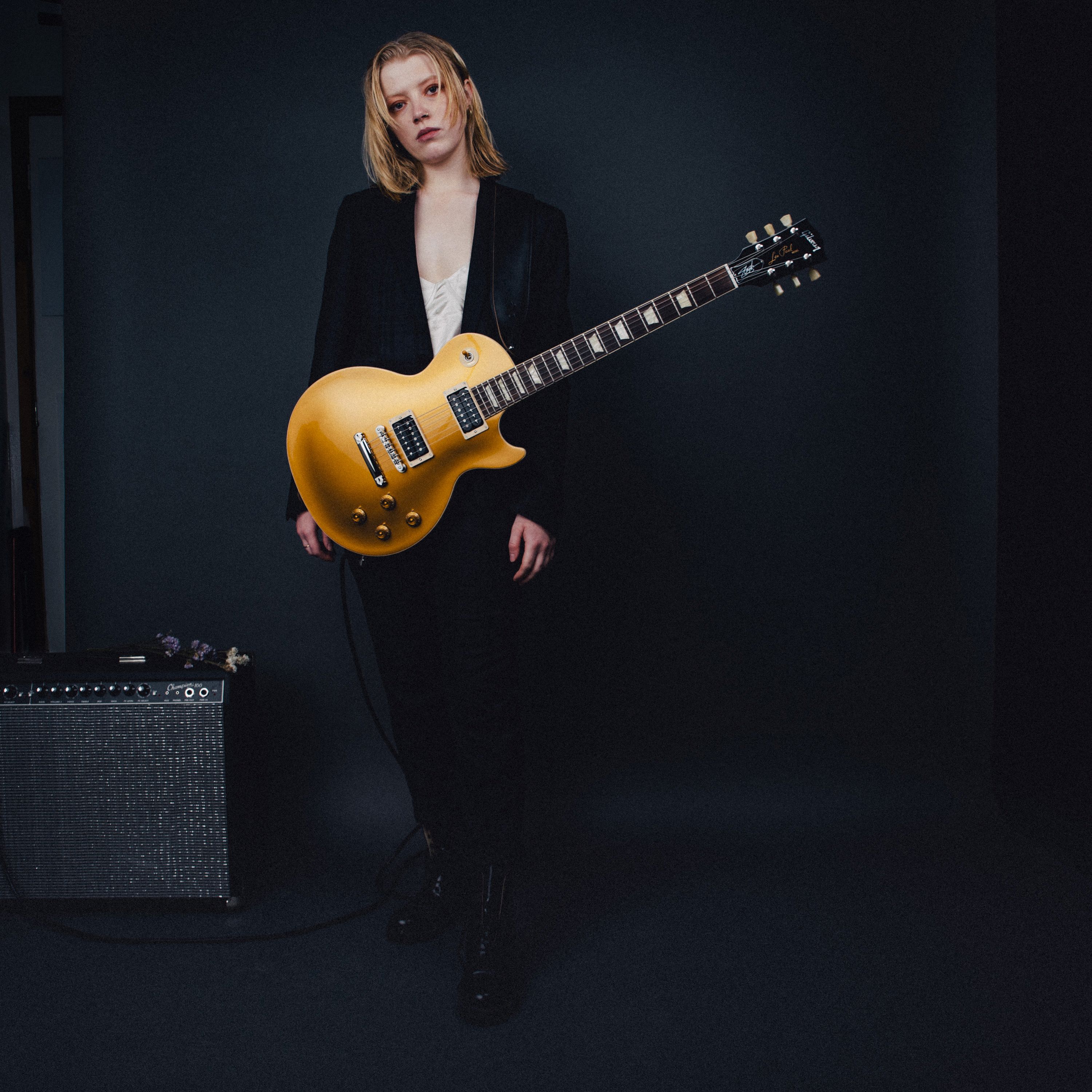
Name: Rosie Frater-Taylor
Nationality: British
Occupation: Singer, songwriter, guitarist, composer, improviser
Current release: Rosie Frater-Taylor's new single "In A Dream" is out via Cooking Vinyl. Full-length album Featherweight - Deluxe Edition will follow on November 21st 2024. Order the album here.
Current event: Rosie Frater-Taylor is one of the artists appearing at this year's EFG London Jazz Festival. The event will take place 15-24 November 2024 and feature artists such as Anohni, Imelda May, the Crosscurrents Trio, Charles Tolliver, Veronica Swift, Brandee Younger, Ill Considered, Tashi Wada, Yazz Ahmed, Spencer Zahn, Melike Şahin, Fabiano Do Nascimento, Belle Chen, the Neil Cowley Trio, Matters Unknown, Mark Kavuma, Avishai Cohen, Tigran Hamasyan, and Fran & Flora.
For tickets, head over to the festival's official website.
[Read our Ill Considered interview]
[Read our Tashi Wada interview]
[Read our Yazz Ahmed interview]
[Read our Melike Şahin interview]
[Read our Fabiano Do Nascimento interview]
[Read our Belle Chen interview]
[Read our Neil Cowley interview]
[Read our Matters Unknown interview]
[Read our Mark Kavuma interview]
[Read our Tigran Hamasyan interview]
[Read our Fran & Flora interview]
[Read our Anouar Brahem interview]
[Read our Dawn Richard interview]
[Read our Tami Weis interview]
[Read our Helena Kay interview]
[Read our Avishai Cohen interview]
If you enjoyed this Rosie Frater-Taylor interview and would like to know more about her music, visit her official homepage. She is also on Instagram, and Facebook.
The London Jazz Festival is just around the corner. Tell me just a little bit about your performance at the festival, please.
I’ll be performing at a really beautiful new venue in Nine Elms called World Heart Beat Embassy Gardens alongside my wonderful band: Tom Potter (drums), Dave Edwards (bass), Azz Loukil (vocals / keys) and Verushka George (vocals).
My new record Featherweight came out this year so we’ll be playing songs from that as well as my last album Bloom and some choice covers with a twist (TLC, Kate Bush, Stevie Nicks).
How would you say your live performances and your recording projects are connected at the moment? How do they mutually influence and feed off each other?
They’re inextricably linked, I always prefer the humanity of playing my guitar and vocal takes from start to finish during the recording process, I tend not to loop or copy parts over … I suppose I like to test myself sometimes - like, how well can I actually play this part in time? Can I play it the whole way through convincingly?
The main difference at live shows is instrumentation. Where my recordings are multi-layered, doubled and harmonised (sometimes the ‘guitar part’ can have as many as 4-6 guitar tracks going all at once) during shows, the set up is stripped back (unless I’m using the looper).
The band also leans into a more ‘contemporary jazz’ style of comping; a bit like that Gretchen Parlato live in NYC album if you know it.
In as far as you have any experience or insights, what's your view of the London jazz scene?
I think it’s great you know but it’s way more stylistically diverse than people think. There’s a lot of creative people doing a lot of creative things that don’t necessarily fit into what ‘London jazz’ has become known for … Maria Chiara Argiro, Snowpoet, Daudi, Sans Soucis - we’re a bit obsessed with genres over here!
Having said that, any big success for the jazz genre is generally a win for us all.
Music has become a lot more global and incoporating elements from other parts of the world or the musical spectrum is commonplace. Do you still think there are city scenes with a distinct, unique sound? What holds these communities together?
I’m not really one to comment on it because I’ve never thought of my music in those terms or thought of myself as being part of a particular scene (perhaps that then proves your point!).
I like to draw inspiration from lots of different folks and genres. I think musicians are the key to scenes and musos are often tied to geographical locations … Perhaps where they studied, who they know, family ties.
I think that’s why the Ground UP Music (Snarky Puppy) scene in New York is so fruitful. Those guys have been playing together for decades and they all collaborate on each other’s records … Not dissimilar to the London jazz scene.
What does the term jazz mean today, would you say?
I don’t think the definition of jazz has changed, I just think that we’re open to combining it with a greater variety of genres. Jazz-folk, jazz-pop, jazz-rock-folk, jazz-electronica.
It’s a palette and it’s also a very particular way of being educated on your instrument if you study it at university - it’s pretty brutal! It really makes you ‘proficient’ on your instrument!
Derek Bailey defined improvising as the search for material which is endlessly transformable. As of 2024, what kind of materials are particularly transformable and stimulating for you?
I think simplicity brings a certain creative, transformable and stimulating ease to improvising i.e. not trying to do too many things at once, not overcomplicating your approach to the chords.
Most of my soloing is based on the major, minor and pentatonic scales and arpeggios; for me it’s the most melodic way to achieve the desired effect.
Thanks to technological advances, collaboration has become a lot easier. What's your view on collaboration and its ongoing role for the music you make?
Collaboration is great but it’s a skill to be tamed and mastered.
In my opinion, it’s crucial to understand your own sound before you let anyone else tamper with it. It’s great to know what you can offer others during a session and honestly, what your limitations are too. The best collaborations are always the ones where your collaborator can bring something you simply cannot bring to your own music.
I have to collaborate with friends and colleagues who truly accept me for how I am in the studio ha! That includes my dad and people who I get on with on a personal level only! I rarely enjoy collaborative situations where I don’t feel I can openly express how I feel, although it can be tough, I / we’ve got to leave the ego at the door.
In terms of the results, the process, and the satisfaction, how does making music in the same room together versus file sharing compare to you?
I think it’s difficult to make sure ‘file-sharing’ is as collaborative a process as writing in the same room as another real-life human. Writing requires us to spot nuances, sparks and ideas in the moment.
If I sit with something on my own, I can only approach it in my own way … If I’m in a room with someone, we’re pretty much forced to design a mutual approach in order to work together effectively!
I think both approaches have their merits but depends what you want.
It is often said that the energy in the room on any given night will influence the performance. I have often wondered how this energy manifests itself. What is this like for you and how does it have an effect on what's happening on stage?
This comes into play for me when I play headline shows versus festivals and support slots. It’s much easier to have that almost telekinetic communication with an audience that knows your music and your intentions from the very offset!
My album launch at Omeara this year was exactly that, a bundle of energy. Other types of shows are awesome for building audiences but there’s sometimes a burden on the artist to capture their audience in that moment.
It’s a challenge but can be very rewarding.
Improvisation is obviously an essential element of jazz but I would assume that it’s just like composition, it is transforming. How do you feel the role of improvisation has changed in jazz?
Well, I think improvisation has been about dexterity since the bebop era, how and when you choose to flex that dexterity is up to you.
I think something that’s always struck me about improvisation, being such a fan of pop and singer-songwriter music, is that (for me) it needs to move and touch the audience, not alienate them. The mentality of some musicians can be the opposite.
All forms of music are valid, there’s no world in which we can start dictating how people should be making music but for my own tastes, more and more so recently, I think there’s a movement in jazz towards bringing the wider public into this improvised world rather than shutting them out with too much complexity.
What, would you say, are the key ideas behind your approach to improvisation?
Simplicity as I said above - I think it sets you free as an improviser. Emotion, melody, sound, rhythmic interest are some of the others.
I sing my solos as much as possible to achieve a vocal-like quality in my lines.
How would you describe your own relationship with your instrument – is it an extension of your self/body, a partner and companion, a creative catalyst, a challenge to be overcome, something else entirely?
You hit the nail on the head with the ‘extension of self / body’, that’s exactly how I see the guitar. It’s my means to express myself and for me it’s just full of emotions - my emotions!
So yes, an extension of who I am and how I communicate with the wild world out there. I hardly know what to do with my hands sometimes without a guitar!
The term identity is an important aspect of many communities. Are you acting out parts of your identity in your improvisations which you couldn't or wouldn't through other musical approaches? If so, which are these?
I believe I act out my most confident and authentic self when I perform and when I improvise, it’s like a way of getting people to listen to what I’m saying.
As artists, music is tied up in our personalities, our identities, our daily conversations … Music is our ‘ikigai’ or purpose, it’s hard to know what to do with yourself sometimes if you’re not able to perform. It’s our pride and joy!
Songwriting for me is another means of expression of course but the emotion I can put into improvising something unique on the spot is a special privilege of this job.
I have always been fascinated by the many facets of improvisation but sometimes found it hard to follow them as a listener. Do you have some recommendations for “how to listen” in this regard?
I’ll just refer you back to my previous answer about improvisation!
The burden is never on you or any audience member to “understand”, the burden is on us, the performers, to make ourselves understood in my opinion. Personal music tastes aside of course.
In a way, improvisations remind us of the transitory nature of life. When an improvisation ends, is it really gone, just like a cup of coffee? Or does it live on in some form?
Deep! I think if you have a strong personal style as an artist (as all the guitar greats do - Pat Metheny, George Benson, John Scofield, Wes Montgomery) then that permeates all of your improvisations.
We all have language and improvisational methods we resort to when we’ve had a bad night’s sleep or something, so in that way maybe you’re hearing some of the same licks!
But, the joy of it for me is the excitement and adrenaline of taking flight with something momentary and transitory.